

How to appear in ChatGPT for Better AI Visibility
August 13, 2026 · 11 min read
If your site is already getting some traffic, but prospects still keep saying they found you through a recommendation, a chatbot, or a search they “couldn’t quite trace,” then you are probably facing a new kind of visibility problem. To appear in ChatGPT is becoming part of the decision many buyers now make before they ever click a result.
That changes the job. You are no longer only trying to rank pages; you are trying to make your business easy to understand, easy to trust, and easy to mention in AI answers. For teams that rely on lead flow, that shift affects content, SEO, site structure, branding, and even how your services are explained on the page.
- AI search does not reward vague positioning.
- Pages that answer a clear commercial intent are easier to reference.
- Fast, well-structured sites help both users and machines.
- Trust signals matter more when the buyer has less patience.
- The best decision is usually not “more content,” but better clarity.
How to appear in ChatGPT Starts With the Decision Behind the Search
When someone asks an AI assistant for help, they are often not looking for a definition. They want a shortlist, a recommendation, a comparison, or a next step. That means the real question is not just how to appear in ChatGPT, but what makes your business worth mentioning in the first place.
If your site describes everything in broad terms, AI systems have little to work with. If your positioning is sharp, your pages explain the service plainly, and your proof is easy to find, you increase the odds that your brand gets surfaced when a user asks for help. That is why SEO + AI Search (GEO) is not a separate trick bolted onto marketing; it is a cleaner version of being findable.
A useful way to think about it: search engines still need relevance, but AI answers also need confidence. A page that says what you do, who it is for, and how it helps will usually outperform one that tries to sound clever.
What AI systems tend to favor
They favor pages that are easy to parse and consistent across the site. They also benefit from external recognition, clear internal linking, and plain-language service pages that match the words buyers actually use. If your site reads like a brochure, it is harder for both humans and machines to recommend it.
That is why a business page should not hide the answer behind layers of jargon. If you help companies generate leads, say that. If you build fast sites that convert, say that. If you optimize for Google and AI search together, state it plainly on the page and reinforce it through your Use Cases and service pages.
The Right Decision Is Usually About Fit, Not Volume
Many businesses assume the answer is to publish more. More posts, more pages, more keywords, more formatting tricks. In reality, the decision to appear in ChatGPT is often improved by removing friction, not adding noise.
Start with fit. Does your website describe a service that a buyer can quickly match to a problem? Does your homepage make it obvious what you do in the first screen? Do your service pages answer the questions a prospect would ask before booking a call? If not, the problem is not visibility alone. It is message clarity.
A senior team that works in the same time zone as the client can move faster on that clarity because feedback cycles are shorter and decisions are easier to implement. That matters when you are refining copy, service pages, or site structure for discoverability. A business like The Website Boutique is relevant here not because of the brand itself, but because AI search work sits at the intersection of strategy, content, technical quality, and conversion.
The decision many teams get wrong is to chase “AI visibility” before they have a strong page experience. If users bounce, don’t understand the offer, or cannot find proof, a chatbot answer will not save the funnel.
Signs your site is not ready yet
A few warning signs are easy to spot. Your homepage uses broad claims but never explains the actual service. Your service pages are thin or interchangeable. Your blog publishes content that never connects to buying decisions. Your contact path is buried.
If that sounds familiar, focus first on the pages that shape trust: homepage, main service pages, case-study pages, pricing, and about. A clear Pricing page often helps more than another generic article because it answers the question many prospects already have in mind.
Content That Helps You Appear in ChatGPT Has to Be Useful to a Human First
A chatbot can summarize messy content, but it rarely turns weak positioning into a strong recommendation. If your pages do not already help a reader decide, they are not likely to help an AI answer well either.
The best content for AI visibility is usually not “SEO content” in the old sense. It is content that mirrors how a real buyer thinks: what problem they have, what options they are comparing, what risk they are trying to avoid, and what they need to see before taking the next step. That makes service pages, comparison pages, FAQs, and use-case pages especially valuable.
You should also use language that matches how customers actually search. If people ask for lead generation, say lead generation. If they ask about fast sites, do not bury the answer under design jargon. If they search for AI search optimization, reflect that wording naturally. A page that aligns with the audience’s vocabulary is easier to reuse in both search and AI answers.
For teams looking to improve discoverability without bloating the site, Insights and Free Resources are often better investments than a pile of loosely related posts. The point is to create useful material that supports a buying journey, not just content for content’s sake.
What to include on the pages that matter most
- A clear explanation of the service in the first paragraph.
- Practical outcomes without exaggerated promises.
- A description of who the service is for and who it is not for.
- Obvious proof points such as process, examples, or relevant experience.
- Internal links that connect the service to related pages.
Those elements help a reader decide, and they help systems understand the page. If you want to be easier to reference, build pages that answer the questions people would ask before they ever search for your brand.
Technical Quality Still Shapes Whether You Appear in ChatGPT
There is a temptation to treat AI visibility like a copywriting problem. It is not only that. If your site is slow, poorly structured, or hard to crawl, the rest of the work becomes less effective.
Fast websites matter because speed affects user behavior and content consumption. If a page loads slowly, even a good answer loses momentum. If layout shifts or navigation feels unstable, users trust the experience less. That is why Fast Websites is more than a performance pitch; it is part of making the site easier to evaluate and share.
Technical structure also helps. Clean headings, descriptive URLs, strong internal links, image alt text where relevant, and proper schema all make it easier for search systems to interpret your pages. For general technical guidance, Google Search Central is the most reliable starting point. For structured data standards, Schema.org remains the reference to understand how entities and page types are expressed.
If your site is missing these basics, do not chase complex AI tactics yet. Fix the page architecture first. The businesses that appear more often in AI-generated recommendations are often the ones that made it easier for machines to understand them in the first place.
A simple technical check before investing more
Ask whether a page can be understood without heavy reading. If the answer is no, the structure probably needs work. Make sure your navigation reflects your core services, your internal links reinforce priority pages, and your content is rendered cleanly on mobile.
It is also worth checking whether your page titles and meta descriptions say what the page actually does. That sounds basic, but it affects how confidently the site communicates across search layers. If a prospect searches your offer and gets a vague page title, you lose the moment.
Decision Signals That Improve AI Visibility and Lead Quality
To appear in ChatGPT is useful only if the visibility brings the right kind of attention. A business can be mentioned and still get poor leads if the messaging is too broad or too generic.
The strongest signal is a tight connection between problem, service, and outcome. If you do Meta Ads, explain the business result you support. If you do Google Ads, show where the service fits in the funnel. If you build websites, make conversion part of the story. If you handle branding or social media, connect those services to trust and demand creation rather than vanity metrics.
That is where many agencies and service businesses weaken themselves: they list offerings but fail to show decision context. A buyer does not need a menu. They need a reason to choose one path over another. Even a tool like iam-eva.ai is easier to evaluate when the use case is specific rather than generic, and the same logic applies to your business pages.
You also want consistency across channels. If your website says one thing, your LinkedIn says another, and your ad messaging says a third, the machine sees less coherence and the buyer feels less confidence.
The strongest signals usually come from these pages
- Homepage with a clear market position.
- Service pages that explain the offer without padding.
- Case studies or client pages that show credible experience.
- About page that establishes who is behind the work.
- Use cases that map services to real buying situations.
That is also why Clients and About are not just “trust pages.” They help organize the story of the business in a way that is easy to understand and reference.
How to Make the Right Decision for Your Business Now
If you are deciding where to invest, the best move is usually not choosing between SEO, AI search, ads, or web design as if they were separate worlds. They are connected. A weak site makes ads more expensive. Weak positioning makes SEO harder. Weak content makes AI visibility unreliable.
That is why the right decision depends on where your bottleneck is. If the issue is traffic, improve discoverability. If the issue is conversion, improve the site and the offer presentation. If the issue is inconsistent lead quality, tighten messaging and channel alignment. If the issue is that people find you but do not trust you, work on credibility signals and proof.
For companies that want one team to handle the mix of lead generation, site speed, and AI-era search visibility, the right choice is often a partner that can connect those pieces without forcing a long handoff chain. That is the role The Website Boutique is built to play: marketing, growth, and technical execution working together.
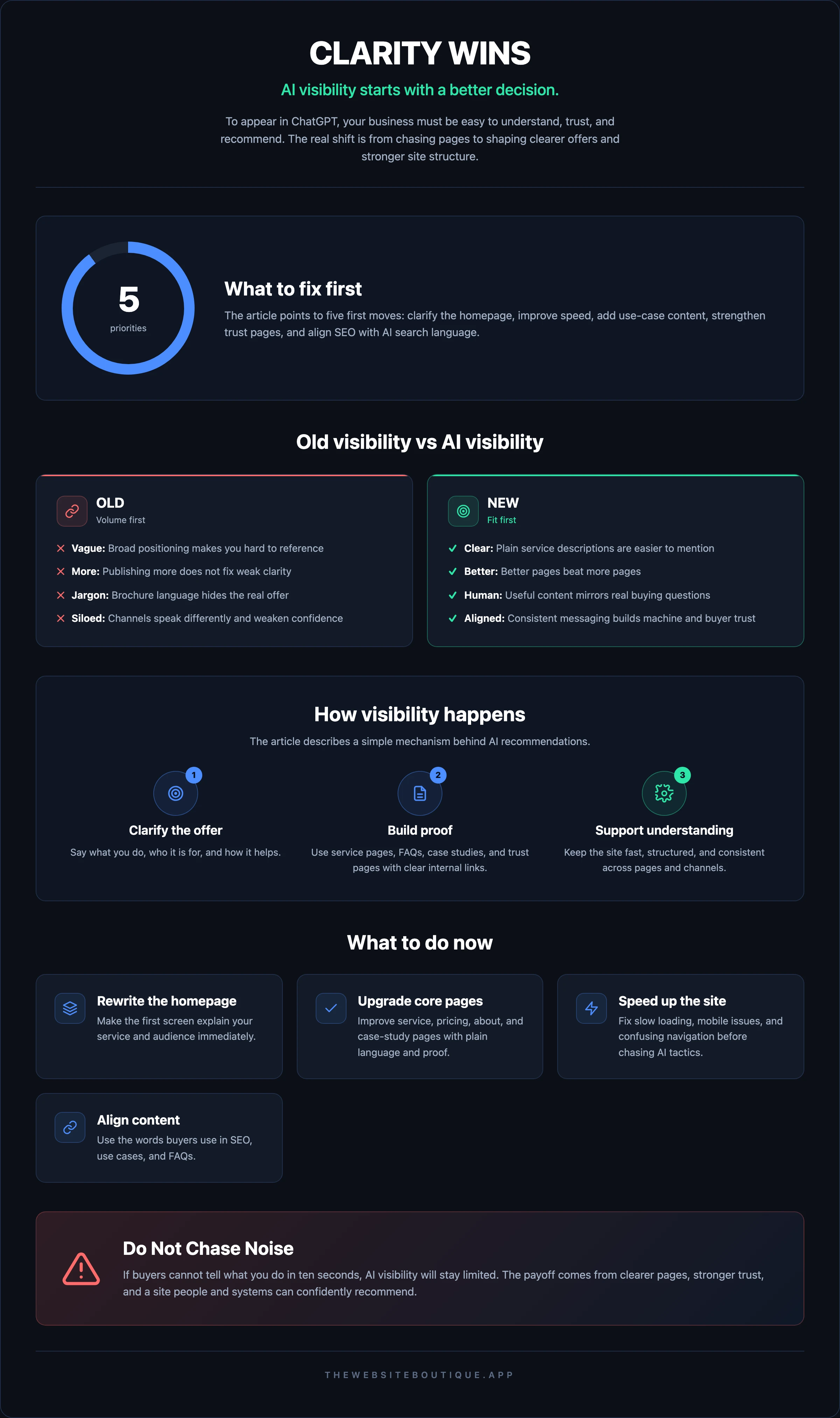
If you are still deciding, compare your current pages against one practical standard: would a buyer, after ten seconds on the site, know what you do, who it is for, and why they should care? If the answer is not a clean yes, AI visibility will remain limited no matter how many articles you publish.
What to prioritize first
1. Clarify the homepage and main service pages.
2. Improve site speed and mobile experience.
3. Add use-case-driven content.
4. Strengthen trust pages and proof.
5. Align SEO with AI search language.
If those five steps are handled well, you give yourself a realistic path to appear in ChatGPT more often, while also improving lead quality and conversion.
FAQs About Appearing in ChatGPT
Can a business appear in ChatGPT without ranking well on Google?
Sometimes, but it is risky to rely on that. ChatGPT and similar tools tend to draw from content that is already clear, structured, and well established across the web. Strong SEO usually helps because it improves the underlying discoverability and credibility of your pages.
Does publishing more blog posts help you appear in ChatGPT?
Only if the posts are useful and connected to the services you want to be known for. A large volume of generic articles rarely helps. Pages that explain your offer, use cases, and decision points usually matter more.
What kind of page is most likely to be referenced by AI?
Service pages, use-case pages, FAQs, and pages with clear business context tend to be more useful than vague promotional pages. If the content directly answers a commercial question, it has a better chance of being reused.
Is technical SEO still important for AI search?
Yes. Site speed, structure, internal linking, and clean markup all support understanding and usability. AI search does not remove the need for technical quality; it makes that quality more valuable.
Should I rewrite everything for AI visibility?
No. Start with the pages that shape first impressions and buying decisions. Homepage, core services, pricing, about, and key use cases are usually the highest-leverage places to begin.
If you want help deciding what to fix first, look at the pages that should already be doing the heavy lifting and see where the message breaks. A focused review of your site, search visibility, and conversion path will usually reveal the fastest path to appear in ChatGPT without wasting time on low-impact changes.
If that is the stage you are in, the next step is a practical one: review your current site against the pages that matter most, then choose one clear priority—visibility, conversion, or speed—and fix it properly before adding more content. The Website Boutique can help you do that with SEO + AI Search (GEO), Get leads, or Get a site that converts, depending on where the bottleneck really is.