

ChatGPT Search Optimization: What It Costs
September 03, 2026 · 11 min read
A client usually asks the same thing after seeing their competitors appear in AI answers: how much should ChatGPT Search Optimization cost, and what am I actually paying for? The question is sensible. If you are spending money on visibility, you want to know whether the work is about real search performance or just polished wording.
That hesitation is healthy. ChatGPT Search Optimization is still a new category for many owners, and the offers around it range from vague “AI visibility” packages to serious technical work. The difference matters because the right scope can improve how a business is understood by search engines, answer engines, and AI tools, while the wrong scope burns budget on activity that never becomes useful.
What ChatGPT Search Optimization actually covers
Many owners hear “show up in ChatGPT” and imagine a single tactic. That is rarely how it works. ChatGPT Search Optimization is usually a mix of content, site structure, entity clarity, and signals that help AI systems understand what your business does, who it serves, and when to recommend it.
For a service business, that can include page titles, headings, internal links, schema, local relevance, and answer-friendly copy. It can also include making sure the site is fast, crawlable, and easy to interpret. If the site is slow, unclear, or built around generic copy, the AI has little reason to treat it as a strong candidate.
If you want the broader strategy behind this work, SEO + AI Search (GEO) is the cleaner way to think about it than treating ChatGPT as a separate channel. Search engines, AI search, and answer engines increasingly reward the same basic thing: useful structure and trustworthy information.
A good benchmark is whether the work would still make sense if ChatGPT changed tomorrow. If the answer is yes, you are probably paying for durable visibility rather than a temporary trick.
What drives the cost of ChatGPT Search Optimization
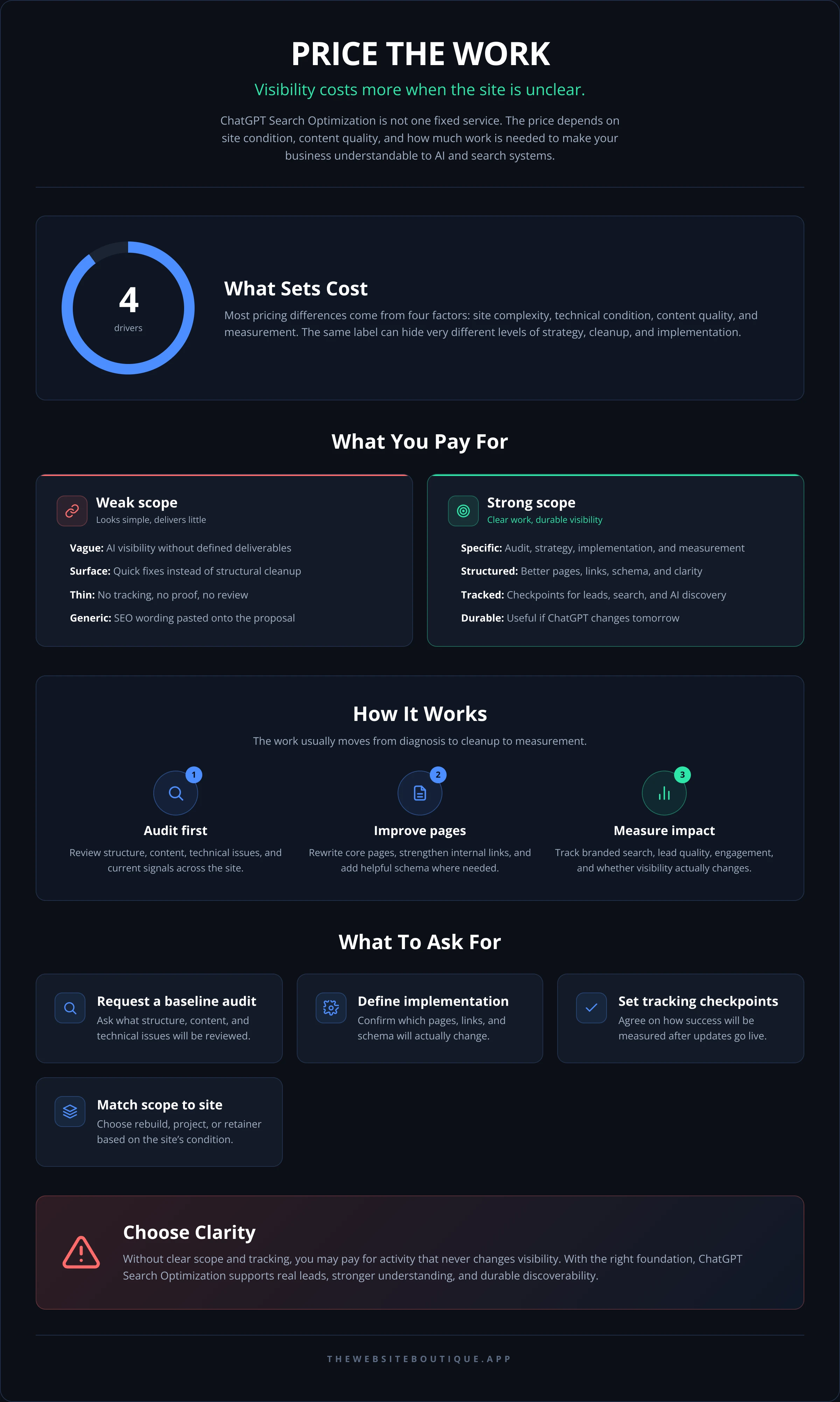
Pricing changes because the starting point changes. A simple five-page site with weak copy needs a very different level of work than a service site with dozens of pages, old blog content, and inconsistent positioning. A freelancer can review surface-level issues quickly; a more complete engagement often needs strategy, implementation, and follow-through.
The main cost drivers are usually these:
1) Site complexity
A small owner-operated business with a focused offer is faster to audit than a multi-service brand with several audiences. More pages, more templates, and more legacy content mean more time spent sorting what should stay, what should be rewritten, and what should be removed.
2) Technical condition
If the site loads slowly, has broken internal paths, or uses a messy information architecture, optimization takes longer. Technical cleanup is not glamorous, but AI search tends to favor sites that are easy to parse. Google’s own Search Central documentation is a useful reminder that crawlability and clear structure remain basic requirements, not optional extras.
3) Content quality
Some sites need new pages. Others mainly need better page hierarchy, clearer service descriptions, and stronger proof. The more the offer depends on trust and nuance, the more time it takes to shape content that can be understood by a machine without sounding robotic to a human.
4) Local or niche targeting
A business serving a defined geography or a narrow service line usually needs more precise wording and entity signals than a broad national brand. The work becomes less about “writing more” and more about making each page unmistakable.
5) Measurement and iteration
If you want to know whether visibility is improving, the plan should include tracking. That can mean referral patterns, branded search movement, lead quality, and whether key pages are being surfaced in AI-assisted discovery. Without tracking, the project becomes a guess.
What a solid package should include
A real proposal should show deliverables, not just promises. If someone is selling ChatGPT Search Optimization, ask what gets audited, what gets changed, and how success will be checked.
A practical scope often includes:
- A baseline audit of the site’s structure, content, and technical issues.
- Keyword and intent mapping for the core services and supporting pages.
- Rewriting or restructuring important pages so they answer real questions clearly.
- Internal linking improvements that connect related pages in a logical way.
- Schema markup where it genuinely helps machine understanding.
- Guidance on author credibility, business identity, and trust signals.
- A measurement plan with checkpoints after implementation.
If a proposal only says “optimize for AI” without naming any of those pieces, it is too vague to price intelligently. If you cannot tell what will be delivered, you also cannot tell whether the price is fair.
For businesses that need the site rebuilt rather than patched, a faster implementation path may be smarter. Fast websites built in 2 weeks can be the better starting point when the current site is holding the business back before any visibility work can stick.
A quick note on tooling: some teams rely on products like EVA by iAmEva for AI-assisted workflows and content operations. Tools can help, but they do not replace clarity in the offer, the site, or the page architecture.
Typical pricing models and what each one means
There is no universal rate card for ChatGPT Search Optimization, and anyone pretending there is is usually simplifying too much. Still, the way an engagement is priced tells you a lot about the work.
One-time audit
This is the lowest-commitment option. It can be useful if you want a diagnostic before changing anything. The risk is obvious: an audit without implementation creates a useful document and an unchanged site.
Setup or implementation project
This is usually the best fit when the goal is to fix the site foundation and publish better pages. You pay for the audit, strategy, and actual changes. If the business has a small number of priority services, this model often gives the clearest path from problem to outcome.
Monthly optimization retainer
This makes sense when the site is growing, content is being added regularly, or lead quality needs ongoing refinement. Retainers should not be a vague maintenance fee. They should define what gets reviewed each month, what gets updated, and what is being monitored.
Performance-linked or hybrid model
These are less common for AI search work because attribution is messy. ChatGPT may influence awareness long before a lead submits a form. If a provider pushes a pure performance model but cannot explain attribution, treat that as a warning sign.
If you are comparing packages, the question is not “what is cheapest?” The better question is: which model actually matches the amount of work my site needs before AI visibility can improve?
How to judge whether the quote is realistic
A reasonable quote usually mirrors the state of the site and the ambition of the project. If the estimate is tiny but the promises are large, something is missing. Most often, what is missing is implementation time, content revision, or the patience required to make the site understandable.
Look for these signs that the quote may be too thin:
- It does not mention your existing site structure.
- It avoids talking about technical cleanup.
- It gives no page-by-page scope.
- It promises “rank in ChatGPT” without explaining how the site will be strengthened.
- It never mentions tracking or review.
You should also be cautious if the proposal sounds like a repackaged SEO template with the word “ChatGPT” inserted. AI search work overlaps with SEO, but it is not the same as publishing generic blog posts and hoping for the best.
If the business depends on leads, a package that stops at visibility is incomplete. Meta & Google Ads + lead generation may be part of the broader growth plan if you need traffic, landing pages, and follow-up aligned from the start.
What actually changes results over time
The most useful improvements usually come from a few specific moves. A page that clearly states who it is for, what problem it solves, and why the business is credible is easier for both people and AI systems to interpret. Internal links help the site build meaning around the core offer instead of leaving every page isolated.
Content also needs to match how real buyers ask questions. ChatGPT users often phrase things like a decision, not a keyword list. That means your pages should answer practical objections, describe the process, and show what happens next. A page that only repeats services is rarely strong enough.
Measurement matters too. If the site is being recommended more often, you should see better signals somewhere: more branded searches, more direct inquiries referencing the right service, stronger engagement on priority pages, or better lead quality from the pages that were updated.
That is why many small businesses are better served by a site and search plan built together. Get a site that converts is not just a design decision; it affects whether AI visibility turns into calls, form fills, or nothing at all.
For readers who want a deeper look at the thinking behind this kind of work, the Insights section and the Glossary can help translate the jargon into something more practical.
Choosing the right scope for a small business
If you run a small owner-operated business, the best plan is usually narrower than the one a large brand would need. You do not need a giant content program before you can compete. You need clarity, speed, and a site that supports the business model you already have.
That is where a tailored approach matters. A few strong service pages, a sensible internal structure, and a site that loads fast can often do more than a sprawling content plan that never gets finished. A leaner project also makes it easier to see what changed and why.
The same principle applies if the site needs rebuilding. A custom site can be more cost-effective than years of patching because it removes friction from the start. About explains the kind of working relationship that helps here: few clients, custom builds, and direct follow-through rather than handoffs.
If you want to see how a small, focused studio frames its offers, the Services and Pricing pages give a useful reference point. They are not a template for every business, but they do show what a clear scope looks like when the goal is implementation instead of buzzwords.
A simple rule for deciding
If your site is already clear, fast, and well structured, a focused optimization project may be enough. If the site is confusing, slow, or built around old assumptions, the smarter investment may be a rebuild followed by search optimization. In both cases, ChatGPT Search Optimization should be tied to business outcomes, not vanity visibility.
Frequently asked questions
How long does ChatGPT Search Optimization take?
It depends on the starting point. A small site with limited issues can be improved faster than a site that needs structural cleanup and rewritten core pages. The timeline should be based on the work required, not on a fixed promise.
Is ChatGPT Search Optimization the same as SEO?
No. It overlaps heavily with SEO, but the goal is broader: making the business understandable to search engines, answer engines, and AI tools. Good SEO often supports AI visibility, but AI search work usually requires more attention to clarity, structure, and entity signals.
Do I need new content for this to work?
Not always. Some sites need new pages, while others need existing pages rewritten or reorganized. The right answer depends on whether the current content already explains the offer clearly enough for humans and machines.
Can I do this with a blog alone?
A blog can help, but it usually cannot fix a weak core site on its own. If the service pages are thin or confusing, the blog becomes support material rather than the main asset.
How do I know if the investment is paying off?
Look for clearer lead quality, stronger branded search behavior, better engagement on priority pages, and more relevant inquiries. Because AI-assisted discovery is hard to attribute perfectly, a good plan should define the indicators before work begins.
If you want a partner that treats AI search as part of the site, not a slogan pasted on top of it, Get found SEO + AI Search (GEO). The right first step is a focused conversation about what your site is doing now, what it is missing, and whether a rebuild or optimization plan will get you to useful visibility faster.
If you prefer to see the work, not just hear about it, review the Work page and then reach out for a scope that matches your site’s real condition. The best time to fix how AI sees your business is before more traffic reaches pages that cannot convert it.