

ChatGPT Visibility Optimization: What Matters
August 24, 2026 · 12 min read
What ChatGPT visibility optimization actually covers
ChatGPT visibility optimization is the process of improving the chances that an AI assistant will mention your company, page, or expertise when someone asks a relevant question. That includes the way your site is written, how your brand appears across trusted sources, and whether the offer is specific enough for a model to classify correctly.
A useful way to think about it is this: the model is not “discovering” you from scratch. It is pulling from patterns. Those patterns come from your website, business profiles, reviews, external mentions, structured content, and the clarity of your niche. If those signals conflict, the system has less confidence in putting you forward.
That is why broad claims rarely help. “We help businesses grow” sounds polished, but it tells nobody what you do best, who you do it for, or why you would be the right recommendation for a particular prompt. More specific language gives the model and the reader a better frame.
If you want a practical starting point, look at your brand the way a buyer would inside an AI answer box: what category are you in, what problem do you solve, and what proof exists that your team is real? If you want to see how that connects to search and AI, The Website Boutique’s SEO + AI Search (GEO) page is a good example of positioning that is designed to be understood quickly.
The signals AI systems use to choose answers
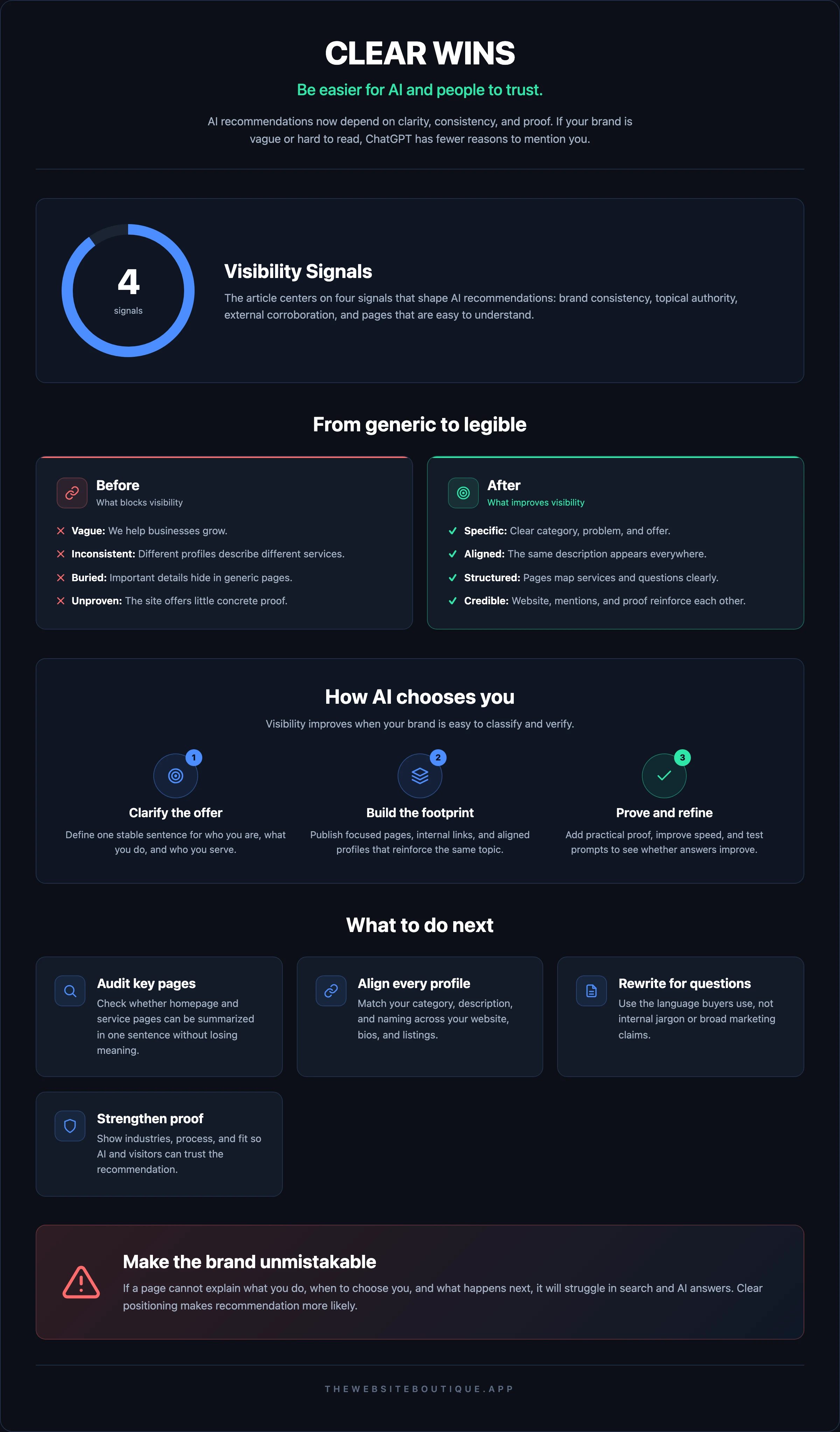
No one outside the platforms can see the exact weighting of every signal, and pretending otherwise would be dishonest. Still, the patterns are clear enough to work with. AI systems tend to favor clarity, consistency, and corroboration. In other words, if multiple credible sources say roughly the same thing about your business, your odds improve.
Brand consistency across the web
Your company name, service description, and category should look stable wherever they appear. If one profile says you do paid media, another says you are a web studio, and your homepage sounds like a branding agency, the model has to resolve the inconsistency. That can blur your chances of being recommended for a specific need.
It also helps to keep naming tidy. Decide how you describe the business in one sentence and use that sentence, or a close variation, across the site, profile pages, and major listings. This does not mean writing like a robot; it means avoiding three different identities at once.
Topical authority that is easy to map
AI systems do better with businesses that have a clear topical footprint. If your site contains one page on ads, one on fast websites, one on lead generation, and one on AI search, the model can more easily connect you to those areas than if everything is buried in a generic services page.
This is one reason a structured site architecture matters so much. Relevant pages, internal links, and service-specific language help the system map your expertise. A strong content hub, such as the one you can browse in Insights, makes that footprint easier to read.
External corroboration
When a third-party source mentions your business in a relevant context, that can strengthen the picture. It does not need to be a huge media feature. It can be a client listing, a partner page, a directory entry, or a mention in a place that clearly connects your brand to your offer.
That is why reputation assets matter more than many teams think. If your only proof is your own homepage, you are asking one source to do all the work. If your website, use-case pages, and external mentions all align, the recommendation becomes easier to justify.
Build pages that AI can actually understand
A lot of ChatGPT visibility optimization fails because pages are written for internal politics rather than real queries. The homepage says everything and nothing, the service page is vague, and the contact page is the only place with concrete details. That structure makes life difficult for both visitors and AI systems.
Start with pages that answer one job at a time. If you offer ads, lead generation, fast websites, branding, and AI search optimization, each service deserves language that reflects the actual buyer intent behind it. Someone asking for growth help is not asking for the same thing as someone asking for a landing page built to convert.
Write for the prompt behind the search
People do not always ask ChatGPT using industry terminology. They ask in the language of the problem: “How do I get more qualified leads without hiring an in-house team?” or “Why isn’t my agency showing up when I ask for recommendations?” Pages should reflect that language without sounding forced.
A strong service page usually contains three things: the problem it solves, the way you work, and the signs that the fit is right. If your page only lists deliverables, it may describe activity without helping the model understand outcome.
Use structured content that can be summarized cleanly
Short sections, meaningful headings, and direct explanations make a difference. Long stretches of generic copy are hard to summarize. So are pages where every paragraph says the same thing in different words.
A good test is to read a page out loud and ask whether a junior teammate could explain your offer after one pass. If not, the page probably needs editing. If you want a real-world reference for a fast, conversion-oriented site structure, Fast websites shows how a service can be positioned for speed and clarity without overcomplicating the message.
Make it easy to trust what you claim
AI answers tend to be cautious. They are less likely to recommend a business that sounds inflated or vague. Show the practical proof points that matter: the industries you serve, the kinds of problems you solve, the way your team works, and what a buyer can expect after the first conversation.
That does not mean oversharing. It means removing the haze. On a page like About, readers should understand who is behind the work and why the team is equipped to handle the problem. The more concrete the description, the easier it is for a system to classify the brand.
The role of SEO, site speed, and conversion design
ChatGPT visibility optimization does not replace SEO. It sits on top of the same foundations: crawlable pages, strong internal linking, meaningful content, and technically sound performance. If a site is messy, slow, or hard to navigate, the rest of the work becomes harder.
Site speed matters because it shapes the user experience and the quality of the page itself. A fast site often feels more credible, especially when someone arrives from an AI recommendation and wants to verify the business quickly. If a prospect lands on a bloated page that takes too long to load, the chance of losing that visit goes up immediately.
Conversion design matters for another reason: AI visibility is pointless if the landing experience fails. A recommended business still needs a page that makes the next step obvious. That can be a simple consultation path, a service overview, or a specific use case that matches the original question.
If you are comparing options and want a working framework for business growth support, Use Cases can help you think about how different offers connect to different buyer problems. For teams that need both demand generation and AI visibility, Get found SEO + AI Search (GEO) is the most directly relevant service page.
Common mistakes that quietly reduce visibility
The mistakes that hurt AI visibility are often the same ones that hurt search performance, only they are easier to overlook because the site still “looks fine.” A pretty homepage can hide weak positioning. A well-designed page can still be impossible to interpret.
One common issue is trying to rank every service from one generic page. Another is publishing content that covers too many topics without a clear point of view. If you mention ads, CRM setup, web development, and social media in one breath, the model may not know what recommendation to associate with you.
A second issue is inconsistency. If your social profile, homepage, and proposal templates describe the company differently, you weaken the overall pattern. Even small mismatches can matter when the system is deciding which businesses belong in a short answer.
A third issue is neglecting proof. Buyers do not need a biography; they need confidence. If the site lacks client context, case details, or a clear explanation of process, the recommendation may still happen, but the click or lead is less likely to follow.
If you need a more operational view of what that looks like when a growth team is involved end to end, Lead generation shows how ads, landing pages, and conversion work can fit together instead of living in separate silos.
A practical workflow for improving AI recommendations
Start with an audit of your most important pages. Look at the homepage, the main service pages, and any content that should support discovery. Ask whether each page can be summarized in one sentence without losing meaning. If the answer is no, the page needs work before it can support ChatGPT visibility optimization.
Then review the external footprint. Check your business profiles, social bios, directory listings, and any pages that mention your name. Make sure the category, summary, and service description are aligned. If you already have good references from clients or partners, verify that the language matches the offer you actually want to be known for.
Next, create or revise content around questions people genuinely ask. Do not publish for volume. Publish for relevance. A good article answers something specific, shows the business’s point of view, and links naturally to the service page that should receive the demand.
This is also where internal linking becomes strategic. A reader should be able to move from a blog post to a service page, from a service page to a case study or use case, and from there to contact. That path helps people and gives the site a clearer topical map.
If you want a lightweight tool to help with answer formatting and message testing, the EVA app can be useful as a companion for content workflows. It should not replace editorial judgment, but it can help teams move faster when they are organizing prompts and drafts.
A simple decision rule
If a page does not help a buyer understand what you do, when to choose you, or what happens next, it is not doing its job. That is true for SEO, and it is even more true for AI search. The goal is not to sound clever; it is to sound unmistakable.
How to measure progress without guessing
You do not need perfect attribution to know whether the work is moving. Start by testing prompts that reflect how a buyer would ask. Use the same few questions over time and note whether your brand appears, whether the answer description becomes more accurate, and whether the system cites pages that actually matter.
Track referral behavior too. If more qualified visitors arrive already familiar with your positioning, that is a useful sign. It suggests your content is becoming easier to summarize and the right pages are being surfaced.
Look at the quality of inquiries, not only the volume. Better AI visibility often shows up as shorter sales cycles, more relevant calls, and fewer explanations needed at the first meeting. A prospect who already understands your category saves your team time.
For teams comparing service models, Clients can help you see how proof is presented, while Pricing is useful when internal stakeholders need to understand engagement structure before moving forward. If your business operates in the US and needs a senior team in the same timezone, The Website Boutique’s homepage is the best place to see the broader positioning.
FAQ
How is ChatGPT visibility optimization different from SEO?
SEO focuses on improving visibility in search engines, while ChatGPT visibility optimization focuses on how your brand is understood and recommended by AI assistants. The two overlap heavily, but AI visibility puts more weight on clarity, consistency, and answer-friendly content.
Does ChatGPT visibility optimization require new content every week?
Not necessarily. A sharper homepage, better service pages, and a stronger topical structure can move the needle before any high-volume publishing. New content helps when it answers real questions and supports the services you actually want to be known for.
Can a small business compete in AI recommendations?
Yes, if the business is clearly positioned and has proof that matches the query. AI systems are more likely to recommend a focused company with strong signals than a vague company with a larger site.
What kind of pages help the most?
Service pages, use cases, about pages, and a few high-quality articles that answer specific buyer questions tend to help the most. The best pages are easy to summarize, connected by internal links, and aligned with the same message.
How long does it take to see results?
There is no fixed timeline. Results depend on the current site quality, external signals, and how competitive the category is. What usually changes first is the accuracy of how the brand is described, followed by more relevant inquiries.
If your team wants help turning this into a real acquisition system, The Website Boutique can support the work with SEO, AI search, ads, and a faster website experience that is built for conversion, not just appearance. Explore Get found SEO + AI Search (GEO) if the main problem is discovery, or Get a site that converts if the site itself is slowing down your visibility and sales.
If you are ready to stop guessing whether AI is understanding your business correctly, book a conversation through The Website Boutique’s homepage and review the pages that are currently carrying your brand story. The fastest gains usually come from tightening the message, fixing the structure, and making it easier for the right system to recommend you.