

How Much Does Client-Attracting Landing Page Creation Cost?
September 16, 2026 · 13 min read
A lot of owners wait too long to build a dedicated page because the quote feels like one more decision on an already crowded list. Then the ads start, the inbox stays quiet, and the real question becomes whether the problem is traffic, offer, or the page itself. That’s where client-attracting landing page creation stops being a design task and starts becoming a business decision.
If you are comparing proposals, the fastest way to get clarity is to look past the headline price and inspect what the project actually includes. A cheap page that misses the mark can cost more than a stronger build that does the job the first time. The goal is not to buy “a page.” The goal is to buy a page that helps a visitor decide quickly and take the next step.
Key takeaways
- The price of client-attracting landing page creation depends on strategy, copy, design, development, and tracking—not just visuals.
- A higher quote can be justified when the page includes positioning, conversion-focused structure, speed, and analytics setup.
- The cheapest option often excludes the pieces that make a page perform, such as copy guidance, mobile optimization, and form testing.
- If the page will support ads, the launch setup matters as much as the layout.
- A good estimate should spell out deliverables, revision rounds, ownership, and what happens after launch.
What you are really paying for
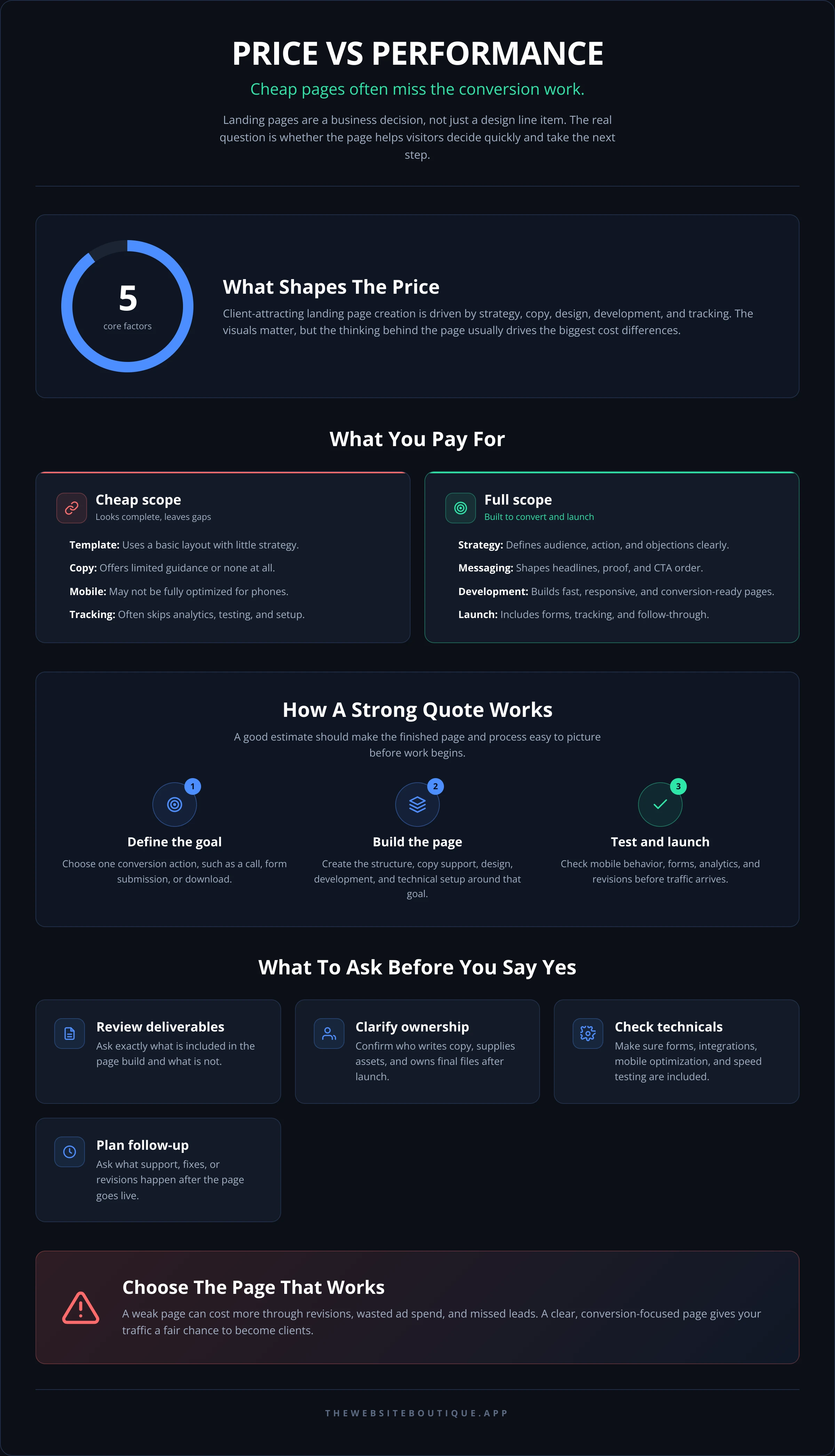
When people compare landing page prices, they often compare the wrong thing. One proposal may include a template-based layout and a form, while another includes messaging, conversion structure, responsive development, and basic tracking. Those are not equivalent offers, even if they both say “landing page.”
The most expensive part is usually not the visuals. It is the thinking behind the page: the order of information, the headline angle, the proof points, the way the offer is framed, and how the page reduces hesitation. If the page is meant to support ads, that thinking has to match the traffic source, because a visitor from search behaves differently from one coming from a Meta ad or a referral.
This is also where a small studio can be useful. A team like The Website Boutique tends to work differently from a volume-based shop: fewer clients at a time, more custom attention, and tighter follow-through from day one. That matters when your page has to do more than look polished.
The main cost drivers
A solid estimate usually reflects a few specific components:
- Discovery and strategy: who the page is for, what action it should drive, and what objections need to be addressed.
- Copy direction: headline ideas, section hierarchy, proof placement, and calls to action.
- Visual design: layout, spacing, mobile presentation, and brand alignment.
- Development: building the page so it loads fast, behaves well on mobile, and supports forms or integrations.
- Tracking and testing: analytics, conversion events, form checks, and launch review.
If a proposal does not mention several of those items, the price may be low because the scope is thin. That is not always bad, but it should be obvious.
What a landing page package should include
A useful proposal for client-attracting landing page creation should be specific enough that you can picture the finished page before work starts. If the scope is vague, the project tends to drift into extra revisions, delayed approvals, and awkward surprises near launch.
At a minimum, the package should define whether the team is handling the message architecture or only building from your copy. Those are different services. The same goes for images, forms, and integrations: if they are included, you should know who supplies what and who owns setup responsibility.
Here is what usually belongs in a complete package:
Strategy and structure
The page should be planned around one primary conversion goal. That may be a booked call, a form submission, a quote request, or a lead magnet download. The structure should support that goal with a clear headline, a short explanation, proof, objections handling, and a focused CTA.
Copy support
Some providers write the copy; others only place what you send. Either approach can work, but the difference has to be clear. If you want a page that performs, the copy should be more than “text on a page.” It should be shaped for scanning, urgency, and relevance.
Design and development
This is where many projects look complete on paper but arrive incomplete in use. The page should be built for mobile first, with fast load times, obvious CTA buttons, and sections that do not collapse into clutter on a phone. If the page will sit inside a larger site, navigation should be intentional rather than left to default.
Forms and technical setup
The page should specify whether contact forms connect to your CRM, email platform, or sales workflow. If you rely on lead follow-up, this matters more than the color of the button. A broken notification or an untested form can make the page look “underperforming” when the real issue is a technical gap.
For teams managing leads end to end, lead generation services can be more useful than a standalone page, because the page, ads, and follow-up are designed together. If you only need the page, that is fine too. Just make sure the scope matches the real job.
Client-attracting landing page creation: pricing models explained
Most pricing falls into one of a few buckets. The label changes from studio to studio, but the underlying model usually stays the same.
A lower-cost package often means a template-led build with minimal strategy and light revision rounds. This can work for simple offers, but the risk is that the page becomes generic. If your business depends on trust, repeat conversations, or a high-value service, generic pages usually underperform.
A mid-range package typically adds custom layout work, stronger messaging guidance, mobile refinement, and basic conversion setup. That is often the most practical middle ground for owner-operated businesses that need quality without building a full marketing department.
A premium package usually includes deeper discovery, stronger positioning, closer collaboration, and more attention to launch details. It may also include ad alignment, analytics setup, or post-launch iterations. For many businesses, that higher scope makes sense because the page is part of a revenue process, not a one-off asset.
If you want to compare proposals more carefully, pricing details can help you map what different service layers tend to cover. The important point is not the number alone. It is whether the offer includes the work that changes outcomes.
Why “cheap” can become expensive
A low quote can hide costs that show up later:
- extra revisions because the positioning was never defined
- delays while someone rewrites weak copy
- a redesign after the first version looks fine but does not convert
- wasted ad spend because the page is not ready to receive traffic
- manual lead handling because the form is not connected correctly
These are the kinds of issues that make a low initial price misleading. The true cost includes the time and opportunity lost when the page does not do its job.
How to evaluate a quote before you say yes
A quote should answer practical questions, not just list a deliverable. If it does not, ask for clarity before signing. You are not being difficult; you are preventing friction later.
Start with the input process. Who is responsible for strategy? Who writes copy? Who chooses images? What happens if you already have a brand system but need help translating it into a page that converts? A clear provider will explain the boundaries without making you guess.
Also check what is not included. That matters as much as the included items. A project can look complete until you discover the quote excludes analytics, form testing, mobile edits, or post-launch support.
Questions worth asking
- What exactly is included in the page build?
- Is copywriting included, reviewed, or entirely my responsibility?
- Will the page be mobile optimized and speed tested?
- Are forms, integrations, and tracking part of the scope?
- How many revision rounds are included?
- Who owns the assets and the final files after launch?
- What happens if I need small fixes after the page goes live?
Those questions reveal whether the vendor is selling a product or managing a conversion asset. The second option is usually the safer choice.
If you are also trying to understand what kind of site architecture supports long-term growth, website projects and fast websites are worth reviewing alongside the page brief. A landing page performs better when it sits inside a system that is built for speed and clarity, not a rushed bundle of disconnected parts.
What changes the price the most
Not every landing page needs the same level of effort. A simple page for a single offer is different from a page that must support ads, multiple audience segments, or a more nuanced service. The more moving parts, the more expensive the work tends to be.
The biggest pricing variables are usually:
Offer complexity
If the offer is easy to understand, the page can be leaner. If the service requires explanation, comparison, or trust-building, the page needs more structure. That adds strategy and copy work.
Messaging maturity
Some businesses already know how to explain what they do. Others are still figuring out how to talk about their value without sounding generic. When the message is unclear, the project usually takes longer.
Design expectations
A polished, custom page with thoughtful visuals takes more effort than a basic layout. But custom does not mean decorative. The best pages use design to reduce friction and guide attention.
Integrations and tracking
A page that simply collects leads is one thing. A page that sends leads into a CRM, records conversions, and supports follow-up is another. The technical setup can be simple or involved, depending on your stack.
Launch support
Some providers hand over the page and disappear. Others stay involved through checks, fixes, and early refinements. If your team needs help after launch, that support should be priced in upfront.
For businesses that rely on search visibility too, SEO and AI search (GEO) can complement the landing page strategy, especially when visitors may discover you through Google or AI-assisted recommendations. A page designed for conversion and a site designed for discovery work best together.
Signs the page is built to convert, not just to look good
You can usually tell when a page was built with conversion in mind. It feels simple without feeling empty. The visitor does not have to hunt for the next step, and the content reads in the same order a buyer asks their questions.
A conversion-focused page usually has one clear offer, one main CTA, and proof placed where hesitation appears. It does not overwhelm the user with unrelated menu items, too many alternatives, or long blocks of decorative copy. It gives enough detail to feel credible, then stops before attention drops.
Look for these signals:
- The headline speaks to a specific outcome or problem.
- The form is easy to find and easy to complete.
- The page loads quickly on mobile.
- The copy answers objections before they become excuses.
- The design helps the visitor decide, rather than showing off.
If the page cannot pass those tests, the issue is rarely “more traffic.” It is usually the page itself, the offer framing, or the handoff after the click.
That is also why some businesses benefit from working with a studio that handles landing pages as part of a larger funnel rather than as a standalone design exercise. When the page, follow-up, and lead handling are planned together, you reduce the gaps that lose prospects.
Choosing the right partner for the job
Not every provider is a fit for every business. If you need a high-volume, low-touch service, a large production shop may be fine. If you want closer collaboration, more custom thinking, and a page that is shaped around your actual sales process, look for a smaller team that handles fewer projects at a time.
The right partner should be able to explain tradeoffs plainly. They should tell you when a custom page is worth it, when a simpler layout is enough, and when your offer needs stronger messaging before you spend heavily on design. That kind of honesty saves money.
A studio like The Website Boutique is usually a fit for owner-run businesses that want a page built with care, speed, and accountability rather than mass production. If you are comparing vendors, use your first call to test how they think. Good partners ask better questions than the average sales deck.
If you want to see how that approach shows up in real work, browse the work samples. If you prefer to explore outside the project itself, the blog and free resources can help you pressure-test your own brief before you request a quote.
A simple rule for deciding
If the page needs to do more than “look professional,” price should not be your only filter. Look for clarity, scope, and follow-through. A solid landing page is usually cheaper than a weak one over time because it saves revisions, avoids confusion, and gives your traffic a fair chance to convert.
For teams that are also considering broader site upkeep, support and maintenance can keep the page healthy after launch, especially if forms, integrations, or content updates are part of your workflow. If the page breaks, even briefly, it stops being an asset.
FAQ
How much should client-attracting landing page creation cost?
The price depends on what is included. A simple page with minimal strategy costs less than a custom page with copy support, mobile optimization, tracking, and form setup. The right comparison is scope, not just the number on the proposal.
What should be included in a landing page quote?
A clear quote should spell out strategy, page structure, design, development, revisions, mobile optimization, form setup, and any tracking or integrations. If copywriting is included, that should be stated directly.
Is a cheaper landing page ever worth it?
Sometimes, if the goal is very simple and the traffic volume is small. But if the page supports paid ads, a higher-value service, or lead follow-up, cheap builds often leave out the parts that make the page effective.
Do I need SEO on a landing page?
Not always. A landing page built for ads or a focused campaign may not need broad SEO work. If it should also attract organic traffic, then the page strategy needs to account for search intent and discoverability.
How do I know if my current page is underperforming?
If people are visiting but not converting, or if leads are arriving without clear next steps, the issue may be the offer, the page structure, or the follow-up system. A page audit can show where the friction is.
Can a landing page connect to my CRM?
Yes, and for many businesses it should. When the form connects to your CRM or sales workflow, follow-up becomes faster and more consistent, which can make the page much more useful.
If you are ready to build a page that does more than sit online, start with a focused conversation about your offer, your traffic source, and your lead process. That is the fastest way to get an estimate that reflects real work instead of a generic template.
If you want a partner who can shape the message, design the page, and connect the follow-up without adding noise to the process, The Website Boutique can help you scope it properly and build it with care. For a team that values speed, clarity, and direct support from the start, that is usually where the right project begins.