
Common Google Ads Agency Mistakes for U.S. Businesses
September 04, 2026 · 10 min read
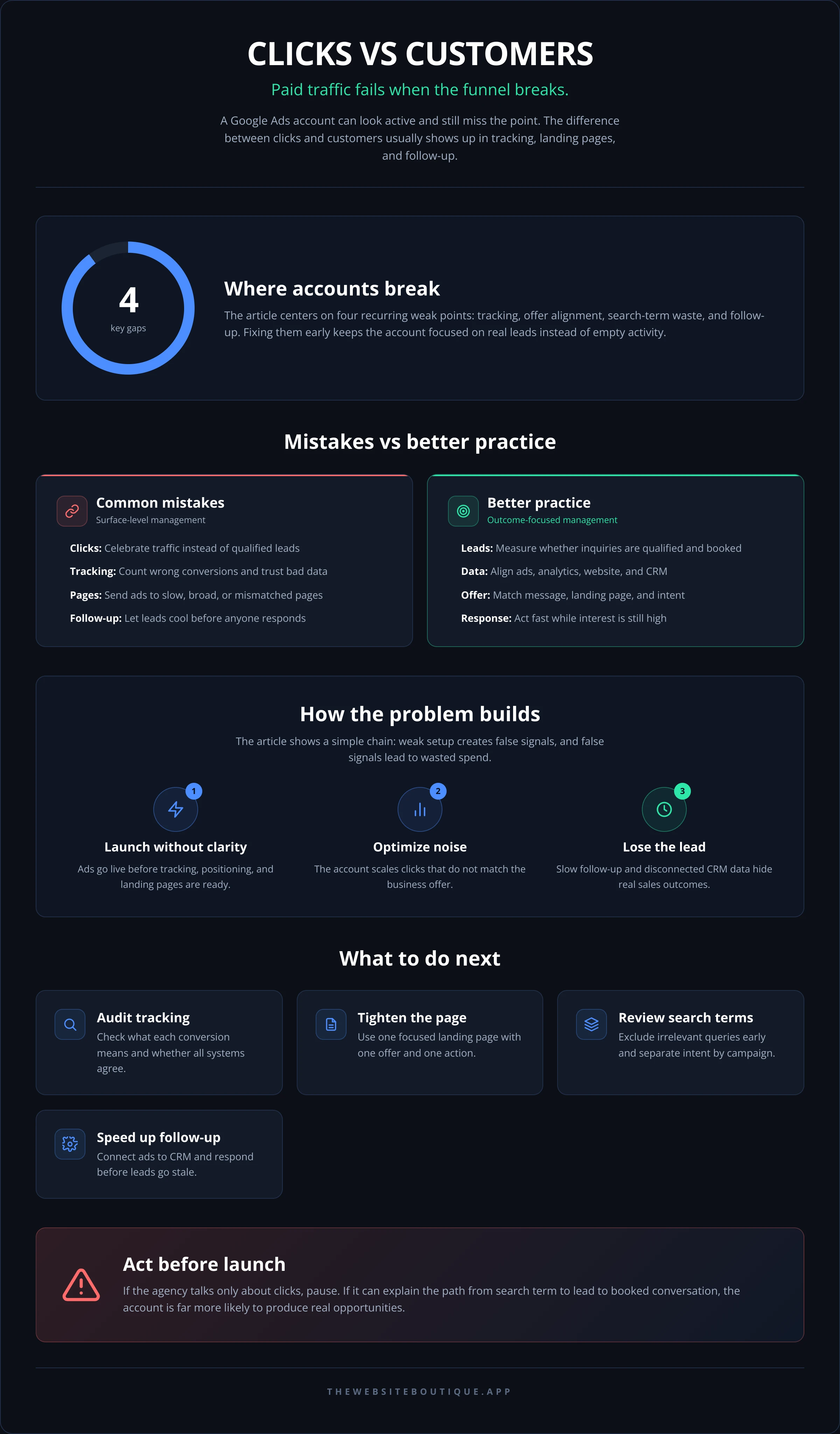
A campaign can look active and still miss the point. That is usually when owners start asking why the phone is quiet, why form fills feel off, or why a Google Ads agency for businesses in the United States keeps talking about clicks instead of customers.
You can tell a lot in the first two weeks of an account. If the reports are full of impressions but no one is asking about lead quality, the work is already drifting. If the agency changes bids before the landing page is ready, or launches ads without a clean tracking setup, the account is learning the wrong lessons.
- The biggest mistakes usually happen before the ads spend much money.
- Weak tracking creates false confidence and bad decisions.
- Search terms, landing pages, and follow-up all need to match the same offer.
- Small businesses feel these mistakes faster because every wasted lead matters.
- A good agency should make the business easier to run, not harder to monitor.
The most common mistakes in a Google Ads agency for businesses in the United States relationship
The first mistake is assuming the agency’s job starts and ends inside Google Ads. For a local service business, a consulting firm, or an owner-operated company, the ad account is only one part of the system. If the landing page is slow, the form is awkward, or the phone number is buried, paid traffic gets blamed for problems it did not create.
A second mistake is vague positioning. If the agency writes ads for everyone, the account usually ends up attracting people who want cheap, broad, or unrelated solutions. That may produce clicks, but it rarely produces the right kind of inquiries. A strong Google Ads agency for businesses in the United States should help define the offer clearly enough that the ads can filter, not just attract.
The third issue is a reporting habit that celebrates activity instead of outcomes. Owners do not need a dashboard filled with every available metric; they need to know what happened to the leads after they arrived. If nobody checks whether calls were answered, forms were followed up, or booked appointments were actually qualified, the campaign can look better than it is.
Tracking errors that make good campaigns look bad
Bad tracking is one of the easiest ways to waste months. When conversion actions are set up incorrectly, the platform may count the wrong behaviors: page views, button clicks, or accidental submissions that never become real opportunities. The agency may then scale a campaign that is only good at generating noise.
A second tracking problem is disconnected data. If Google Ads, Google Analytics, the website, and the CRM do not agree, nobody can tell where the leads came from or which search terms created them. That is especially painful for businesses that sell through a sales call or a consultation, because the final result lives outside the ad platform.
For teams that want to audit their setup, the Google Ads Help Center and Google Analytics help are useful starting points. They will not solve the strategy for you, but they do show the basic standards that a serious agency should already know.
A practical test is simple: ask where each conversion is coming from and what counts as a valid lead. If the answer changes every week, the account is probably optimizing for convenience rather than business value.
Landing pages, offer mismatches, and why clicks do not equal leads
Many agencies treat the ad as the main event and the landing page as an afterthought. That works only when the traffic is already very warm. For most service businesses, the landing page has to do the heavy lifting: explain the offer, reduce hesitation, and make the next step feel safe.
The most common mismatch is between the ad promise and the page content. If the ad mentions a fast quote, but the page opens with a generic company story, visitors feel friction. If the ad targets a specific service and the page tries to sell five unrelated services at once, the user has to do the sorting work the site should have done.
This is where a landing page built for one goal usually performs better than a broad service page. A focused page does not need to be fancy. It needs clear proof, a single action, and enough detail to help a real buyer decide without scrolling in circles.
Speed matters too. If the page loads slowly on mobile, the campaign starts leaking interest before the pitch even begins. A fast website is not a luxury in paid search; it is part of the conversion path. Google also offers guidance on page experience through its Search Central documentation, which is useful for understanding how site quality affects visibility and user behavior.
Search terms, targeting, and wasted spend that looks legitimate
One of the hardest mistakes to catch is when an account is spending money on traffic that technically fits the targeting settings but does not fit the business. This happens when match types are too broad, negative keywords are too thin, or location settings are left open enough to invite irrelevant clicks. The spend is real, but the demand is not.
A weaker Google Ads agency for businesses in the United States may point to the size of the audience as a win. That sounds reassuring until you notice that the search terms are drifting toward research queries, DIY phrases, job seekers, or people outside the service area. The account may keep receiving traffic, but the owner sees no meaningful pipeline.
The fix is not to choke the account immediately. It is to watch search terms carefully, build exclusions early, and separate campaigns by intent. High-intent searches, competitor searches, and informational queries should not all be treated the same way, because each one needs a different message and budget discipline.
A useful sign of maturity is when the agency can explain why a term is allowed to spend. If the answer is only “it has clicks,” the account is still being managed at the surface.
Follow-up, CRM, and lead quality after the click
Paid traffic ends very quickly when the follow-up process is slow. A lead that waits hours for a reply often cools down before a human ever touches it. That is why the ad account should not be managed separately from the sales workflow.
Businesses that use lead generation with CRM tracking have a better chance of seeing which leads actually move forward. The important question is not just whether a form was submitted, but whether the inquiry was answered, scheduled, and qualified. Without that chain, the agency can only optimize toward surface-level events.
This also affects how the business interprets ad performance. A campaign with fewer leads may still be the better one if those leads are more serious and easier to close. On the other hand, if a campaign creates a flood of weak inquiries that staff never convert, the account is probably targeting the wrong intent or the wrong offer.
For businesses that want more automation in how inquiries are handled, a tool like Eva can be relevant when the follow-up process needs structure after the click. The point is not to add software for its own sake; it is to keep good leads from going stale.
When a Google Ads agency is the wrong fit
Sometimes the issue is not the campaign itself but the working style. A small business that wants close attention will struggle with an agency that runs accounts like a production line. If the team cannot explain what changed, why it changed, and what happened after the change, the relationship will feel noisy even if the reports look polished.
There is also a mismatch when the agency sells only media management but the business needs the full path: site, message, ads, and follow-up. That is where a Google Ads agency for businesses in the United States should be judged by how well it understands the whole funnel, not by whether it can spend a budget quickly.
If you are comparing providers, ask a few direct questions:
- What counts as a qualified lead in this account?
- How will search terms be reviewed and excluded?
- Who checks landing page performance and form friction?
- How do you connect ad data to actual sales activity?
- What happens if the campaign is getting clicks but not customers?
Those questions reveal whether you are buying tactical execution or actual decision-making support. The difference matters most when you are operating with limited time and every lead has to count.
How to evaluate a Google Ads agency before the account goes off track
The easiest time to avoid problems is before the first campaign launch. Ask for a clear explanation of the strategy, not a parade of platform features. You want to hear how the agency plans to choose keywords, structure campaigns, build the landing experience, and measure lead quality.
Look for signs that they understand the business, not just the ad account. If they ask about close rates, average job size, service area, response time, and what happens after someone fills out a form, that is a strong signal. If they jump straight into budget talk without understanding the sale, the account may never get past guesswork.
It also helps to see how the team handles web and search together. When the site is weak, a better ad strategy only reveals the weakness faster. That is why some businesses prefer working with a small studio like The Website Boutique that can design the page, support the ads, and keep the follow-through tight without making the process feel fragmented.
A final check is ownership. You should know who has access to the ad account, the landing page, the analytics, and the CRM. If those pieces are locked in different places, you can lose time every time something needs to be fixed.
A simple decision rule
If the agency talks mostly about clicks, but not about what happens after the click, pause. If they can explain the journey from search term to landing page to lead to booked conversation, you are closer to a setup that can actually work.
The best accounts are not the flashiest ones. They are the ones where the offer is clear, the data is trusted, and the follow-up process is quick enough to catch the lead while interest is still high. When those pieces line up, paid search stops feeling like a gamble and starts behaving like a system.
If your current campaign is producing activity but not enough real opportunities, Services is a good place to compare what needs fixing first, while Pricing can help you see whether you need a focused repair or a full rebuild.
FAQs
What is the most common mistake a Google Ads agency makes?
The most common mistake is optimizing for clicks or platform conversions instead of qualified leads. When that happens, the account may look busy while sales stay flat.
How do I know if my tracking is set up correctly?
Your ads, analytics, website, and CRM should agree on what counts as a conversion. If each system reports different lead numbers with no clear explanation, the setup needs review.
Should a landing page be different from the main website?
Often yes. A landing page works best when it is focused on one offer and one action. A general website page usually has more distractions and less conversion clarity.
Why are my ads getting clicks but no real leads?
The problem may be the keyword targeting, the landing page, the offer, or the follow-up speed. Clicks alone do not prove that the campaign is reaching the right people.
What should I ask before hiring an agency?
Ask how they define a qualified lead, how they handle search terms, how they measure outcomes, and what they do when traffic is coming in but sales are not.
If you want a second set of eyes on the whole path from ad to lead to follow-up, start with a quick review of your current site and campaign flow. A tighter landing page, cleaner tracking, or a better lead-handling setup can change the outcome faster than a bigger budget.
If you are ready to fix the weak points instead of guessing at them, reach out through The Website Boutique and ask for help with the part of the funnel that is blocking real inquiries. A small, careful rebuild often does more for a paid search account than another month of broad optimization.