

Common Mistakes in ChatGPT Search Optimization
September 08, 2026 · 12 min read
- AI systems do not reward vague marketing copy; they reward clarity, structure, and evidence.
- If your site is hard to parse, a chatbot is less likely to use it confidently.
- The biggest mistakes usually come from SEO habits that worked for humans but fail for AI retrieval.
- You do not need to chase every model; you need pages that explain your business well and consistently.
- Small fixes to content, schema, internal links, and trust signals often matter more than rewriting everything.
A business owner can spend weeks polishing a site and still wonder why AI answers never mention it. That usually means ChatGPT search optimization was approached like a slogan exercise instead of a retrieval problem. If a model cannot quickly understand what you do, who it helps, and why it should trust the page, it will move on to a clearer source.
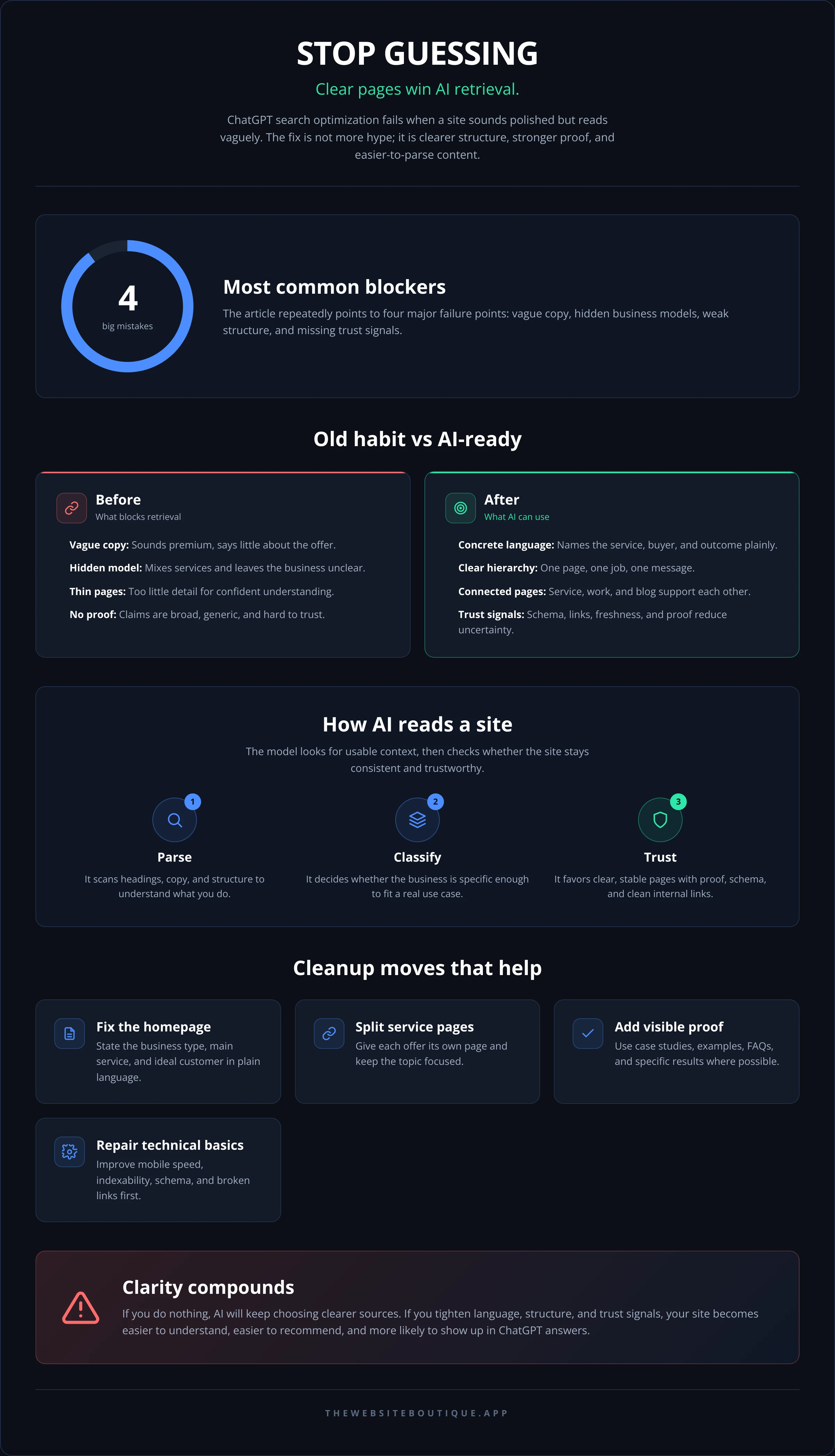
That is frustrating because the site may still look good to a human. The problem is that AI systems do not browse like a person skimming a homepage. They look for usable context, consistent phrasing, and signals that reduce uncertainty. The mistakes below are the ones that most often block that process.
Common ChatGPT search optimization mistakes to avoid
The first mistake is writing for brand mood instead of answerability. A page that says it is “innovative,” “premium,” or “client-focused” without saying what is actually built, for whom, and with what outcome gives AI very little to work with. In ChatGPT search optimization, vague claims are almost invisible.
A close second is hiding the business model. If your homepage mixes services, industries, and vague promises without a clean hierarchy, the model may not know whether you design websites, sell software, or do lead generation. That confusion is expensive because AI systems tend to prefer pages that are specific and easy to classify.
Many owners also rely on pages that are too thin. One short homepage and a generic services page rarely give enough material for AI search to understand the business deeply. If you want better visibility, you need pages that explain your offers, your process, and the type of client you actually serve.
A more subtle issue is inconsistency. If one page says you specialize in landing pages and another says you do everything for everyone, the site sends mixed signals. Search systems do not interpret that as flexibility; they interpret it as noise.
What ChatGPT usually struggles to interpret
ChatGPT search optimization fails fastest when the site lacks concrete language. Weak pages often include:
- Empty phrases like “solutions for modern businesses”
- Service lists with no explanation of deliverables
- Homepage copy that never names the buyer or use case
- Pages that talk about the company more than the work
- CTAs that do not match the page topic
If a page cannot answer a practical question in plain English, it is not doing enough. For example, a visitor should be able to tell whether you build custom websites, launch landing pages, manage ads, or create software without hunting through the navigation. The same clarity helps AI systems map the site correctly.
Structure problems that block AI understanding
One of the most common mistakes is burying the real message inside design. Beautiful sections, animations, and large hero headlines can look polished while still leaving the actual offer unclear. ChatGPT search optimization depends on content that can be read and interpreted cleanly, not just content that looks impressive.
Headings matter more than most owners expect. If every section title sounds clever but says nothing useful, the page becomes harder to scan. A model, like a rushed reader, benefits when headings clearly mark what each section is about.
Internal linking is another weak point. When service pages, case studies, and supporting resources sit in separate silos with no clear links between them, authority does not flow well. Pages should support each other, especially if you want AI systems to see the depth of your expertise. If you are building that structure from scratch, a useful place to start is the Services page and then connect it to related pages such as Work and Blog.
You also want one page to do one job. A homepage that tries to be an about page, a brochure, a portfolio, and a pricing table often ends up doing none of them well. Separate those roles when it makes sense, then link them together so both humans and AI can move through the site logically.
Site architecture mistakes that are easy to miss
A few structural issues show up again and again:
- Important pages buried too many clicks deep
- Duplicate explanations spread across multiple pages
- Navigation labels that are cute but unclear
- No dedicated page for a core service
- Contact or pricing details hidden from the main funnel
These issues do not always hurt traditional SEO in obvious ways, but they often weaken retrieval quality. A model needs a stable picture of what the business offers, and clear architecture helps create that picture. If your site is still evolving, compare how your top services are presented on Landing page and Get a site that converts so the messaging stays distinct.
Content mistakes that make your site hard to trust
ChatGPT search optimization is not just about being found; it is also about being believed. That is where many sites fail. They say too little to be useful or too much without giving proof, and both patterns reduce confidence.
Thin testimonials, generic claims, and unnamed results are especially weak. If a service page says it can improve leads, but never explains how the process works or what type of work is included, the model has little reason to treat it as a reliable source. The same goes for buzzwords that hide the actual deliverable.
Owners sometimes assume the site needs more “SEO copy.” What it really needs is better information architecture and stronger specificity. An effective page explains what is included, what is excluded, what the next step is, and what kind of business is a good fit. That kind of clarity is useful to both users and AI search.
If you offer multiple services, separate them cleanly and avoid blending unrelated promises into one page. A website design page should not read like a general marketing agency page. A lead generation page should not be written like a generic technology overview. If your site includes a focused offer such as Get leads, the surrounding copy should reinforce that topic rather than distract from it.
Better content signals for AI retrieval
A stronger page usually includes:
- A clear description of the service
- The buyer the service is for
- The problem it solves
- What the process looks like
- Proof points that are specific and visible
You do not need dramatic language to make this work. In many cases, plain English performs better because it reduces ambiguity. If someone can read the page and immediately say, “Yes, this is for me,” that same clarity helps ChatGPT understand the offer.
For technical businesses or custom builds, detailed pages matter even more. A generic “custom solutions” paragraph does not tell AI whether you build a SaaS product, a mobile app, or a client portal. Pages such as Custom SaaS, Mobile apps, and Custom tools work better when each one explains the actual use case.
Technical and trust signals people forget
A site can have good copy and still perform badly if the technical basics are neglected. Slow load times, broken pages, messy indexation, and poor mobile rendering make it harder for any system to rely on the site. For ChatGPT search optimization, that matters because retrieval systems are more likely to favor pages that are accessible and stable.
Schema markup is one of the most overlooked trust signals. It helps search engines understand page type, organization details, services, FAQs, and relationships between pages. You do not need to over-engineer it, but you do need to make sure it matches what the page actually says. Google’s own structured data documentation is a useful reference when you want to keep the implementation clean.
Trust also depends on consistency across the site. If your footer, about page, service pages, and contact details do not align, the site feels unfinished. That kind of inconsistency can weaken confidence in the business itself. A well-maintained support or repair page, such as Support or Repair, can help show that the business stays active after launch rather than disappearing once the invoice is paid.
There is also a practical signal many businesses ignore: freshness. Pages do not need constant rewriting, but outdated service descriptions and broken links make a site look neglected. That is a problem for AI systems because stale content can be treated as less reliable, especially when better-organized alternatives exist.
Technical checks worth doing before anything else
Focus on these first:
- Make sure key pages load quickly on mobile
- Confirm that service pages are indexable
- Check that titles and headings match the page topic
- Fix broken internal links and outdated URLs
- Add schema that reflects the real business structure
If you are unsure where the weak points are, it helps to compare the site against a stable reference page and then map the missing pieces. Resources like Free resources and the Glossary can help you tighten the language before you invest in a full rebuild.
Aligning your site with the way AI search reads
A useful mental shift is to stop treating AI like a search box and start treating it like a summarizer with limited patience. ChatGPT search optimization improves when the site gives it easy material to summarize. That means clear service names, direct explanations, and evidence that supports the claim.
This is where many businesses benefit from a focused review of their homepage, services, and supporting content. The homepage should say what the business is, the service pages should say what each offer includes, and the proof pages should show what the work looks like. If those pieces are disconnected, AI has to guess, and guessing is not a growth strategy.
A page like SEO + AI Search (GEO) is useful not because it adds more jargon, but because it shows how to present the same offer in a way that matches user intent. The words matter, but the order matters too. A clear page usually starts with the problem, then the service, then the result, then the proof.
If you want to show up more often in AI recommendations, your pages need to answer the questions people actually ask. What do you do? Who is it for? How does the process work? Why trust you? What happens next? Those are the details that tend to surface when a model is deciding whether to cite or mention a business.
app.iam-eva.ai is a good example of a product page that makes a specific use case easier to understand quickly. That kind of clarity is worth studying because the same principle applies to service businesses: reduce friction, reduce ambiguity, and make the offer legible.
A practical cleanup order that saves time
If a site is already live, do not start by rewriting everything at once. That usually creates more confusion. A better approach is to clean up the highest-impact pages first, then move outward.
Start with the homepage. Make sure it states the business type, primary service, and ideal customer in plain language. Then review the main service pages and strip out copy that tries to sound impressive without saying anything concrete. After that, update internal links so the pages reinforce each other rather than compete.
Next, check whether the site gives enough proof. A portfolio, work page, or selected examples can do more for ChatGPT search optimization than another paragraph of general promises. If you have finished projects or representative examples, organize them so they are easy to scan and easy to connect back to specific services.
At that point, you can improve the supporting pages. Add or refine FAQs, fix schema, and make sure your contact and pricing information are easy to find. If your offer needs a more direct conversion path, a dedicated Pricing page often removes friction faster than a clever headline ever will.
For businesses that want help tightening the structure without turning the site into a generic template, The Website Boutique works with owner-led businesses that need sites built around clarity, speed, and lead flow. That matters because the same cleanup that helps AI visibility usually improves conversions too.
Signs your cleanup is working
You will know the site is getting healthier when:
- Visitors ask fewer basic questions before booking
- Service pages attract more relevant conversations
- The site feels easier to explain in one sentence
- The homepage and service pages no longer repeat themselves awkwardly
- New pages fit into the structure without forcing the rest of the site to bend
The goal is not to impress a model with clever wording. The goal is to make the business easier to recognize, easier to trust, and easier to recommend.
FAQs
Is ChatGPT search optimization the same as SEO?
Not exactly. Traditional SEO focuses heavily on rankings in search engines, while ChatGPT search optimization also cares about how clearly a site can be understood, summarized, and trusted by AI systems. There is overlap, but the content structure and clarity requirements can be different.
Do I need a lot of content for AI search visibility?
You need enough content to explain the business well. More words do not automatically help if they are vague or repetitive. A smaller site with clear service pages, proof, and strong internal structure can outperform a larger site that says very little.
Will schema markup alone improve how my business appears in ChatGPT?
No. Schema can support understanding, but it cannot fix unclear messaging or weak service pages. It works best when the site already has clean content, consistent page structure, and trustworthy information.
What is the most common mistake businesses make?
The most common mistake is being too generic. Many sites describe themselves in broad marketing language without naming the real services, buyers, or outcomes. That makes it harder for AI systems to confidently surface the business.
Should I rewrite my whole site for ChatGPT search optimization?
Usually not. Start with the pages that matter most: homepage, core services, work examples, and supporting FAQs. If those pages are clear and consistent, you can improve the rest of the site more gradually.
If your site is not showing up in the right AI answers, start with the pages that create the most confusion: homepage, services, and proof. We can help you tighten the structure, clarify the offer, and build a site that is easier for people and AI to understand. Explore Services or Book a project through The Website Boutique when you are ready to fix the parts that are holding visibility back.
If you already have a site but it is not being recommended the way you expected, a focused rebuild or content cleanup may be enough to change that. Work shows how a more deliberate structure can support better leads, and About explains how the team approaches custom builds from the first day of the project.