

Fast Website Design for Businesses: Cost and Inclusions
September 01, 2026 · 11 min read
What fast website design for businesses really means
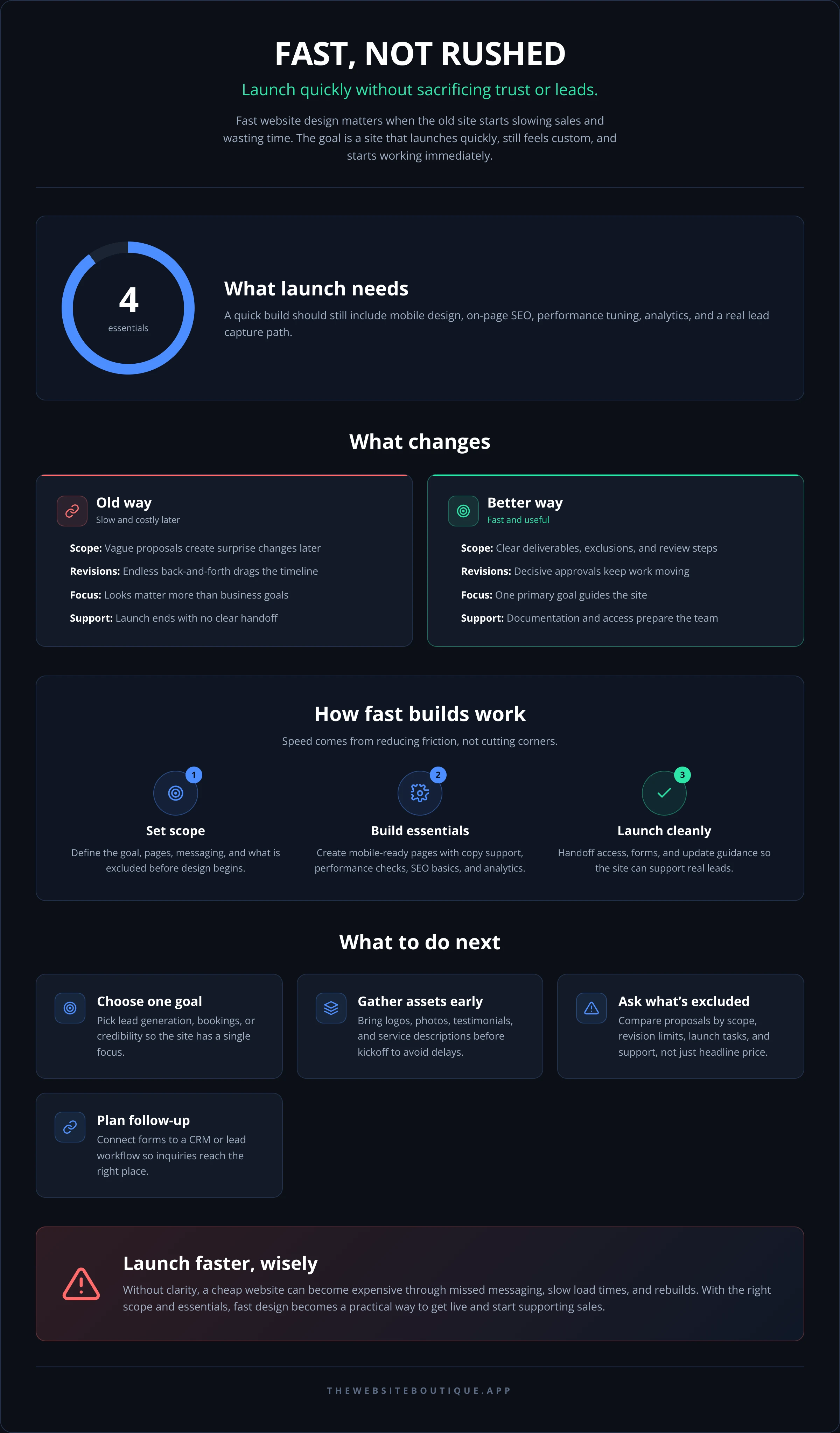
A fast build is not the same as a rushed one. Rushed projects cut corners and hope no one notices; fast projects remove unnecessary friction and make decisions early. That usually means a tighter scope, a smaller number of pages, a clear message, and a process that does not depend on endless revisions.
For most small businesses, this kind of project is meant to solve a specific problem: replacing an outdated site, launching a new offer, or creating a focused lead-generation page. If the provider can explain how the site supports those goals, you are closer to a useful result than if they spend most of the call talking about animations and visual trends.
A practical fast website often includes a home page, a services page or two, an about page, contact details, and maybe a landing page for one core offer. That structure keeps the project manageable while still giving visitors enough information to act.
If you want a sense of what a streamlined approach can look like, compare a build built around clarity with a broader agency-style process. Some businesses use a design partner like The Website Boutique for a more focused, hands-on delivery model, while others prefer a larger vendor with longer cycles. The right choice depends on how quickly you need the site to start working.
What drives the cost
Fast website design for businesses is priced by scope, not by slogans. A 5-page site with a strong content direction can cost less than a 3-page site that requires custom layout decisions, deep copy help, multiple integrations, and several rounds of revisions. The difference is usually in the hidden labor.
The main cost drivers tend to be straightforward:
- Strategy and messaging work. If the provider helps you define the offer, structure the pages, and shape the conversion path, that takes time.
- Design depth. A polished custom design costs more than a light template adjustment.
- Development complexity. Booking systems, forms, CRM handoff, payment flow, or multilingual setups add work.
- Content support. If the team writes or rewrites copy, cost usually rises.
- Revision volume. A fast process depends on decisive approvals; open-ended edits slow everything down.
- Launch readiness. Analytics, SEO setup, redirects, and performance checks are part of a serious delivery, not extras to bolt on later.
If you are comparing quotes, read what is excluded. A low number can look attractive until you realize the proposal does not include copy cleanup, mobile optimization, or any real post-launch support. At that point, the site may be “done” but not actually ready.
A useful benchmark is not “What is the cheapest website?” but “What will this site cost me if it fails to generate trust or leads?” That question changes the conversation quickly. It also helps you avoid paying twice: once for the build and again for the rebuild.
For business owners who want to understand broader pricing structures, the Pricing page can help frame the difference between a quick, focused build and a more expansive engagement.
What should be included in a fast build
A proper fast site should still cover the essentials that make it useful after launch. If those pieces are missing, speed becomes a liability instead of an advantage.
At minimum, expect the project to include:
Strategy, structure, and page planning
Before design starts, the site needs a clear structure. That usually means deciding which pages exist, what each page should persuade a visitor to do, and how the main offer is presented. This step prevents the common problem where a beautiful site still fails because it talks around the business instead of saying what it does.
Design that works on mobile
Most owner-operated businesses get a large share of first visits on phones, especially from ads, social media, or word-of-mouth traffic. Mobile design should not be treated as a reduced version of desktop. Buttons, spacing, form fields, and reading flow all need to be intentional.
Copy support and basic messaging
A visually strong site can still underperform if the words are vague. If the provider helps improve headlines, service descriptions, proof points, and calls to action, the site has a much better chance of turning traffic into inquiries.
Technical setup and performance
Fast load times matter because they shape trust and usability. The site should be built with sensible image sizes, clean code, and lightweight plugins or scripts where possible. Google’s Core Web Vitals overview is a useful reference if you want to understand why performance affects the search experience.
Analytics, forms, and lead capture
If the site is meant to generate leads, tracking should be in place from the start. That means forms that actually work, event tracking when needed, and a way to know where inquiries come from. Without that, you are guessing.
Basic SEO and search readiness
A fast site should not ignore search fundamentals. Titles, headings, internal links, metadata, and indexability all matter. If you expect the site to support organic growth, make sure the build includes the basics, not just attractive visuals. For a deeper path into search and AI discovery, SEO + AI Search (GEO) is a useful next step.
Clear handoff and support
The build should not end with a silent launch. You need access, documentation, or a simple handoff so your team knows how to update content, manage forms, and handle small changes. If maintenance is offered, understand what is covered and what is not.
A clean way to judge the proposal is to ask: if the site went live tomorrow, would it be ready to support a real customer journey? If the answer is no, something important is missing.
Which decisions speed up the project without lowering quality
The fastest projects are usually the ones where the owner makes decisions early. That does not mean rushing. It means not asking the designer to solve business uncertainty that should have been clarified before the build began.
A few choices tend to make a big difference:
- Choose one primary goal. Lead generation, bookings, or credibility work better when the page has a single focus.
- Limit the number of core pages. More pages mean more content, more layout decisions, and more review cycles.
- Bring existing brand assets together before kickoff. Logos, photos, testimonials, and service descriptions reduce delays.
- Decide who approves what. Too many decision-makers slow everything down.
- Use real examples of sites you like for direction, but not as a shopping list of disconnected features.
One trap is asking for “just a few more sections” after the project begins. A section sounds small, but it usually affects layout, copy, mobile behavior, and testing. A good provider will tell you when a small request changes the timeline.
Another trap is trying to make the website solve every business problem at once. A quick site can support sales, but it cannot replace weak positioning, bad follow-up, or unclear offers. If your lead response process is slow, no amount of design polish will fix that.
That is where pairing the site with a simple CRM workflow can help. A form that sends leads to the right place, with a clear follow-up path, gives the site a job beyond “looking professional.” If that matters to you, Get leads is the kind of service to explore once the website itself is in place.
What to watch out for when comparing quotes
When people shop for fast website design for businesses, they often compare only the headline price. That can be misleading. Two proposals can look similar and still produce very different outcomes.
Watch for these warning signs:
Vague scope language
If the proposal says “custom website” but does not explain page count, revision limits, content support, or launch tasks, the scope is too fuzzy. Ambiguity tends to create change orders later.
No mention of process
A fast site still needs a process. You should know how discovery works, when drafts appear, how feedback is shared, and what happens before launch. If none of that is defined, expect delays.
No device testing or performance check
A site that looks fine on a desktop mockup can break down on phones. Ask how the team checks responsiveness and load performance before handoff.
Too much emphasis on visual bells and whistles
Motion and effects can help when used with restraint, but they are not what makes a site convert. If the pitch is mostly about aesthetics, the business outcome may not be the priority.
No plan for updates after launch
Many small businesses need occasional edits, security checks, or help fixing something simple. If support is not discussed, you may end up waiting for basic changes or paying more later.
If you want to see how a focused build is packaged from a service perspective, the Fast websites page is a helpful reference point. It shows the difference between a quick delivery and an improvised one.
For buyers who want a second opinion on how a lean team presents its offer, nikamediaus.com is worth reviewing as an example of a small agency presence online.
How to judge whether the price is fair
A fair price is one that matches the business impact of the site and the amount of expert work included. If the website is central to how you get leads, book consultations, or establish trust, the price should reflect more than surface design.
A useful test is to look at the work behind the scenes. Does the provider help shape the offer? Do they set up the pages to support action? Do they make launch simpler for you? If yes, you are paying for more than layout. You are paying for a process that reduces mistakes.
It also helps to compare the build to the cost of delay. Waiting three extra months for a site that still needs major edits can be more expensive than launching a leaner site sooner. That does not mean buying the cheapest package. It means understanding where speed has real business value.
The best fit for this kind of project is usually a small, attentive team that can move quickly without turning the site into a generic template. The Website Boutique works with that style of engagement: fewer clients at a time, more direct attention, and a build process meant to get you live without dragging the project out.
If your site also needs a stronger acquisition channel after launch, a dedicated campaign or landing page can come next. That is where Landing page design, ads, and lead handling become more relevant than adding yet another homepage section.
Frequently asked questions
How long does a fast website project usually take?
It depends on scope, decision speed, and how ready your content is. The fastest projects are the ones where the business already knows its offer, has basic assets on hand, and can approve work quickly.
Is a fast build the same as using a template?
No. A template can be part of the process, but a fast build can still be custom in structure, messaging, and user flow. The difference is that the team makes smart choices instead of rebuilding everything from scratch.
Should SEO be included from the start?
Yes, at least the basics. Search-friendly page titles, headings, metadata, internal links, and technical setup are much easier to handle during the build than after launch.
What if I need more than a website later?
That is common. Some businesses start with a fast site, then add ads, SEO, CRM workflows, mobile apps, or custom software as the next stage. If that becomes your path, Services can help you see the broader options.
Can a fast website still be scalable?
Yes, if it is built with clean structure and realistic future updates in mind. A well-planned site can begin small and still leave room for expansion without forcing a full rebuild.
If you want fast website design for businesses that feels built for a real owner-run company, not a demo, talk to The Website Boutique about a focused launch. The right starting point is a site that gets live quickly, represents the business clearly, and does not leave you with a cleanup project two months later.
If you are already comparing options, send over your current site and the one thing you want the new build to do first. That is usually enough to tell whether you need a lighter redesign, a more complete rebuild, or a faster launch plan built around leads.