

Frequent SEO Service Mistakes for U.S. Businesses
September 05, 2026 · 11 min read
When SEO is sold like a checklist instead of a growth system
One of the most common mistakes with an SEO service for businesses in the United States is treating optimization as a pile of tasks: publish a few posts, add some keywords, fix metadata, wait. That approach can create movement in a dashboard without changing actual demand.
The better question is simple: what business action should this search traffic produce? A quote request, a booked call, a form fill, a product inquiry, a local visit, a demo? If the service cannot answer that before work starts, it is easy to end up with traffic that looks fine and converts badly.
This is also where many owners get stuck with monthly deliverables that sound productive but do not match their real funnel. Some businesses need a stronger service page and local intent pages. Others need SEO + AI Search (GEO) so they can show up in the places people now use to evaluate providers. Others need landing pages that actually support the search terms already sending traffic. Search visibility is only useful when it supports a buying decision.
Choosing keywords without reading intent
Keywords are not the problem. Bad keyword selection is. A business can rank for the “right” phrase and still attract the wrong visitor if the intent behind the query is off.
For example, someone searching for pricing, reviews, or a comparison page is often much closer to choosing than someone searching for a broad educational term. A service page that ranks for broad informational traffic may get plenty of visits and very few leads. That is not a traffic problem; it is an intent problem.
A practical SEO service for businesses in the United States should separate:
- buyer-intent pages for services, pricing, and contact
- support content for questions that help people evaluate
- location or vertical pages when the business serves specific markets
- comparison content only when it genuinely helps the decision process
The mistake is not targeting broad terms at all. The mistake is building the whole plan around them. If you want an example of how search strategy has shifted beyond classic blue-link rankings, Google’s own Search Central documentation is useful for understanding how pages are discovered and interpreted.
Weak pages that cannot earn trust or action
A lot of SEO work fails because the page itself is thin. The search engine may still index it, but people do not trust it enough to inquire.
This happens when service pages sound generic, use the same claims as every competitor, or bury the actual offer beneath filler. If the visitor cannot quickly tell what you do, who it is for, and what happens next, they leave. A page that ranks but does not convert becomes a vanity asset.
Owners often notice this after they compare their site to stronger competitors and realize the difference is not only backlinks or volume. It is specificity. The stronger page usually shows the service scope, the type of client served, and a clear next step. If your current pages are holding you back, a focused fast website or a cleaner service page structure can make the difference between a curious visitor and an actual lead.
There is also a content quality problem that many agencies miss: pages written for “SEO” instead of for the actual buyer. A law firm, trades business, local clinic, B2B service, or SaaS company each needs different proof, objections, and language. A generic template may satisfy a report, but it rarely satisfies a customer.
Ignoring local signals, maps, and market context
For many businesses, the search results are not just ten blue links. They include maps, local packs, review signals, business profiles, and pages that make proximity or service area obvious. If your SEO provider ignores that context, they are planning for half the screen.
This matters even for businesses that are not strictly storefronts. Service-area businesses, consultants, and owner-led firms often win or lose by how clearly they describe where they work, who they serve, and what makes them reachable. A page can be technically optimized and still fail because the local intent is unclear.
That is why the smartest SEO service for businesses in the United States usually connects search work with location strategy, reputation, and contact paths. If your market is concentrated in one state or region, pages like Florida or Texas can make sense when they are part of a real geographic strategy rather than thin keyword stuffing. And if reviews or local listings are part of your visibility, the Google Business Profile help center is worth reviewing so the basics are not left to guesswork.
The mistake here is thinking local SEO is only for shops with addresses people walk into. It is also for businesses that need to look credible in a search result before the first conversation ever happens.
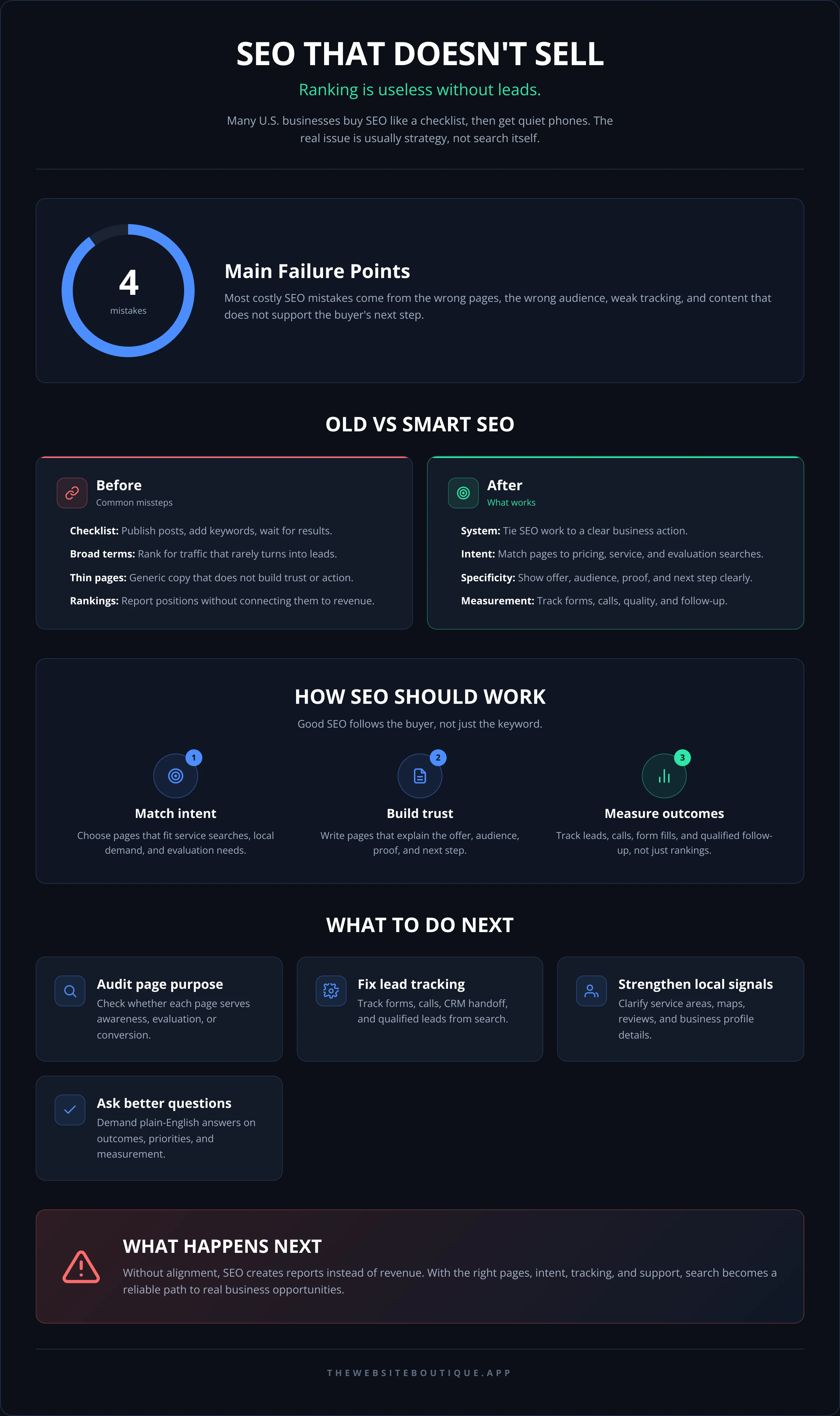
Reporting on rankings while ignoring leads and follow-up
A ranking report is not a business report. It tells you where a page appears, not whether the page is creating revenue opportunities.
This is where many businesses waste months. They get screenshots showing upward movement, but no one has connected search traffic to form submissions, booked calls, phone clicks, CRM activity, or closed deals. If the site has no proper tracking or the forms do not route cleanly, the work becomes hard to judge and easy to overpromise.
A stronger SEO service for businesses in the United States should look at what happens after the click. That often means:
- tracking form submissions and call clicks
- separating branded traffic from non-branded discovery traffic
- identifying which pages assist conversions, not just close them
- checking whether leads are actually qualified
- making sure the handoff into email, CRM, or sales follow-up works
If you also run paid traffic, this becomes even more important. SEO and ads should share the same measurement logic. A page that attracts organic traffic but fails in a paid campaign usually has an offer or message problem, not just an ad problem. For businesses that want both demand generation and follow-up under one roof, lead generation with Meta and Google Ads can be a cleaner way to connect clicks to real pipeline.
One useful standard here is the way Google explains how search and site ownership data are handled in Google Search Console. If an agency avoids showing how measurement is set up, that is not a small gap. It is a core operational issue.
Building content without a clear buyer journey
Some SEO programs create content because content is what the package includes. That is how sites end up with articles nobody searches for, blog posts that answer the wrong questions, and pages that do not connect to a service.
Good content should move someone from curiosity to confidence. It should answer a real question, reduce uncertainty, and lead naturally to the next step. For a small business, that may mean a page that explains a service in plain English, a support article that removes friction, or a comparison page that helps a buyer choose without feeling pressured.
This is where a structured content plan matters more than volume. A useful SEO service for businesses in the United States should decide which pages serve awareness, which pages serve evaluation, and which pages are built to convert. If the business also needs a better educational hub, a blog or free resources page can support that work without turning the site into a content farm.
If the content reads like it was written for search engines first, readers notice. They may not say it that way, but they behave that way: short visits, low engagement, few inquiries. That is usually the signal that the topic selection, page purpose, or offer positioning is off.
Choosing speed, scope, and support that fit a small team
A lot of businesses do not need more complexity. They need an SEO partner that can make decisions quickly, explain tradeoffs, and stay close to the actual site.
That is especially true when the business is owner-led and the site is also doing sales work, lead capture, scheduling, or quote requests. If the provider is slow to respond, vague about priorities, or unwilling to touch the site after launch, the business pays for that hesitation every month. Search is not a one-time deliverable; it is part of how the site keeps working.
For some owners, the real issue is not the SEO tactic itself but the overall site foundation. A custom website may need a better page hierarchy, clearer conversion paths, or a rebuild that can support search from day one. Others need ongoing support or repair so small technical issues do not keep undoing the work.
A smaller studio can sometimes be a better fit than a large agency for this reason alone. Fewer clients usually means tighter attention, faster decisions, and less handoff loss. That does not guarantee results, but it often avoids the common failure mode where the account is active while the site stays unchanged.
The other reason support matters is that search no longer lives in one place. Businesses now need visibility in classic search, AI-assisted results, and on-site conversion paths. If a team cannot talk about SEO and AI search visibility, page experience, and lead flow in the same conversation, the strategy can get fragmented quickly. For a different point of view on integrated digital execution, Nika Media is a useful reference.
What to ask before hiring any SEO provider
A good sales call should make the service clearer, not foggier. If you are comparing providers, ask questions that force specifics.
Start with the business outcome. What will they optimize first and why? Which pages matter most? How will they know a lead came from search? What do they need from your team to keep pages accurate? Which parts are SEO, which are content, and which are conversion work?
Then ask how they handle ongoing decisions. A serious SEO service for businesses in the United States should be able to explain whether the first win is technical cleanup, page restructuring, new landing pages, local improvements, or content rework. If they jump straight to backlinks, blog volume, or a generic “full-service package,” they may be skipping the part that actually moves the business.
A few useful signals during evaluation:
- They speak about pages, intent, and conversion, not just rankings.
- They can explain how work will be measured in plain English.
- They acknowledge that some sites need structural changes before content.
- They do not overpromise quick rankings for competitive terms.
- They can show how SEO fits with ads, CRM, or lead routing when needed.
If you want a preview of how a more integrated service model is organized, the services and pricing pages can help you compare scope before you commit. That matters more than most owners realize, because many problems only show up after the site is already carrying the wrong plan.
FAQs
How long should it take to see value from SEO work?
There is no honest universal timeline. Some changes affect indexing, page quality, and usability quickly, while broader visibility and lead growth usually take longer. The better question is whether the first month creates clarity: better pages, better tracking, and a realistic plan.
Is SEO still worth it if I already run ads?
Yes, because ads and search usually solve different parts of demand. Ads can create immediate visibility, while SEO can strengthen trust and reduce dependency on paid traffic over time. The strongest results often come when the messaging and landing pages are aligned across both channels.
What is the biggest warning sign in an SEO proposal?
If the proposal is heavy on deliverables and light on business outcomes, be careful. A long list of tasks does not mean the service understands your market, buyer intent, or conversion path. The work should connect to leads, calls, inquiries, or sales.
Do small businesses need different SEO than larger companies?
Usually, yes. Smaller businesses often need fewer pages, clearer positioning, faster updates, and tighter lead tracking. They rarely benefit from bloated campaigns that assume a large internal marketing team.
Should I rebuild my website before investing in SEO?
Not always, but if the site is slow, unclear, or hard to convert, SEO will struggle. In that case, improving the site structure first often saves time and money later. Search visibility is harder to monetize on a weak foundation.
If your current SEO plan is generating reports but not real inquiries, it may be time to look at the site itself, the page structure, and the lead path instead of buying more of the same. A focused team like The Website Boutique can help you fix the parts that usually get skipped: the pages, the follow-up, and the strategy that connects them.
If you want a cleaner approach, start with the page that should be earning leads now and work backward from there. Get found with SEO + AI Search (GEO) if your visibility needs a stronger strategy, or get a site that converts if the current website is making SEO harder than it should be.