Key points to keep in mind
A Google Ads agency for U.S. businesses is usually priced around a management fee, but the real cost depends on how much setup, testing, and tracking is included.
Low monthly retainers can look attractive until you discover that landing pages, conversion tracking, search term review, and reporting are billed separately.
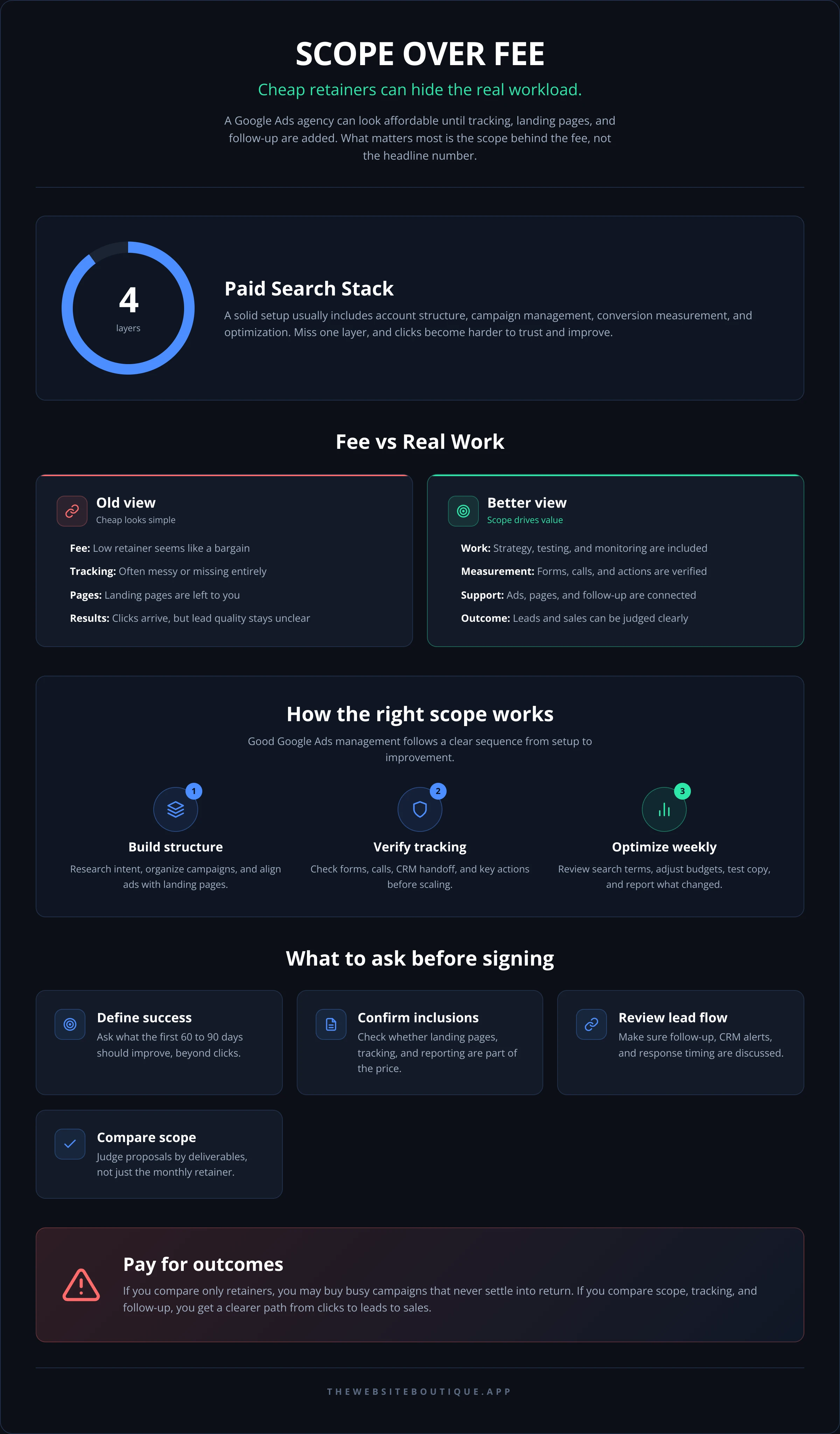
The right scope matters more than the headline fee: weak tracking or poor account structure can waste more money than a higher retainer would cost.
If the agency is also expected to write ads, build landing pages, and manage lead follow-up, the package should reflect that work clearly.
A good proposal explains what is included, what is excluded, how decisions are made, and how you’ll know whether the account is improving.
Your budget is already under pressure before a single click happens. A Google Ads agency for U.S. businesses can look affordable on paper and still become expensive once you add the pieces that actually make paid search work: tracking, landing pages, negative keywords, creative testing, and lead handling. That gap between the quoted fee and the real workload is where many owners get burned.
If you are comparing proposals, the question is not only what the agency charges. It is what gets built, monitored, changed, and reported after launch. That difference decides whether your ad spend turns into leads or disappears into a campaign that looks busy but never settles into a stable return.
What you are really paying for
A serious paid search setup usually includes four layers: account structure, campaign management, conversion measurement, and optimization. When a Google Ads agency for U.S. businesses leaves one of those out, the rest of the work becomes harder to trust. You may still get clicks, but you will not know whether those clicks are the right ones.
The most overlooked item is measurement. If call tracking, form tracking, CRM handoff, or event setup is messy, every optimization decision becomes a guess. Google’s own Google Ads Help Center is useful for basic platform features, but it will not replace a solid business setup that matches your sales process.
A proper scope often includes:
keyword research based on buyer intent, not just volume
campaign and ad group structure that keeps themes tight
ad copy written for search intent and landing page match
conversion tracking and QA across forms, calls, and key actions
search term review and negative keyword management
bid and budget adjustments based on actual performance
reporting that explains what changed and why
For owner-operated businesses, the hidden cost is usually time. If the agency sends vague reports or requires constant back-and-forth to approve basic changes, you are paying with attention instead of money. That can be acceptable for a large team; it is much less acceptable when you are also running operations, sales, and customer service.
Google Ads agency for U.S. businesses: what pricing usually reflects
There is no honest flat number that fits every account. A Google Ads agency for U.S. businesses may charge a monthly retainer, a percentage of ad spend, a one-time setup fee, or a hybrid of those models. The structure matters less than whether the agency can explain why that model fits your situation.
A simple lead generation account with a single offer is usually cheaper to manage than a multi-location or multi-service account with several conversion paths. If the agency is handling Meta & Google Ads + lead generation together with a dedicated landing page and CRM follow-up, the price should reflect that broader scope. Asking for “just management” while expecting strategy, page work, and reporting will produce a thin engagement.
Watch for these pricing signals:
Very low management fees often mean limited communication or minimal optimization.Percentage-only pricing can be fine, but only if the agency is transparent about what happens when spend increases.Setup fees make sense when tracking, structure, and landing pages need real work before launch.All-in packages are easier to compare if they list exactly what is included.
A good proposal should also say how often optimizations happen. Weekly search term review is different from monthly maintenance. So is writing new ad copy every month versus keeping the same creative live until performance drops. Those details explain the fee more honestly than the headline number.
If you are reviewing agencies, compare how they think about the first 30 days. Do they start with tracking and structure, or do they rush to spend? Do they ask about your lead quality, sales cycle, and close rate? Those questions tell you whether the agency is building a campaign for business results or simply managing an ad account.
What should be included in a monthly engagement
A useful monthly engagement is more than “we ran ads.” For most service businesses, the value comes from repeated diagnosis. Search intent shifts, competitors adjust, budgets drift, and landing pages wear out. The agency’s job is to keep the account aligned with what buyers are actually doing.
At a minimum, the relationship should include ongoing keyword and search term analysis, conversion tracking checks, ad copy refinement, and budget allocation decisions. If the business depends on leads, then lead quality should be reviewed too. A Google Ads agency for U.S. businesses that never asks how leads are closing is flying with one eye closed.
A stronger engagement may also include:
dedicated landing page recommendations or build support
CRM integration and lead routing checks
audience and remarketing setup where appropriate
call and form quality review with the sales process in mind
experiment planning for headlines, offers, and landing page sections
coordination with SEO or SEO + AI Search (GEO) when search visibility is handled holistically
That last point matters more than many owners realize. Paid search and organic visibility often share the same message, the same offer, and the same user intent. If the ad promise and the landing page promise are out of sync, cost per lead rises for reasons that do not show up in the ad dashboard.
The best monthly work also includes judgment. An account can have enough traffic and still need a reset because the offer is weak, the page is slow, or the intent is too broad. Agencies that only move sliders in the interface rarely solve those problems. The ones that do are usually looking at the full path from search to lead to sale.
The hidden costs that make cheap management expensive
Cheap management often becomes costly when the agency leaves the unglamorous tasks to you. That can mean asking your team to write the landing page, set up events, clean up duplicate conversions, and explain lead quality after the fact. None of those tasks are visible in the ad interface, but they shape the result.
A common mistake is assuming that Google Ads alone should carry a poor page. It will not. If the offer is unclear or the page is slow, the campaign often gets blamed for what is really a conversion problem. If you need a site that is built to support paid traffic, fast websites and dedicated landing pages matter more than another round of budget tweaks.
A few hidden costs show up often:
Untested landing pages that force visitors to guess what happens nextWeak conversion tracking that causes good leads to look badPoor lead follow-up that makes profitable campaigns appear unprofitableBroad keyword targeting that pulls in research traffic instead of buyersReporting without interpretation that keeps you informed but not informed enough to act
If an agency cannot explain what they changed last month and why it matters, that is a warning sign. So is a dashboard full of impressions and clicks but no view of lead quality, sales conversations, or pipeline movement. The campaign may be active, but the business impact may be invisible.
This is where platforms like Google Ads Help can help you understand terminology, while sales-focused tools such as HubSpot’s CRM resources can clarify how lead handling affects revenue. Neither replaces an agency, but both help you judge whether the engagement is set up around real outcomes.
How to evaluate an agency before you sign
When you speak with a potential partner, ask how they define success in the first 60 to 90 days. If the answer is only “lower CPC” or “more clicks,” keep asking. A Google Ads agency for U.S. businesses should talk about conversion quality, search intent, and whether the offer can absorb more traffic profitably.
You should also ask who actually does the work. Some shops sell the strategy and outsource the day-to-day management. That is not automatically bad, but it should be disclosed. If the same person is responsible for strategy, build, tracking, and reporting, the plan needs to be realistic about bandwidth.
A strong conversation usually includes:
1. what business problem the ads are solving
2. how tracking will be verified
3. what landing page support is included
4. how often changes will be made
5. what information you need to provide to keep the account moving
Look closely at the handoff from ads to sales. If your process depends on quick response times, CRM alerts, or follow-up sequencing, the agency should acknowledge that. The work does not stop at the form submission. For businesses that want this connected end to end, lead generation management is often a better fit than isolated ad management.
If you want a reference point for service scope rather than a vague promise, compare the level of specificity in a firm’s pricing page with the level of clarity in its deliverables. Clear packages usually tell you more about the way the team thinks than a polished sales pitch does.
When an integrated setup is worth more than a standalone ad account
Some businesses need only media buying. Others need the whole path built: the site, the page, the tracking, the ads, and the lead follow-up. If you are selling a high-consideration service, the second model often makes more sense because the problem is not just traffic. It is trust, clarity, and timing.
A Google Ads agency for U.S. businesses is more valuable when it understands that an ad click is only a signal of interest. The rest of the system has to convert that interest into a real conversation. That is why owner-led businesses often benefit from a smaller team that can build custom pages, handle search, and stay involved after launch rather than disappear once campaigns go live. The The Website Boutique model is built around that kind of focused work, which is useful when you want fewer clients and more hands-on attention.
Integrated support makes sense when:
the existing website is slow or hard to trust
different services need different messages and different landing pages
your team does not have time to manage technical tracking issues
lead quality matters more than raw volume
the buyer needs multiple touches before booking or calling
That does not mean every account needs a rebuild. Sometimes the ad structure is the issue. Sometimes the page is the issue. Sometimes the offer is too broad. Good agencies do not force a redesign when campaign cleanup is enough. They also do not keep spending when the page is the bottleneck and the fix is obvious.
If you are still deciding whether to keep ads separate from the rest of the growth stack, review your own process first. Where do good leads get lost? Where does the handoff slow down? Which part of the funnel is hardest to measure? The answer usually points to the right scope faster than any generic package name.
Common mistakes owners make when comparing quotes
The biggest mistake is comparing retainers without comparing work. Two proposals can have the same monthly fee and wildly different responsibilities. One may include strategy, landing page support, tracking, and optimization. The other may only mean log in once a week and adjust bids.
Another mistake is treating the agency like a vendor instead of a partner in revenue. That mindset pushes the conversation toward tactical trivia and away from business quality. You do not need every change explained in platform jargon. You do need to know whether the account is maturing, stalling, or drifting.
A few traps are especially common:
choosing the cheapest option because the first month feels low-risk
assuming more spend will fix a weak message
ignoring the landing page because the ad account looks organized
approving a campaign without agreeing on success metrics
expecting lead follow-up to happen automatically after the click
If you need a better sense of how broader digital services can support campaigns, browse the work portfolio , services overview , or blog for examples of the kind of thinking that connects design, search, and lead generation. The point is not to collect more opinions. It is to see whether the provider thinks in isolated tasks or in outcomes.
For many businesses, the smartest move is to start with a smaller scope and a sharper offer, then expand once the tracking and messaging are proving themselves. That approach lowers waste and gives you cleaner data. It also makes the agency’s role easier to judge.
The cost depends on scope, complexity, and whether the agency is also handling landing pages, tracking, and lead follow-up. A simple management-only engagement costs less than an integrated setup, but the cheaper option is not always the better deal if you still need to add the missing pieces elsewhere.
At minimum, monthly work should cover campaign management, search term review, budget adjustments, ad optimization, and reporting. If your account depends on leads, conversion tracking and quality review should also be part of the relationship.
Neither model is automatically better. A flat fee can be easier to predict, while a percentage model may scale with spend. The important part is whether the pricing matches the amount of work and whether the agency is transparent about what is included.
Not always, but many service businesses do better with a page built for one offer and one action. If your current site is broad, slow, or unclear, a dedicated landing page can improve the quality of the traffic you already pay for.
Ask what changed, why it changed, and how those changes affect leads or sales. If the report only shows clicks and impressions, you are not getting the full picture. A solid Google Ads agency for U.S. businesses should be able to connect the account to business outcomes without hiding behind jargon.
Often yes, if your business depends on being found at different stages of intent. Paid search can drive immediate leads, while SEO and AI search visibility can support demand over time. The right mix depends on your offer, competition, and how quickly you need results.
If you are comparing agencies and the proposals still feel too vague, request a scope that spells out setup, tracking, page support, reporting, and lead handling in plain English. If you want a smaller team that works closely with you on the ad-to-lead path, get in touch with The Website Boutique and ask for a proposal built around your actual funnel, not a generic package.