
Google Ads Agency for U.S. Businesses: FAQs
August 25, 2026 · 10 min read
When the leads slow down, the first question is usually not “Should we spend more?” It is whether the account is being managed by someone who understands what a U.S. business needs: speed, clear reporting, and decisions that affect revenue, not just clicks. A good Google Ads agency for U.S. businesses should make that pressure easier to handle, not add more confusion.
Key takeaways
- A strong agency should connect ads to lead quality, sales follow-up, and landing page performance.
- You should expect a clear account structure, clean tracking, and a weekly view of what is changing.
- The best partner is not the one with the loudest promises; it is the one that can explain tradeoffs without hiding behind jargon.
- For many companies, Google Ads works best when paired with faster websites, better conversion paths, and search visibility.
- If your team is short on time, the agency should reduce operational load, not create another layer of approvals and guesswork.
What a Google Ads agency should actually handle
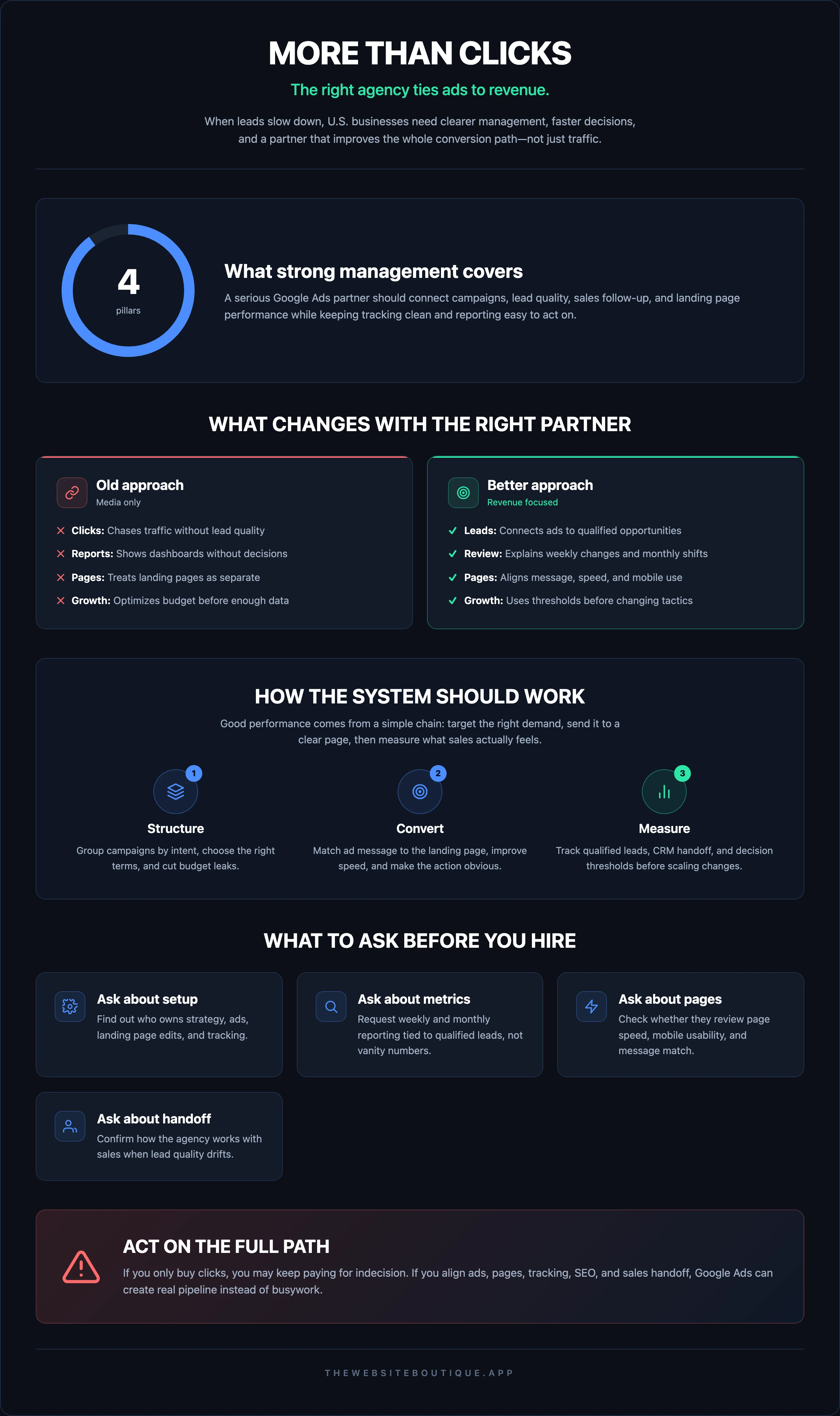
A serious Google Ads agency for U.S. businesses is not only bidding on keywords and checking whether cost per click went up. It should decide how campaigns are grouped, what search terms are worth paying for, how landing pages are aligned with intent, and where budget is leaking. If those pieces are handled separately, the account often looks active while performance quietly stalls.
The daily work also includes tracking. If conversions are not set up correctly, you can end up optimizing for the wrong signal: form opens instead of qualified leads, calls that never connected, or duplicated conversions that inflate results. For that reason, it helps to review how the agency handles Google Ads conversion tracking, CRM handoff, and attribution before any campaign goes live. Google’s own Google Ads Help Center is useful if you want to compare the language they use with the standard platform terminology.
A capable team should also be comfortable saying when a request is not the right move. If your search terms are too broad, your landing page is too slow, or the offer is unclear, more budget can make the problem more expensive. That is where senior attention matters: not because the platform is mysterious, but because the decisions are easy to oversell.
Signs the fit is good before you sign
The first filter is not industry awards. It is whether the agency asks questions that map to your sales process. If they only ask for a monthly budget and a target cost per lead, they are likely working from templates. If they ask about sales cycle length, close rate, service margins, and the difference between a lead and a real opportunity, you are probably talking to someone who has done this before.
Look closely at how they talk about reporting. A reliable Google Ads agency for U.S. businesses should be able to tell you what you will see every week, what will be reviewed monthly, and which metrics are being used to make decisions. If the report is only a dashboard full of numbers, you will still need to interpret the data yourself.
A useful sign is how they handle the landing page conversation. Strong paid search teams usually care about page speed, message match, mobile usability, and the first form field as much as they care about keyword match types. If they offer fast websites built to convert, that can be a practical advantage because the campaign and the page can be improved together rather than treated as separate problems. If the site loads slowly, Google’s PageSpeed Insights can help you identify obvious friction before traffic gets expensive.
Questions that expose real experience
- How do you decide whether to use Search, Performance Max, or a narrower campaign setup?
- What do you consider a qualified lead for our type of business?
- How often do you change bids, budgets, or match types?
- What happens if conversion volume is too low for clean optimization?
- How do you work with sales when lead quality starts to drift?
These questions matter because they show whether the agency manages the account as a growth system or as a media-buying exercise. A team that can answer them clearly usually understands the operational side of the work too. That is where a Google Ads agency for U.S. businesses earns trust: by connecting traffic to outcomes that your team actually feels.
How Google Ads and landing pages should work together
People often look at the ad first, but the page usually decides whether the visit becomes a lead. If the message in the ad says one thing and the page says another, the user hesitates. That pause is costly, especially when the search intent is strong and the visitor is ready to compare options.
For service businesses, the page should reduce uncertainty quickly. The headline needs to match the search term, the offer must be obvious, and the call to action should be easy to spot on mobile. A Google Ads agency for U.S. businesses should push for this alignment instead of assuming that better bidding can solve a weak page.
This is also where operational timing matters. If your team works in the same time zone as the agency, it becomes much easier to approve changes, review search terms, and update landing pages without waiting a full day for feedback. The Website Boutique positions itself around that operating rhythm, which can matter more than people expect when campaigns need quick adjustments. You can compare how they explain that approach on their About page and in their Clients section.
One useful rule: if the page cannot answer the visitor’s likely objections in under a minute, the ad account will keep paying for indecision. That does not mean longer pages are bad. It means the page has to earn its length with clarity.
Common mistakes that waste budget
The most expensive mistakes are often simple. Broad targeting without a strong negative keyword list can fill the account with searches that sound relevant but never convert. Bidding on too many services at once can also blur the data, especially when each service has a different sales process.
Another common issue is optimizing too early. If the agency changes too many variables before there is enough conversion data, it becomes hard to know what actually worked. That can lead to a cycle of false confidence: every week looks active, but no one can explain why the results changed.
A Google Ads agency for U.S. businesses should also care about search visibility beyond ads. When people research a service, they often compare ad results with organic results, reviews, and AI-generated recommendations. That is why Google Ads, SEO, and AI search visibility increasingly belong in the same conversation. Google Search Central’s SEO Starter Guide is a good baseline if you want to separate timeless fundamentals from tactics that will change next quarter.
There is also a reporting mistake that shows up often: celebrating low cost per lead without checking whether those leads are worth pursuing. A cheap contact form can be a sign of strong targeting, but it can also be a sign that the campaign is attracting unqualified traffic. If sales keeps rejecting the same lead types, the account is not really performing.
When AI search and Google Ads should be planned together
A lot of teams still treat paid search and AI visibility as separate projects. That division makes less sense now. People ask search engines, chat tools, and assistants for recommendations in the same buying journey, and your brand has to be understandable in each of those places.
If your agency only talks about keyword bids and never touches how your business appears in AI-assisted discovery, they may be missing part of the demand already in motion. A Google Ads agency for U.S. businesses should at least think about the relationship between landing page content, structured information, and the language buyers use when they compare vendors. That does not mean chasing every new platform. It means building a presence that can be read clearly by people and systems.
For companies that rely on trust, this is especially relevant. When the buyer is comparing service providers, the ad may start the conversation, but the rest of the web presence usually shapes confidence. That is why some teams pair Google Ads with SEO, content, and fast websites rather than trying to force paid media to do everything alone.
If you want a broader view of how this fits into a sales motion, lead generation services can be a better reference point than “ads management” as a label. It frames the work around the full path from visit to opportunity.
Practical questions to ask before you choose
Before you hire, ask the questions that reveal how the team thinks when things get messy.
Ask about the operating model
Will you have a dedicated strategist or a rotating account manager? How often are campaign changes reviewed? Who writes the ads, who approves landing page edits, and who owns the tracking setup? The answers matter because paid media projects often fail at the handoff, not in the platform itself.
Ask about the first 30 days
A solid Google Ads agency for U.S. businesses should be able to explain what happens first: audit, tracking cleanup, keyword research, creative review, page recommendations, or account restructuring. If the answer is vague, the setup phase may already be undercooked.
Ask about measurement
The real question is not whether they use Google Analytics or call tracking. It is whether the agency knows how to separate signal from noise. A lead-generation business may need offline conversion imports, CRM feedback, or tighter qualification rules. Google’s Analytics Help can be useful for checking whether the tools they mention are standard or merely decorative.
Ask about decision thresholds
What has to happen before they pause a search term, shift budget, or rewrite a page? Good managers use thresholds, not moods. That discipline matters because small changes compound, and random adjustments make it harder to learn.
If you are comparing partners, an agency like The Website Boutique may be worth reviewing when you want senior attention, same-time-zone collaboration, and a broader growth stack that includes ads, SEO, fast websites, and AI search visibility. The point is not to buy every service at once. It is to avoid piecing together a system that no one actually owns.
FAQs about choosing a Google Ads partner
How much involvement should I expect from the agency?
Enough to keep the account moving without turning every small change into a bottleneck. You should still approve major messaging or budget shifts, but you should not need to micromanage routine optimization.
Should I hire an agency if my ads already run in-house?
Yes, if the team is stretched thin, conversion quality is uneven, or the account needs a fresh structure. An outside team can often spot tracking gaps, wasted spend, and landing page issues that internal teams stop noticing.
Do I need SEO if I already use Google Ads?
Usually, yes. Ads capture demand quickly, but SEO and AI search visibility help you show up when buyers research more deeply. The combination tends to be stronger than paid media alone.
What is a red flag in the first meeting?
Any promise that sounds automatic: guaranteed rankings, instant lead volume, or a fixed result without asking about your sales process. If they skip the details, they are probably skipping the hard part of the work too.
How do I know if the leads are good?
Look at what sales says, not just what the dashboard says. If the team keeps rejecting the same lead type, or if conversion to opportunity is weak, the account may need better targeting, better qualification, or a better page.
Can Google Ads work for a smaller U.S. company?
Yes, if the offer is clear and the tracking is tight. Smaller budgets usually need better focus, not louder spending.
If your team is deciding whether to keep the current setup or rebuild it properly, talk with The Website Boutique about the account, the landing pages, and the sales handoff together. That conversation is usually the fastest way to see whether your Google Ads work is creating real pipeline or just activity. If you want to explore how that would look for your business, start with the pricing page or review the free resources before you commit to the next round of spend.