

Learn how to appear on google through SEO
August 13, 2026 · 12 min read
How to appear on google and earn visibility
Google has two jobs that matter for your business: it has to understand what a page is about, and it has to decide whether that page is useful enough to show. If either piece is unclear, the page may get crawled and still fail to rank for anything meaningful.
That is why people who ask how to appear on Google often get stuck on keywords alone. Keywords matter, but they sit inside a larger system: crawlability, content relevance, internal linking, authority, user satisfaction, and freshness where it matters. If you are building a site from scratch, a fast and clean structure helps a lot; if you already have one, the first task is to remove friction.
For the mechanics, Google’s own Search Central documentation is the safest place to verify how crawling, indexing, and structured data work. If your pages are blocked, duplicated, or buried, no amount of copywriting will fix that.
The three signals that usually decide the outcome
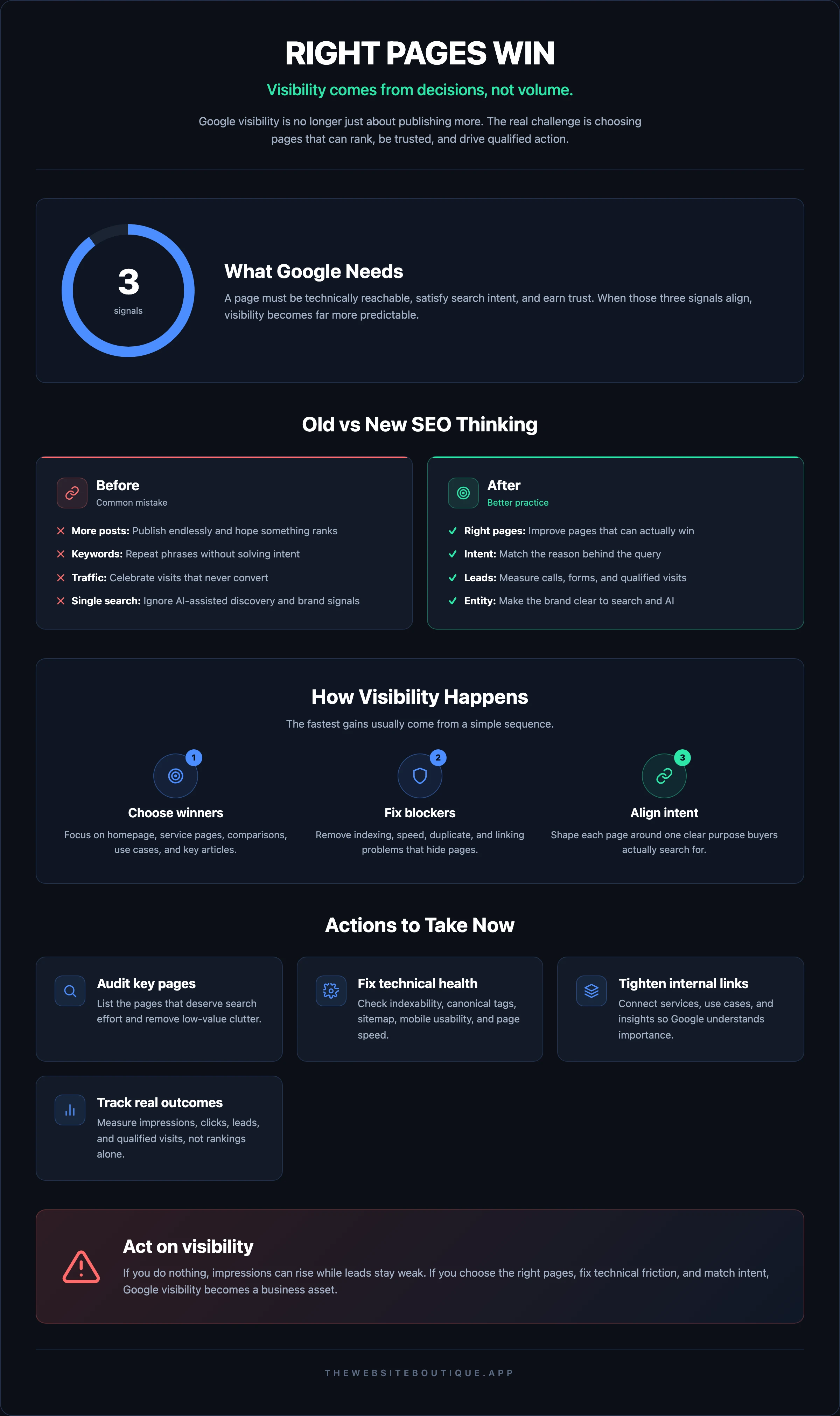
First, the page has to be indexable and technically reachable. Second, it has to satisfy a specific search intent better than competing pages. Third, it needs enough trust signals for Google to take it seriously, especially when the topic is competitive or commercial.
When those three align, visibility becomes much more predictable. When they do not, people keep asking how to appear on Google while the site keeps producing weak impressions and low-quality clicks.
Start with the pages that can actually win
A lot of websites try to rank every page, and that is a mistake. Some pages are meant to convert, some are meant to educate, and some should exist only if they serve a clear business purpose. The first smart decision is to identify which pages deserve search effort.
For most service businesses, the pages that can win first are the homepage, core service pages, comparison pages, use-case pages, and a few highly relevant articles that answer buyer questions. If you need a clearer way to organize the website around intent, the structure used in Use Cases is a useful reference point for thinking in terms of problems, not just services.
If your site is broad but thin, your priority is not to publish more. It is to make the existing important pages sharper, more specific, and easier to connect with each other. That usually produces better results than adding ten blog posts that nobody would choose during a buying decision.
A useful test for every page
Ask three questions:
- Would a real buyer search for this page?
- Can this page answer the query better than a generic article?
- Does the page support a business action, such as a call, form, or demo request?
If the answer is no to all three, the page may not deserve your time yet. If the answer is yes to one or two, that page might be worth improving before you create anything new.
This is one of the simplest ways to approach how to appear on Google without wasting budget: focus on pages that can convert after they rank, not only pages that can attract impressions.
Fix the technical issues that quietly block rankings
Technical SEO is often ignored because it does not look like marketing. Yet a site can have strong messaging and still fail because it loads too slowly, wastes crawl budget, or confuses search engines with duplicate versions of the same page.
Start with the basics: indexability, canonical tags, XML sitemap, robots directives, redirect chains, mobile usability, and page speed. If the site is slow, a redesign may be more valuable than another round of content edits. For speed-sensitive builds, Google PageSpeed Insights is a practical way to see where the problem lives, especially on mobile.
If you are working with a team that builds sites for performance, a page launch should feel like a measurement project, not just a design handoff. That is why services like fast websites matter when the current site is making every acquisition channel more expensive than it should be.
Watch for these invisible blockers
- Pages that are live but not indexed
- Duplicate title tags across service pages
- Missing or weak internal links to important pages
- Thin template pages that all say the same thing
- Heavy scripts that slow down mobile rendering
None of these problems is dramatic on its own. Together, they can make how to appear on Google feel harder than it should be.
Match the search intent behind the query
You do not rank because a page mentions a phrase often enough. You rank because the page solves the reason the person searched in the first place. That sounds obvious, but many service websites still publish content that answers the wrong version of the question.
Someone searching for “how to appear on Google” may want a practical checklist, but they may also want to know whether they need SEO, ads, a better website, or all three. If your page jumps straight into generic theory, it loses them. If it talks only about tactics without showing decision paths, it also loses them.
The strongest pages make the next step clear. For a business evaluating growth channels, that may mean a direct path to SEO + AI Search (GEO), where traditional search visibility and AI-assisted discovery are handled together. That matters because search behavior is no longer limited to classic blue links.
Build the page around one dominant intent
A page should usually have one main purpose. If it tries to explain SEO, pitch services, educate on brand, and sell every offering at once, it becomes harder to rank and harder to convert.
A good service page might target a commercial intent. A good blog article might target a learning intent. A good use-case page might target a problem-solution intent. Mixing all three on one page usually creates a weaker result than splitting them into focused assets.
If you are unsure, look at what already ranks. Search the phrase, study the dominant format, and ask whether your page can genuinely improve on it. That is a more honest path to how to appear on Google than guessing what the algorithm wants.
Make Google and AI systems understand your brand
Search is getting broader. People still use Google, but they also ask AI tools for recommendations, comparisons, and shortlists. If your site has no clear entity signals, these systems may overlook you even when the content is decent.
This is where brand consistency matters: the same business name, the same core services, the same location cues when relevant, and a coherent network of pages that reinforce each other. Your site should not look like five separate companies glued together. It should look like one clear operation with a definable offer.
For teams that want to be visible in both search engines and AI search surfaces, Get found with SEO + AI Search (GEO) is the cleanest way to think about the problem. It is not about chasing buzzwords; it is about making your expertise legible to machines and humans at the same time.
For a broader industry perspective on how AI search assistants surface information, I am Eva is a useful example of the kind of product ecosystem that is influencing discovery habits.
Practical signals that help
- A clear About page with real company positioning
- Service pages that use consistent terminology
- Structured data where appropriate
- Strong internal linking between services, use cases, and insights
- External mentions or citations that confirm the brand exists and does what it says
If you are serious about how to appear on Google now, think beyond keywords. People will still discover you through search, but the way you are interpreted by Google, AI answers, and referral pages is becoming more connected every month.
Content that deserves to rank
Content works when it reduces uncertainty. If a buyer is wondering whether your company can handle lead generation, website performance, or search visibility, the content has to make the next decision easier—not louder.
The best articles are built from real questions sales teams hear every week. The second-best are based on objections, comparisons, and implementation choices. The worst are generic definitions with no edge, no audience, and no point of view.
This is why strong content strategy often includes a mix of service pages, educational articles, and proof pages. If you need to see how that looks in a business context, the Insights section is the kind of library that should answer buying questions without drifting into filler.
What good content usually does
It names the problem clearly. It explains the tradeoffs. It helps the reader decide what to do next. If the next step is not obvious, the content usually remains informational traffic with little business value.
That distinction matters because many people asking how to appear on Google actually need two different wins: visibility and conversion. Traffic without action is not the goal. Pages that rank and move people toward a call or form are the pages worth keeping.
The measurement that tells you whether it is working
Rankings can mislead you. A page can move up for the wrong term, bring in unqualified visits, or produce surface-level traffic that never turns into business. If you only watch positions, you miss whether the site is helping revenue.
Use Search Console to monitor queries, impressions, clicks, and indexed pages. Use analytics to see what happens after the click. Look at how visitors move to pricing, contact, service, or case study pages. If the site is truly improving, the path from discovery to action becomes shorter and clearer.
If you are trying to connect search work to sales, lead generation is the right frame. Search visibility should support a system that captures interest, qualifies it, and routes it to the right next step.
Signs the strategy is on the right track
- More impressions on relevant commercial queries
- Better click-through rates on pages with clearer titles and descriptions
- Longer dwell time on important pages
- More visits to pricing, contact, or service pages
- Better lead quality from organic traffic
If those signals are not moving, the issue may be intent, content depth, page experience, or the offer itself. That is why asking how to appear on Google should always lead to a broader decision: do you need to tune the site, or do you need to rethink how the business is presented online?
When it makes sense to get outside help
Some teams can handle the basics internally. Others need help because the site is already large, the offer is complex, or the team is too close to the product to see what users need. Outside help is most valuable when it brings judgment, not just task execution.
A senior team that works in your time zone can spot the difference between a ranking issue and a messaging issue faster than a checklist can. That matters when you need faster decisions across ads, website changes, and search visibility. If you want a broader look at how a growth team can support those decisions, The Website Boutique explains the service model clearly, and Pricing helps you evaluate fit without guesswork.
The right partner should not promise magic. It should help you choose what to fix first, what to ignore for now, and where search visibility is being blocked by the business itself.
What to ask before you hire
- Which pages would you improve first, and why?
- How will you measure success beyond rankings?
- What technical issues are most likely suppressing visibility?
- How will SEO connect to conversions and lead quality?
- How will you adapt for AI search as well as Google?
Those questions quickly separate real operators from slide decks. They also keep the conversation focused on outcomes instead of vanity metrics.
Frequently asked questions
How long does it take to appear on Google?
It depends on whether you mean being indexed or ranking for a competitive term. Indexing can happen quickly, but meaningful visibility usually takes time because Google needs to understand the page, compare it against alternatives, and trust the site.
Do I need blog content to rank?
Not always. Some businesses need stronger service pages, better internal linking, or a faster website before content becomes useful. Blog content helps when it targets real questions and supports the buyer journey.
Is local SEO required for every business?
No. Local SEO matters when customers search with location intent or when proximity affects buying decisions. If your business serves the United States broadly and not just one city, the strategy should be broader than local signals alone.
Can AI search improve my visibility on Google too?
Yes, indirectly. Clear structure, authoritative content, and strong entity signals help both classic search engines and AI systems understand your site. A page built for one often performs better in the other.
What is the biggest mistake people make?
They publish more before fixing the site architecture, indexing, or page intent. That usually creates more content to maintain without solving the visibility problem.
Should I focus on SEO or ads first?
It depends on timing and budget. Ads can create immediate demand, while SEO builds durable visibility. Many businesses need both, especially when the website is not yet converting well.
If you want a practical path from problem to visibility, start with the pages that can win, then fix the technical blockers, and then build content that answers buying questions clearly. If your current site is slowing that process down, Get a site that converts and align it with the same search strategy so the traffic you earn has somewhere better to go.
If you want help deciding what to fix first, The Website Boutique can review your site, identify the pages worth improving, and map the fastest route to stronger organic and AI search visibility. The next move is not to post more content; it is to make the right pages impossible to miss.