
Google Ads agency for businesses in the United States
August 15, 2026 · 11 min read
When a campaign is spending fast but the pipeline feels thin, the problem is often not Google Ads itself. It is usually the agency managing the account, the handoff between ads and sales, or the lack of a clear operating standard. Choosing the right Google Ads agency for businesses in the United States can decide whether your budget buys qualified leads or just expensive clicks.
- Look for proof of thinking, not just screenshots.
- Make sure the team understands lead quality, not only traffic and CTR.
- Ask how they handle landing pages, conversion tracking, and follow-up.
- Pay attention to who actually works on the account and in what timezone.
- Avoid agencies that promise easy wins without showing the process behind them.
What a Google Ads agency should actually do for a U.S. business
A serious agency should be able to explain how it will connect search intent, ad messaging, landing page experience, and conversion tracking. If the conversation stays at the level of “we’ll run your campaigns” or “we optimize weekly,” you are still missing the real operating model.
For many companies, the hardest part is not setting up a campaign. It is deciding which services, locations, audiences, and search terms deserve budget. A competent team should push back when the offer is too broad, the landing page is too generic, or the lead form asks too much too early. That kind of judgment matters more than polished reporting.
A good fit also understands the daily reality of a U.S. business: speed, responsiveness, and time alignment. If your team works East Coast hours and your agency replies the next day from another time zone, small issues linger and ad spend keeps flowing while decisions wait.
How to evaluate a Google Ads agency for businesses in the United States
Start with the work, not the presentation. Ask how they audit accounts, what they look at in search terms, how they separate brand from non-brand demand, and what they do when conversions drop but clicks stay steady. A team that knows the platform will have specific answers, not generic promises.
A reliable agency should also explain the relationship between paid search and the rest of the funnel. If they cannot speak clearly about landing pages, CRM handoff, or the difference between a form fill and a qualified lead, they may be optimizing the wrong metric. Google’s own Google Ads Help and Google Ads documentation are useful references when you want to verify whether a proposed tactic is aligned with the platform’s current structure and measurement model.
Questions that reveal real capability
Ask these directly:
- How do you define a qualified lead for our business?
- What would you change first in the account, and why?
- How do you test ad copy against landing page intent?
- What conversion actions do you trust, and which do you ignore?
- Who will actually manage the account day to day?
The best answer is not the longest answer. It is the one that shows the agency understands tradeoffs. For example, a team may recommend fewer keywords, tighter geographic settings, or a narrower service page because that improves relevance. That can feel conservative, but it often saves money and makes reporting cleaner.
If you want a sense of how a team thinks beyond media buying, review their Use Cases and Clients pages. You are not looking for a trophy wall. You are looking for patterns: what kinds of businesses they serve, how they talk about outcomes, and whether the work looks operationally mature.
Red flags that cost U.S. businesses money
A common warning sign is the agency that starts with ad spend before it understands the offer. If they ask for budget numbers before they can explain structure, tracking, and landing page logic, they may be selling media management rather than growth.
The next red flag is vague reporting. If monthly updates are just impressions, clicks, and spend, you are not getting a management system; you are getting a dashboard. For a Google Ads agency, the real question is whether the numbers connect to pipeline movement, lead quality, and sales follow-up.
Watch for these habits:
- They avoid discussing negative keywords, search term cleanup, or match type discipline.
- They treat all conversions as equal.
- They do not mention landing page speed or message match.
- They promise results without discussing risk.
- They talk about “optimization” but never show what gets changed.
There is another quiet red flag: a team that is brilliant in ads but disconnected from the rest of your digital presence. If the website loads slowly, the brand is unclear, or search visibility is weak, ads will carry more weight than they should. A better partner will be comfortable working alongside SEO, site improvement, and even AI search visibility. For that broader picture, The Website Boutique’s SEO + AI Search (GEO) service is a good example of how paid and organic growth can support each other instead of competing for budget and attention.
The agency model that fits your stage of growth
Not every company needs the same type of support. A local service business with a narrow geography needs different management than a multi-state B2B company with long sales cycles. The wrong agency fit usually shows up when the partner applies the same playbook to every account.
If you already have demand but conversion is weak, the agency should focus on message match, landing page clarity, and lead qualification. If you do not have enough demand, then the work shifts toward account structure, keyword expansion, and offer testing. If your internal team is thin, the best partner is often the one that can handle ads, creative, landing pages, and follow-up coordination without making you manage five vendors.
That is where a Google Ads agency for businesses in the United States can create more value than a freelancer or a purely tactical buyer. The right team can connect paid media to landing page speed, sales process, and search presence. If you are comparing that model to a narrower specialist, Nika Media is one example of a U.S.-focused agency many teams may review alongside others during evaluation.
When full-service matters and when it does not
Full-service support helps when the business has one or more of these conditions:
- The website is slow or hard to trust.
- The offer needs clarification.
- Sales follow-up is inconsistent.
- Lead quality matters more than raw volume.
- Internal marketing capacity is limited.
If those issues do not exist, a more focused ads partner can still work well. The mistake is buying a big promise when the real bottleneck is only one part of the funnel. If your team is also considering a faster site rebuild, Fast websites can be worth reviewing before you scale ad traffic into a page that loses users too early.
What to ask about tracking, landing pages, and lead quality
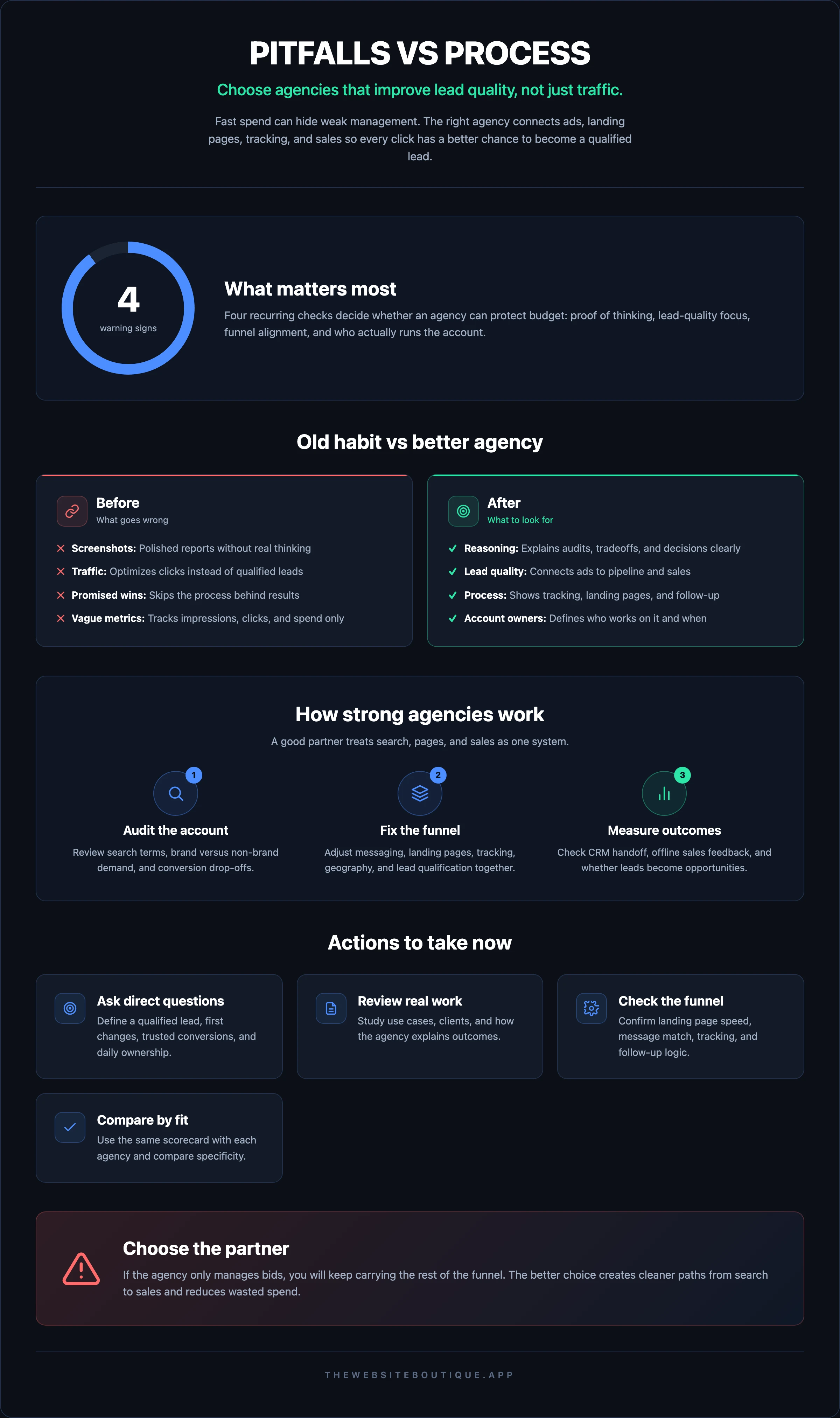
Before you sign anything, ask how the agency measures success beyond the platform. A good answer should include attribution limits, CRM visibility, and how the team checks whether leads turn into opportunities. If they only talk about platform conversions, they may be blind to the difference between form submissions and actual business value.
A solid Google Ads agency for businesses in the United States should also be able to talk about landing page testing with enough specificity to be useful. That means page structure, headline relevance, CTA placement, mobile performance, and the role of trust signals. If the agency cannot influence the page or at least flag problems clearly, they are leaving performance to chance.
Tracking deserves more scrutiny than many buyers give it. Confirm what counts as a conversion, how duplicate leads are handled, whether phone calls are tracked, and how offline sales feedback reaches the media team. Google’s Analytics platform and Google Tag Manager are useful tools for understanding the mechanics, but the main question is whether the agency can design a measurement system your sales process can actually use.
A useful test before you hire
Ask the agency to walk through a recent campaign decision from start to finish. A credible team should explain why they changed the keyword mix, what they learned from search terms, how they adjusted ad messaging, and whether landing page changes affected lead quality. If the explanation stays abstract, the account may be managed on autopilot.
You can also ask what they would do in the first 30 days if conversions stalled. The answer should include both diagnostic steps and operational changes. For example, they might review query data, check form friction, tighten geography, or change the offer hierarchy. That is the sort of practical thinking you want in a partner.
Common mistakes businesses make when hiring
The biggest mistake is hiring the cheapest option and then expecting strategic leadership. Low monthly fees often lead to shallow management, limited testing, and slow response times. By the time you realize the account is drifting, the real cost is not the retainer; it is the wasted spend and lost opportunities.
Another mistake is assuming an agency will fix an unclear offer. If your message is vague, your qualification criteria are loose, or your sales process is inconsistent, media buying alone will not solve it. The better agencies say this out loud. The weaker ones keep the conversation on impressions because impressions are easy to show.
Many businesses also underestimate how much speed matters. If your pages take too long to load, if forms feel clunky, or if your branding creates doubt, you are paying for traffic that leaves before it engages. That is why teams like The Website Boutique often connect paid media with site improvement, SEO, and conversion design rather than treating them as isolated services. If you want a deeper look at that operating style, their About page explains how the team works and why time-zone alignment can matter so much when campaigns need fast decisions.
How to compare agencies without getting trapped by sales talk
Comparing agencies gets easier when you use the same lens for each one. Ask for the same inputs, request the same type of audit, and listen for differences in specificity. You are trying to identify who understands your business model, not who can produce the nicest proposal.
Use a simple scorecard:
- Do they explain strategy in plain language?
- Do they understand your sales process?
- Can they connect ads to the website and CRM?
- Do they show judgment, not just activity?
- Are they clear about who does the work?
If two agencies sound similar, ask how they would approach your account differently in month one. That question quickly separates operational thinking from sales language. It also reveals whether the team has handled your type of business before or is learning on your budget.
For companies that want ads, SEO, and conversion support in one place, Lead generation with Meta & Google Ads is a useful reference for the kind of end-to-end work that reduces handoff friction. If your team needs a broader digital partner, Insights, Free Resources, and Glossary can help you pressure-test the language agencies use before you commit.
Frequently asked questions
How do I know if a Google Ads agency is a good fit for my business?
A good fit shows up in the questions they ask. They should understand your offer, your sales cycle, and what a qualified lead means for your team. If they only talk about clicks and traffic, they are probably not thinking beyond the platform.
Should I choose a specialist or a full-service agency?
Choose based on the real bottleneck. If only media buying is missing, a specialist can work well. If the website, tracking, follow-up, and search visibility also need attention, a broader partner is often more effective.
What should I expect in the first 30 days?
Expect an audit, tracking review, search term analysis, and a plan for testing or restructuring. If the agency does not mention landing pages, conversion quality, or search intent, the first month may become busy without becoming useful.
How important is website speed for Google Ads performance?
Very important. Slow pages increase friction and can reduce the value of every click you buy. If the site is part of the problem, fixing ads alone usually leaves money on the table.
Why does time-zone alignment matter so much?
Because campaigns often need quick decisions. A team that works in your business hours can respond to search term issues, budget shifts, and landing page problems before they compound.
The right Google Ads agency for businesses in the United States should make your media, website, and lead flow work like one system. If your current vendor only manages bids, you are likely carrying the rest of the funnel yourself.
If you want a partner that can handle Google Ads, landing pages, SEO, and AI search visibility with a senior team in your time zone, explore Pricing and Get leads, or start with the homepage at The Website Boutique. The next campaign should not just spend; it should create a cleaner path from search to sales.