
Google Ads agency for US businesses that drives growth
August 10, 2026 · 11 min read
If your ads are getting clicks but not enough qualified leads, the problem is rarely just the budget. More often, it is the Google Ads agency for US businesses you chose, the way they set expectations, or the gap between strategy and execution.
A lot of business owners only notice the issue after a few expensive months: reports look busy, the account has activity, but sales are flat. That is usually when the real question appears: who can actually manage Google Ads for a U.S. company with discipline, speed, and accountability?
Key points
- The right agency should understand your sales process, not just keywords and bidding.
- Ask how they handle tracking, landing pages, and lead quality before discussing monthly spend.
- A strong Google Ads agency for US businesses will explain tradeoffs clearly and avoid vague promises.
- Time zone alignment matters when your campaigns need quick changes, approvals, or landing page fixes.
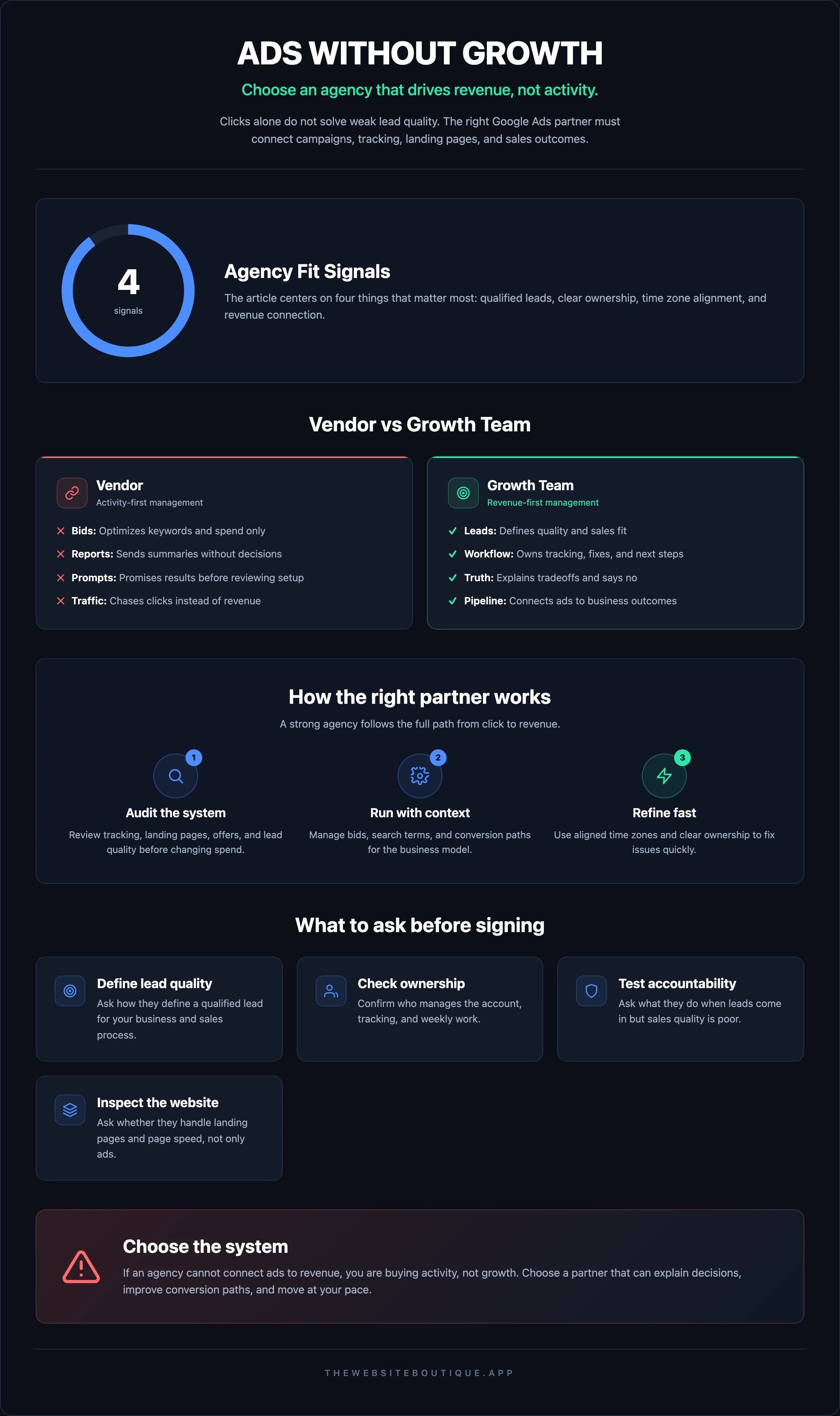
- If your agency cannot connect ads to revenue, you are buying activity, not growth.
What a Google Ads agency for US businesses should actually do
The easiest mistake is assuming all agencies do the same thing. They do not. Some manage bids and search terms, then hand you a report. Others work like a growth team: they inspect tracking, tighten conversion paths, test landing pages, and keep the campaign tied to pipeline quality.
A reliable partner should be able to explain where leads come from, what happens after the click, and how they decide whether a campaign is healthy. If they only talk about impressions, CTR, or “more traffic,” they are probably optimizing for the wrong layer of the funnel.
That matters because Google Ads can produce very different outcomes depending on the business model. A local service company, a B2B firm with a long sales cycle, and an e-commerce brand all need different account structures, different conversion definitions, and different levels of landing page support. A team that treats them the same usually gives you generic performance.
If you want a clearer picture of what a broader growth partner can cover, The Website Boutique’s approach to lead generation shows how paid media, landing pages, and conversion work together rather than as isolated tasks.
Questions to ask before you sign anything
Most sales calls sound confident. The useful ones are the ones that force specifics. A good agency should answer without hiding behind jargon or “we’ll optimize as we go.”
Start with the basics, but do not stop there:
- How do you define a qualified lead for my business?
- Who owns the account and who actually works in it every week?
- What do you need from my team to launch tracking properly?
- How do you react when leads are coming in but sales quality is poor?
- What changes do you make beyond bids and keywords?
- How often will I see campaign decisions, not just reporting summaries?
These questions expose whether the team has a working system or just a process for monthly check-ins. A serious agency should talk about conversion tracking, search intent, landing page friction, negative keywords, and call handling without making that sound unusually advanced. It is the minimum.
One useful test is to ask them how they would approach your account if the current campaigns were already generating traffic but not revenue. A weak partner will jump straight to more spend. A better one will ask about page speed, offer clarity, lead routing, and whether the forms or calls are being qualified properly.
If you need a deeper look at how paid media setups are packaged and scoped, The Website Boutique pricing can help you compare models without guessing what is included.
Signs the agency is thinking like a vendor, not a growth team
There are warning signs that show up early, often before the contract is signed. One is a proposal that leads with deliverables instead of decisions. If the pitch focuses on a number of campaigns, number of ads, or number of monthly reports, ask what business problem those items solve.
Another red flag is vague ownership. If you cannot tell who will manage the account, who will fix tracking issues, and who will make creative or landing page recommendations, you are likely buying a thin layer of communication over a disconnected workflow. That becomes painful the moment something breaks.
Watch for agencies that are allergic to hard questions about attribution. Many companies in the United States use multiple channels, sales reps, and follow-up steps. If the agency cannot explain how it will distinguish a marketing lead from a real opportunity, they may not be ready for a serious pipeline conversation.
A few more signals should make you pause:
- They promise a result before reviewing your offer, website, or tracking.
- They talk about “secret hacks” instead of account structure and testing.
- They avoid discussing what happens after a lead is captured.
- They cannot explain how they handle branded search versus non-branded demand.
- They are unwilling to say no to a bad idea.
That last point matters more than it sounds. Good agencies protect your spend by challenging weak assumptions. If a landing page is confusing, if your offer is too broad, or if your follow-up is too slow, a competent team should say it plainly.
Tracking, landing pages, and speed are part of the Google Ads decision
Many buyers think they are hiring for ads, when what they really need is a system that converts traffic into revenue. That system starts before the ad and continues after the click.
If tracking is incomplete, you cannot tell which campaigns produce useful leads. If the landing page is slow or unclear, you pay for traffic that exits before acting. If the form or call process is clunky, your cost per opportunity rises even when click prices look stable. That is why a high-performing partner should care about the page itself, not just the account dashboard.
This is also where time zone alignment becomes practical. A campaign can need urgent changes if a landing page breaks, a conversion tag stops firing, or a high-intent search term starts producing bad leads. Working with a team that shares your working hours reduces the delay between spotting the problem and fixing it. That delay is often expensive.
Page speed deserves special attention. Fast-loading websites usually give you more room to spend efficiently because they remove friction at the moment of intent. Google’s own Search Central documentation is a useful reference point if you want to understand how search visibility, page quality, and technical basics intersect. For tracking, Google Analytics help is worth checking when you need to verify event setup or conversion behavior.
If your current site is slowing down campaigns, the answer may not be a deeper bid strategy. It may be a better website. A partner that can also build conversion-focused pages is often easier to work with than a media buyer who sends you elsewhere for every fix. That is one reason businesses look at fast websites when the landing experience is part of the growth problem.
How to compare agencies without getting lost in presentations
Agency presentations are designed to sound complete. Your job is to separate polish from capability. The best comparison framework is simple: look at strategy, execution, visibility, and fit.
Strategy means they understand your market and sales motion. Execution means they can set up and manage the work without endless handoffs. Visibility means you know what is happening in the account, why it is happening, and what they changed. Fit means the team can move at your pace and communicate in a way your team actually uses.
When comparing a Google Ads agency for US businesses, ask them to walk through a real account workflow. What happens in week one? What gets reviewed first? What is the order of priorities if tracking is broken, search terms are messy, and the landing page is weak? A thoughtful team can explain the sequence without sounding scripted.
You should also look for restraint. Not every campaign needs a full rebuild on day one. Sometimes the best move is to clean up conversion measurement, isolate the highest-intent search terms, and remove wasted spend before expanding. Agencies that rush into broad changes often create noise and make it harder to learn.
If you want examples of how a senior team approaches different business models, The Website Boutique use cases can help you see how the work changes depending on the goal. That is more useful than a generic service list because it shows how the process adapts.
The role of SEO, AI search, and the rest of your marketing stack
Google Ads does not live alone anymore. People discover brands through search, AI answers, social proof, and website experience, often in the same buying journey. That is why your agency choice should not be trapped inside one channel.
A strong agency should be able to work alongside SEO, AI search visibility, and website improvements without treating those areas as someone else’s problem. If your organic presence is weak, if your pages are thin, or if your brand is hard to find in search, your paid campaigns usually have to work harder to earn trust.
That does not mean you need one team to do everything badly. It means your paid media partner should understand how the rest of the system affects conversion. Search demand, remarketing readiness, content clarity, and technical performance all shape what happens after the click. If the agency ignores those pieces, your acquisition cost can drift upward even when ads are technically “optimized.”
For companies that care about broader discoverability, SEO and AI search visibility is a useful reference. It reflects the reality that businesses are now being evaluated in more than one search environment, and your paid strategy gets stronger when the rest of the web presence is coherent.
This is also why it helps to work with a partner like The Website Boutique only if you need more than campaign management. The value is not “we run ads.” The value is that media, conversion, website speed, and search visibility can be handled with one senior team that understands the business context.
What a healthy working relationship looks like after launch
Once the campaign goes live, the real work starts. A good agency relationship should feel clear, calm, and specific. You should know what changed, why it changed, and what signal will determine the next move.
You do not need daily noise, but you do need a rhythm. That rhythm usually includes ongoing search term review, conversion quality checks, landing page feedback, and adjustments based on what sales says is actually valuable. If the agency waits until the monthly report to notice problems, the setup is too slow.
A healthy agency will also make it easy to understand tradeoffs. If you want more volume, they should explain what may happen to quality. If you want tighter leads, they should explain what traffic gets excluded. If you want a new campaign structure, they should tell you what data you may lose or distort during the transition.
That kind of communication is what separates a service provider from a growth partner. It is also why reviewing real team credibility matters. Pages like The Website Boutique clients and The Website Boutique about are useful because they show who is behind the work, not just what is being sold.
If you are still collecting information before making a call, The Website Boutique insights and free resources can help your internal team ask better questions. That can save you from choosing too quickly based on a clean pitch deck.
Frequently asked questions
How do I know if I need a Google Ads agency or just a freelancer?
If your account is simple, your lead volume is small, and you only need basic management, a freelancer may be enough. If you need tracking, landing page coordination, faster turnaround, and account structure that supports a real sales process, a stronger team is usually the better fit.
What should a Google Ads agency report on besides spend and clicks?
It should report on lead quality, conversion rate, search term quality, landing page behavior, and what changes were made because of the data. If the report does not connect to business outcomes, it is incomplete.
Why does time zone alignment matter when choosing an agency?
Because ad accounts and landing pages often need fast decisions. If your team and the agency work in the same or a compatible time zone, fixes happen faster and problems do not sit unresolved until the next day.
Should the agency also handle landing pages and website speed?
If your campaigns depend on conversion performance, yes, or at least they should be able to guide those changes. An agency that ignores the website may still manage ads, but it will miss a major part of lead generation.
Is a full-service team always better than a specialist?
Not always. A specialist can be excellent if your site, tracking, and sales process are already strong. A full-service team makes more sense when your growth problem spans media, website, and conversion, which is common for many U.S. companies.
If you are comparing a Google Ads agency for US businesses and want a team that can also handle the website, search visibility, and lead conversion layer, talk to The Website Boutique. We work with U.S. businesses from the same time zone, keep the process senior and direct, and focus on the parts of growth that usually get ignored until they become expensive.
If your next step is to fix paid media without creating more internal work, start by reviewing your current funnel, not just your ads. A short conversation can reveal whether you need tighter management, a faster site, or a full lead generation system that finally connects clicks to revenue.