
Choosing a Meta Ads agency for lead generation
August 18, 2026 · 13 min read
- A good agency should understand your sales process, not just your ad account.
- Lead quality matters more than cheap cost-per-lead if your team has to chase bad inquiries.
- Strong creative, landing pages, and tracking are part of the service, not optional extras.
- Ask how the agency handles testing, reporting, and handoff before you sign.
- The best fit is usually the team that can explain tradeoffs clearly and work at your pace.
How to Choose a Meta Ads Agency for Lead Generation
The pressure usually shows up after the first bad month. Leads are coming in, the dashboard looks busy, and sales still says the pipeline is thin. If you are comparing a Meta Ads agency for lead generation, that is the real problem to solve: not traffic, but qualified conversations that your team can actually turn into revenue.
The search can feel messy because every agency says it can “scale” campaigns. What matters is whether they know how to build demand for your offer, keep tracking clean, and adapt when the market stops responding to the same ad angle. That is where the difference between a media buyer and a real growth partner becomes obvious.
The first filter: Meta Ads agency for lead generation
A serious Meta Ads agency for lead generation should ask about your sales cycle before talking about audiences or creative. Do leads book directly, request a quote, or need a call from sales? Does one inquiry count as success, or do you care about qualified appointments and closed business? If the agency cannot talk through that path clearly, you will likely get media optimization that looks efficient and performs poorly.
The best agencies usually ask uncomfortable questions early. Who follows up on leads? How fast? What happens after the first call? Where do leads get lost? Those questions matter because Meta can produce demand, but it cannot fix a broken handoff. If the team you are evaluating skips that part and jumps straight to budgets, that is a warning sign.
You should also pay attention to how they talk about your offer. A competent partner will challenge vague positioning, weak lead magnets, and landing pages that ask for too much too soon. That may sound less exciting than “we will get you more leads,” but it is closer to how consistent pipeline is built.
Signs they understand lead generation, not just ad delivery
- They ask for access to your CRM or at least your lead stages.
- They discuss form quality, booking rate, and sales feedback.
- They mention landing page friction and follow-up speed without being prompted.
- They can explain when instant forms make sense and when a dedicated page is better.
- They are comfortable saying no to tactics that produce volume but hurt quality.
What the service should include, and what should worry you
A reliable Meta Ads agency for lead generation should not sell only “management.” For lead gen, the work usually spans strategy, creative direction, campaign structure, conversion tracking, and some level of landing page thinking. If one of those pieces is missing, the account may still spend money, but you will spend a lot of time guessing why results changed.
Creative deserves special attention. On Meta, performance often depends on whether the ad stops the right person, frames the pain correctly, and matches the stage of awareness. A team that treats creative as a one-off task tends to run out of good ideas quickly. A stronger team brings a repeatable process for testing hooks, offers, formats, and angles without turning the account into random experimentation.
Tracking is the other non-negotiable. If the agency cannot describe how they validate events, UTMs, CRM attribution, and conversion quality, you should slow down. Meta’s own business help center is useful for understanding how events and permissions work, and Google’s analytics help and product guidance can help you sanity-check measurement across channels. You do not need to become a tracker, but you do need enough visibility to know whether the numbers are trustworthy.
A good agency also understands the gap between lead volume and lead value. If your sales team says the forms are full of bad-fit names, the issue may be the offer, the targeting, the form friction, or the follow-up sequence. A mediocre provider will report the leads and move on. A better one will want to see what happened after the form fill.
When you speak with candidates, ask what they actually deliver each month. Do they only optimize media, or do they also review messaging, page conversion, and remarketing? Some businesses need a narrow buy-side operator. Others need a partner that touches the whole lead system, especially when the site or funnel is weak. If you need to improve both acquisition and conversion, fast websites built to convert may matter as much as the ads themselves.
How to judge their process before the contract is signed
The best predictor of the relationship is the process, not the pitch deck. A well-run Meta Ads agency for lead generation should be able to show how they move from audit to launch to testing to iteration. You are looking for structure, but not rigidity. Good operators know what they are testing and why, yet they do not pretend every account should behave the same way.
Ask how they build the first 30 days. Do they start with one offer or several? How many creative variations do they plan for launch? What is their rule for pausing underperforming ads? How often do they review lead quality with sales? These questions reveal whether the agency is using a real operating system or just reacting to daily fluctuations.
Reporting is another tell. If the agency only shows platform metrics, you are seeing a partial story. Ask for a sample report and look for plain language: what changed, why it changed, what they tested, and what they learned. Good reporting helps your team make decisions. Decorative reporting just fills a slide.
It also helps to check whether they are comfortable speaking about tradeoffs. Sometimes the cheapest leads are not the right leads. Sometimes better qualification means fewer conversions in the short term. Sometimes a narrower audience works better than broad targeting because the offer is specific. A useful agency does not hide those tradeoffs behind jargon.
You can also compare how different teams handle other services around lead gen. If they produce creative, build pages, or support SEO, ask whether those functions are managed in-house or outsourced. That matters because lead generation usually depends on coordination. For a broader view of how a team can connect ads, content, and site experience, browse The Website Boutique's use cases and client stories.
Mistakes that cost money when choosing the wrong partner
The most common mistake is hiring the agency that promises speed without asking enough about the lead source. Fast can be good, but speed without qualification often creates a queue of people who were never going to buy. If sales ends up filtering most of the pipeline manually, the campaign may have been profitable only on paper.
Another mistake is overvaluing industry familiarity while ignoring execution quality. A team may know your vertical and still run weak tests, reuse stale creative, or miss basic measurement issues. Familiarity helps, but only if it is paired with discipline.
A third mistake is treating the initial strategy call like a sales call for them instead of a diagnostic for you. Agencies can sound polished when they are presenting. What you need to hear is how they think when things do not go as planned. Ask for examples of what they change when lead quality drops, CPL rises, or one audience burns out.
Be cautious if the agency tries to avoid discussing ownership. Who owns ad accounts, pixels, and creative files? Who has admin access? Who can export the data if the relationship ends? These details are not administrative trivia. They protect your business from operational friction later.
If you want to benchmark process quality, it can help to review a mix of agencies and growth teams outside your immediate market. For instance, some firms like Nika Media publish a very direct service framing that makes it easy to see how they package paid media. Use that kind of reference as a comparison point, not as a template to copy blindly.
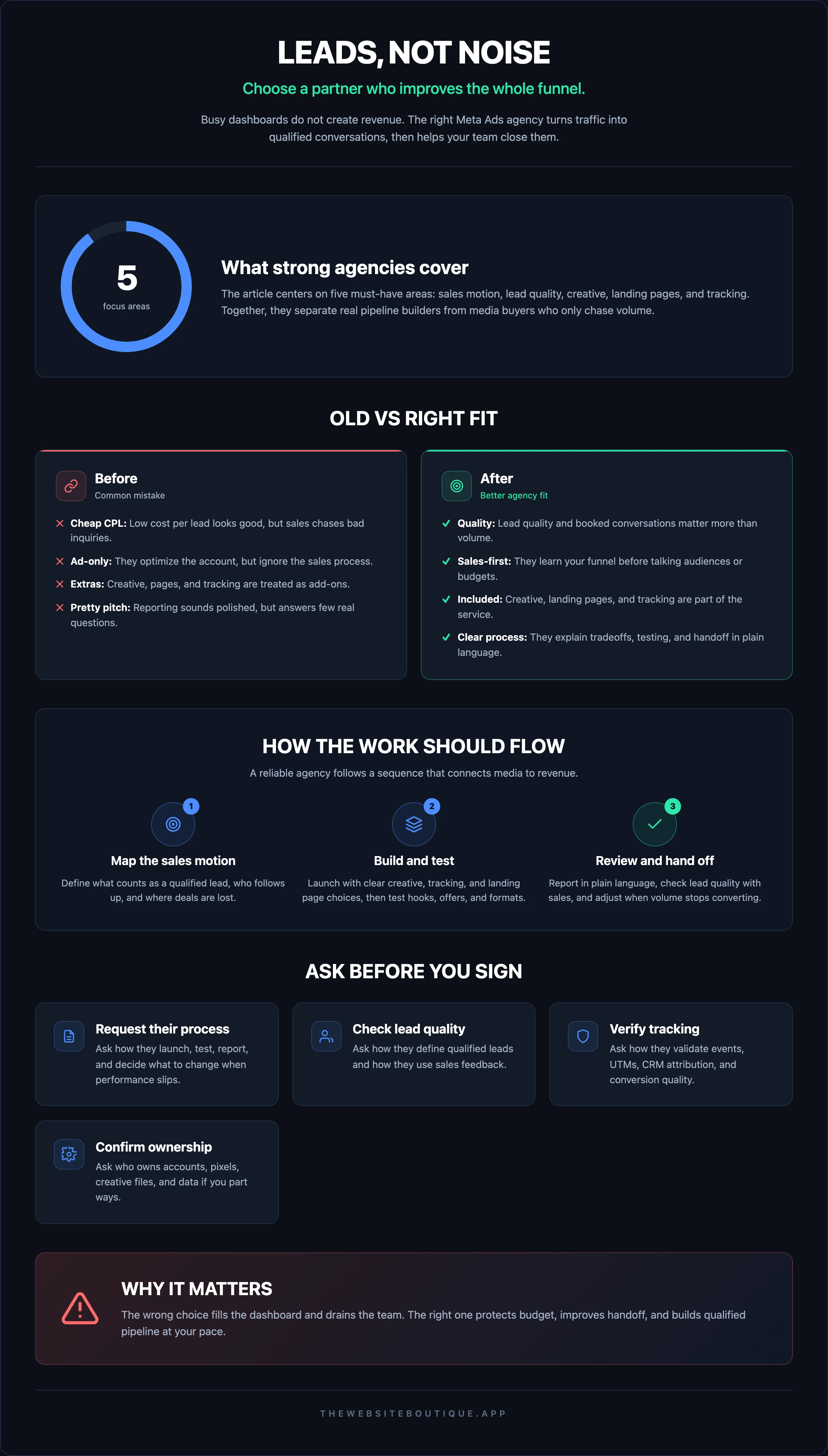
The questions that separate strong agencies from polished sales teams
When you are close to deciding, keep the conversation practical. A strong Meta Ads agency for lead generation should answer these questions without hiding behind broad promises:
- How do you define a qualified lead for this business?
- What will you test first if performance is weak?
- How do you decide between instant forms, landing pages, and hybrid flows?
- What do you need from sales to judge lead quality?
- How do you report on what happened after the lead came in?
- Who is responsible for creative iteration and how often does it change?
- What happens if the campaign starts generating volume but poor-fit prospects?
Listen carefully to the language they use. If everything sounds certain, fixed, and easy, you may be hearing a pitch rather than a process. The agencies that do this work well usually speak in probabilities, priorities, and tradeoffs. That is not a weakness. It is a sign they understand how channels behave when real budget is on the line.
You should also ask how they work with your other growth channels. Paid social does not exist in a vacuum. Search intent, site speed, brand trust, and retargeting all shape conversion. If you are also trying to appear in AI-driven discovery and organic search, it may be worth aligning with SEO and AI search visibility services so your paid and organic messages do not compete with each other.
A practical way to compare proposals
Most proposals look better than the work they describe. To avoid getting lost in polished language, compare each candidate on the same practical criteria. One useful way to review a Meta Ads agency for lead generation is to score the clarity of five things: offer strategy, creative approach, tracking, reporting, and sales alignment.
Offer strategy should answer whether the agency understands what the user is being asked to do and why they would care. Creative approach should show how they think about hooks, formats, and fatigue. Tracking should cover how they validate the source of the lead and tie it back to outcomes. Reporting should show whether they help you make decisions. Sales alignment should show whether they care about the quality of the handoff.
If your team is still building the surrounding system, ask whether the agency can coordinate with web, SEO, or branding work. A weak landing page can cap results no matter how good the ads are. A confusing brand can lower trust before a visitor even submits a form. In that case, a broader partner may reduce fragmentation and save time. If you are planning a rebuild, explore About The Website Boutique and the resources library to see how a growth-oriented team approaches adjacent work.
There is also a timing question. Some businesses need a focused campaign now and a broader system later. Others need both from the start because every lead is expensive and every conversion counts. Your choice should match your sales capacity, not your enthusiasm for growth. If your team cannot follow up quickly, no agency can fully compensate for that.
How to know the fit is right before you commit
The right partner tends to reduce uncertainty in the first few conversations. You leave with a clearer sense of what they would test, what they would avoid, and what they need from your team. They do not overstate certainty, but they make the path understandable. That is usually more valuable than an exciting promise.
One sign of fit is how they handle nuance around your existing funnel. If you already have campaigns running, the agency should be able to review them without turning the conversation into a teardown theater. If you are starting fresh, they should be able to explain what a sensible launch looks like without trying to sell you every service they offer. A team that can adapt its recommendation to your stage usually works better than one with a single preferred package.
If your business depends on local or regional demand, make sure the agency understands how geography affects creative, competition, and message relevance. And if you want to see how a broader growth team presents itself across markets, you can review The Website Boutique's Texas page or its Florida page as a reference for regional positioning. Use those pages as context for how a team organizes its offer, not as a requirement for your selection.
The final test is simple: do you trust them to tell you when a campaign is not ready to scale? That honesty is rare, and it matters more than a flashy dashboard. The best agencies protect your budget when the data is ambiguous and push when the data is clear.
If you are comparing options and want a team that handles ads, landing pages, tracking, and site performance with one senior crew, book a conversation with The Website Boutique or review their lead generation service alongside fast websites. The fastest way to waste money is to buy media before the funnel is ready; the fastest way to improve it is to fix the full path from click to qualified lead.
Frequently asked questions
How many leads should a Meta Ads agency promise?
No one can promise a reliable number without understanding your offer, budget, location, and conversion path. A better agency talks about expected ranges, variables, and what they will test first instead of selling certainty.
Should I choose an agency that specializes only in Meta Ads?
Sometimes yes, especially if your funnel is already strong and you mainly need disciplined media management. If your landing page, tracking, or follow-up process needs work, a broader growth team may be more useful than a narrow specialist.
Are Meta instant forms always the best option for lead generation?
No. Instant forms can help reduce friction, but they can also attract lower-intent leads if the offer is not well qualified. The right format depends on your sales motion and how much qualification you need before the first call.
What should I ask about reporting?
Ask whether they can connect platform data to CRM stages, booked calls, and sales feedback. If reporting stops at impressions, clicks, and form fills, you are missing the part that matters most.
How do I know if an agency is improving lead quality?
Look at the conversations sales is having, not just the volume in the ad account. If booked calls, qualification, and close potential improve over time, the agency is likely optimizing the right variables.
What if my website is slowing results down?
Then the ads are only one part of the problem. A slow or confusing site can raise costs and reduce lead quality, which is why many teams need website work alongside paid media.
If your team is stuck between “more leads” and “better leads,” the next step is not another generic pitch deck. It is a working conversation about your funnel, your sales handoff, and the gaps that keep the current campaigns from producing usable demand. Review The Website Boutique's lead generation service, check the Insights, and if your site is part of the bottleneck, look at fast websites before you scale spend.
When you are ready, send your current campaign setup, landing page, and lead follow-up flow. A senior team can usually spot the friction quickly and tell you whether Meta Ads is the right lever now or whether the real win is fixing the path after the click.