

How to Choose AI Search Optimization for ChatGPT
August 19, 2026 · 11 min read
If your company already ranks on Google but still gets overlooked when prospects ask ChatGPT for recommendations, the gap is usually not traffic. It is visibility inside a new decision-making habit. Choosing AI search optimization for ChatGPT well means understanding how buyers phrase prompts, what signals help you appear, and which work actually changes commercial outcomes.
What ChatGPT visibility actually depends on
People often assume ChatGPT chooses sources the way a search engine ranks pages. It does not work like a normal results page, and that difference matters when you are evaluating AI search optimization for ChatGPT. The model may surface brands, services, or explanations based on a mix of training data, public web signals, search-connected retrieval, and the way a topic is framed across the open web.
That means the job is not to “hack” a single system. It is to make your business easy to understand, easy to trust, and easy to cite in the places that feed AI-assisted discovery. If your site is vague, your service pages are thin, and your brand is hard to recognize outside your own domain, you are making the model work harder than your competitors.
A practical way to think about it: when someone asks ChatGPT for a recommendation, the model is trying to summarize the most plausible, useful answer. If your company has weak topical coverage, inconsistent naming, or little evidence of expertise, you may be absent even if your website looks fine to human visitors.
Official documentation from OpenAI is useful for understanding how ChatGPT behaves and what it can and cannot do. Their API and product documentation does not tell you how to “rank,” but it helps you separate product reality from vendor mythology. That distinction matters when someone is selling you a shortcut.
Signals that matter when choosing a provider
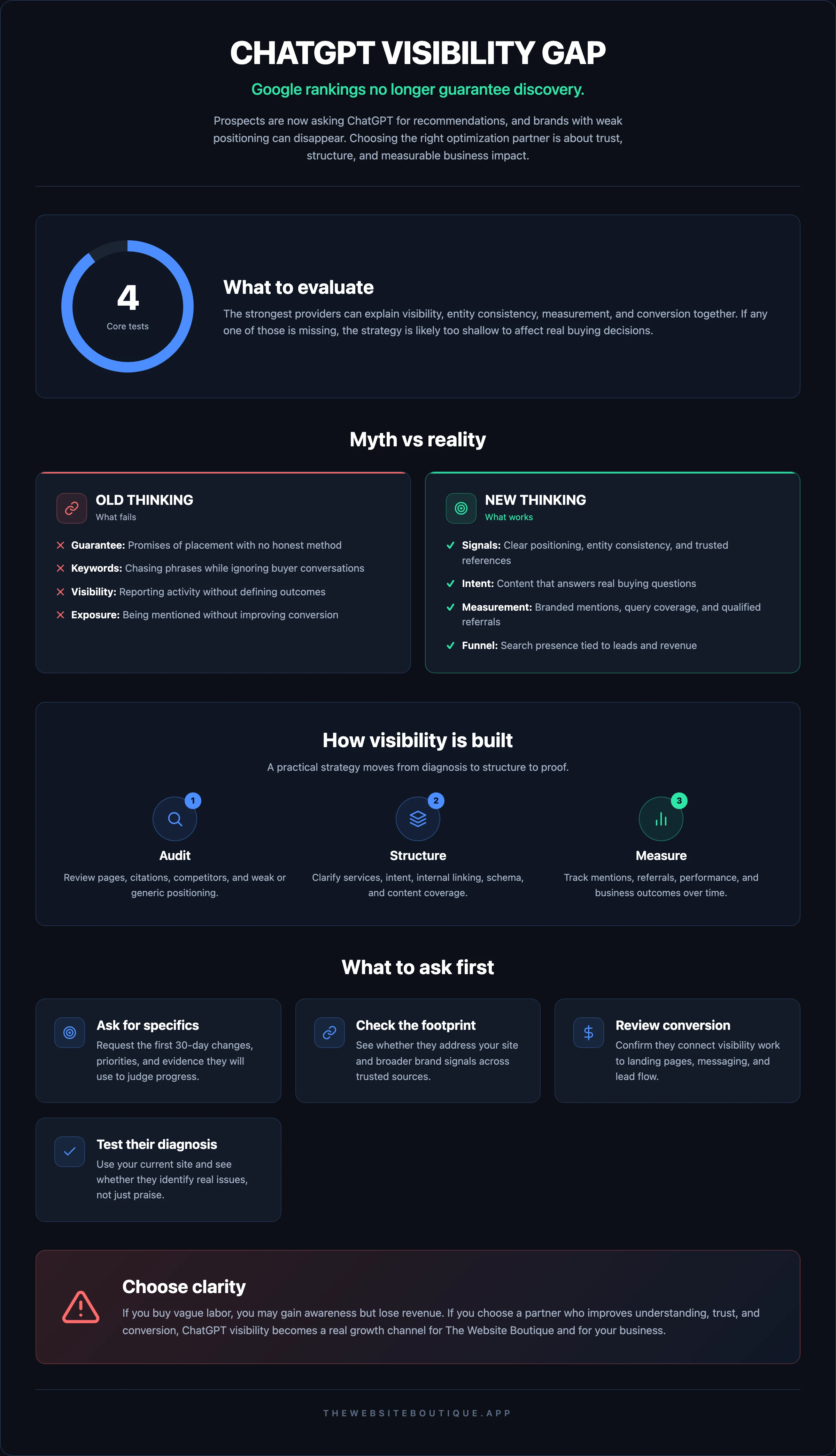
The first test is simple: can the provider explain where AI search visibility comes from without leaning on buzzwords? If their pitch sounds like a renamed SEO package with “ChatGPT” pasted on top, they probably do not have a meaningful method. Real AI search optimization for ChatGPT should touch three layers: the website, the brand footprint, and the way the business is described across trusted sources.
Look for teams that can audit how your services are expressed, whether your pages match buying intent, and whether your content answers the kinds of questions people actually ask before contacting sales. For a service business, this often means clear service pages, supporting articles, useful comparison content, and a site architecture that makes your expertise obvious. If the provider cannot show how those pieces fit together, they are guessing.
You should also ask how they handle entity consistency. Your brand name, services, leadership names, locations, and category descriptions should be aligned across your site and the public web. That does not mean stuffing the same words everywhere; it means reducing ambiguity so machine systems understand who you are and what you do.
A credible partner will also discuss trust signals beyond your own domain. Depending on your market, that can include media mentions, client pages, industry profiles, and reputable directories. If you need a benchmark for how brands can build broader discoverability, Google Search Central is still one of the most useful public references for understanding technical and content quality expectations, even when your goal is broader than classic rankings.
Red flags that usually waste budget
The biggest warning sign is a guarantee. No honest consultant can promise that your brand will appear in ChatGPT responses on demand. If someone sells certainty, they are usually selling confidence theater. The smarter question is whether they can improve the conditions that make inclusion more likely over time.
Another red flag is a narrow keyword mindset. If the proposal only talks about chasing a phrase and ignoring the rest of the customer journey, it misses how people search with AI. Buyers ask follow-up questions, compare options, and refine their requirements. AI search optimization for ChatGPT has to support that conversational path, not just one isolated term.
Watch out for vendors who cannot describe measurement. If they say they will “boost visibility” but cannot define what visibility means, they may only be reporting activity, not outcome. At minimum, they should be able to talk about branded mentions, relevant query coverage, qualified referral patterns, content performance, and how they will review changes in your market.
A third warning sign is work that ignores the rest of the funnel. A business can be mentioned in AI answers and still lose the lead because the site is slow, the offer is unclear, or the contact path is clumsy. If the provider never mentions conversion, your investment may improve awareness while leaving revenue flat. That is a common failure mode, and it is avoidable.
What a real strategy should include
A serious plan usually starts with an audit of how your business is currently represented. That means reviewing your homepage, service pages, about page, blog, case studies, and third-party citations. It also means checking how competitors explain similar offers and where your site is weaker or too generic. In many cases, the problem is not a lack of content; it is a lack of specificity.
From there, the strategy should define the information architecture that supports your category. A service page should say what you do, who it is for, what problems it solves, what makes your approach different, and how prospects move forward. Supporting content should answer the questions people ask before buying, especially the ones that reveal intent, objections, and comparison points. That is where AI search optimization for ChatGPT becomes practical instead of theoretical.
Technical quality also matters more than many teams admit. Fast pages, clean indexing, sensible internal linking, schema where appropriate, and a structure that search systems can crawl without friction all help. If your site is slow or hard to parse, you are making it harder for both search engines and AI systems to process your information reliably. For technical guidance, Google’s Search documentation remains a stable reference for fundamentals like crawlability, indexing, and structured data.
Content quality should be judged by usefulness, not length. A thin page with inflated word count rarely helps. A concise page that clearly defines your service, gives examples of use cases, and addresses objections often performs better. If the work you are considering does not include editorial judgment, topic mapping, and page-level intent matching, it is probably too shallow.
How to evaluate agencies without getting lost in promises
The best evaluation starts with questions that force specificity. Ask how they would improve your visibility for a service category, not just for your brand name. Ask what they would change in the first 30 days, what they would publish, and what evidence they would use to decide whether the work is moving the needle. If the answers stay abstract, keep looking.
Request examples of prior reasoning, not just deliverables. You do not need them to disclose private data to understand their method. You do need to hear how they diagnose opportunities, why they prioritize one page over another, and how they decide whether to strengthen a page, create a new one, or improve external signals. That judgment is what separates experienced operators from content factories.
It helps if the provider understands acquisition, not only visibility. A team that can connect AI search to sales messaging, landing pages, and conversion paths will usually make better decisions than one that only thinks in terms of rankings. If your business also relies on paid media or landing page performance, a broader growth partner may be more useful than a narrow specialist. The Website Boutique, for example, positions its work around search visibility, ads, and conversion together, which is closer to how buyers actually behave.
If you want a reference point for how structured service positioning can be presented, review a clear offer page such as SEO + AI Search (GEO) or compare it with a practical set of Use Cases. Good partners make their thinking visible. That does not guarantee results, but it does reduce the chance of buying vague labor.
What to ask before you sign anything
Before committing, ask whether the provider will work on your site alone or also on the broader brand footprint that supports discovery. Ask what they need from your team, how often they will review progress, and what changes they expect your internal stakeholders to approve. A mature process should be clear about dependencies and should not assume that content, design, and technical changes happen by magic.
You should also ask how they will prioritize content. For example, if your services include multiple offerings, which one is most likely to drive qualified demand first? Which pages need better structure? Which questions should be answered in the blog, and which deserve dedicated pages? A provider that cannot explain sequencing may not understand the relationship between search demand and commercial value.
If you are comparing vendors, use your own website as the test. Does the proposal identify real issues on your current pages? Does it point out confusing messaging, weak proof, slow performance, or missing topic coverage? A serious review will expose specifics. If the only feedback is praise, the analysis may be too superficial to trust.
For teams that want more context on growth operations and execution, it can also help to review Insights, Free Resources, and the agency’s About page to see how they think. If an agency has a public glossary, that is often another sign they care about shared understanding, not just selling a package.
How to compare options without overcomplicating it
A useful comparison usually comes down to four questions. First, does the team understand your market and the way your buyers ask questions? Second, can they improve the website so the brand is easier for both humans and AI to interpret? Third, do they know how to build supportive signals outside the site? Fourth, can they connect the work to leads, not just exposure?
If the answer to any of those is weak, the offer probably needs more scrutiny. AI search optimization for ChatGPT is most effective when it sits inside a broader growth system, because visibility by itself is not the business objective. A mention that never turns into a contact is a vanity metric dressed up as strategy.
It can also help to review the company’s own proof of execution. Browse Clients and look for evidence that they can work across different business models without forcing one template onto every account. If they also offer Fast Websites, that can be valuable when speed and conversion are part of the problem, not just discoverability.
For businesses that need both acquisition and demand capture, a combined approach may be more efficient than running separate vendors. And if your team is exploring paid media as well, Get leads can serve as a useful comparison for how search, ads, and landing pages can work together. The point is not to buy everything from one place. The point is to avoid fragmented execution that weakens the customer journey.
For a broader view of the company’s ecosystem, the homepage is useful, and if regional relevance matters to you, pages like Florida or Texas can show how location-specific messaging is handled. That kind of structure often matters when a business serves a specific market and needs clarity without overexplaining.
FAQs about choosing AI search optimization for ChatGPT
Can I guarantee that my brand will appear in ChatGPT responses?
No one can honestly guarantee that. What you can do is improve the conditions that make your brand more likely to be mentioned: clearer positioning, stronger content, better technical foundations, and a more credible public footprint.
Is this the same as traditional SEO?
It overlaps with SEO, but it is not identical. Traditional SEO focuses on search results pages, while AI search optimization for ChatGPT also considers how systems summarize, interpret, and recommend brands in conversational contexts.
What should I expect from a good provider?
A clear audit, a prioritization plan, content and technical recommendations, and a way to measure progress that connects to business outcomes. If they cannot explain how the work supports leads or pipeline, their plan is incomplete.
Do I need to publish a lot of content?
Not necessarily. You need the right content. In many cases, a smaller set of better pages that clarify your offer, answer buying questions, and build trust will do more than a large volume of generic articles.
Should I choose a specialist or a full-service growth agency?
It depends on your situation. If your visibility problem is isolated, a specialist may be enough. If your issue includes site speed, conversion, ads, messaging, and search visibility, a broader team may be more effective.
If you want a partner that can work across search, paid media, and conversion without turning the project into a handoff maze, talk to The Website Boutique. Review the offer, compare the use cases, and ask for a plan that shows how AI search optimization for ChatGPT would fit your current growth priorities.
If your team is ready to make the website easier to understand, easier to trust, and easier to recommend, the next step is a focused conversation. Start with your current pages, your main services, and the questions buyers already ask. Then get a proposal that addresses those specifics instead of selling you a vague promise.