

Choosing an SEO service for U.S. businesses
August 16, 2026 · 12 min read
- Look for a team that understands U.S. search behavior, sales cycles, and local market differences.
- Ask how they measure success beyond rankings: leads, conversions, and revenue signals matter more.
- Watch for red flags such as guaranteed results, vague deliverables, or a one-size-fits-all package.
- The best fit often includes technical SEO, content, and AI search visibility—not just keywords.
- A strong provider should explain what they will do, why it matters, and how progress will be reported.
You can feel the difference in the first sales call. One provider asks about your margins, your service area, and how leads are handled. Another jumps straight into “more traffic” and sends a generic proposal. If you are comparing an SEO service for U.S. businesses, that gap matters more than the pitch deck.
The wrong choice usually does not fail loudly. It wastes months on pages nobody needs, rankings nobody can turn into leads, and reports that look busy without changing the pipeline. The right choice is usually less flashy and more specific: it aligns search work with how your U.S. customers actually buy.
What an SEO service for U.S. businesses should really include
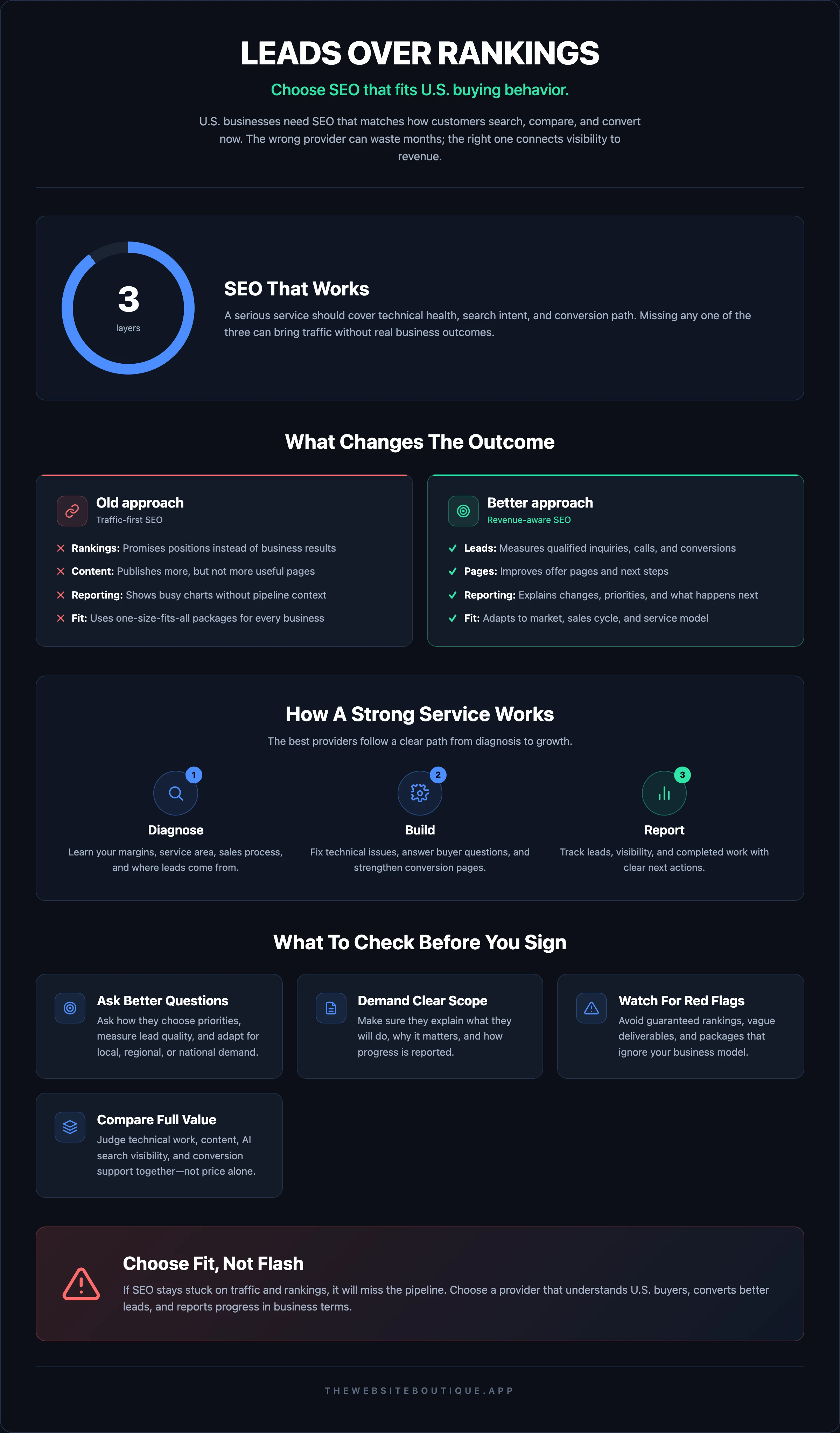
A serious SEO service for U.S. businesses should cover three layers: technical health, search intent, and conversion path. If one of those is missing, the work may generate visibility but not outcomes. That is especially true for service businesses, B2B firms, and companies where one qualified lead is worth far more than a hundred casual visits.
Technical work should make the site easy to crawl, fast to load, and clean enough for search engines to understand. Content work should answer the questions buyers ask before they request a quote, book a call, or compare vendors. Conversion work should make sure the traffic has somewhere useful to go: a page with a clear offer, trust signals, and a simple next step.
If the provider only talks about blog posts or backlinks, ask what happens after the click. For many businesses, the more valuable work is not publishing more—it is improving the pages that already represent your offer. Google’s own Search Essentials documentation is a useful reminder that helpful, people-first pages tend to perform better over time.
SEO for AI search is now part of the conversation
Search behavior is changing. People still use Google, but they also ask ChatGPT-like tools for recommendations, comparisons, and “best fit” suggestions. That means visibility is no longer limited to classic blue links. A modern SEO service for U.S. businesses should think about how your brand appears in both search engines and AI-assisted discovery.
That does not mean chasing buzzwords. It means building clearer topical authority, stronger entity signals, and pages that answer questions in a way machines can parse. If a provider cannot explain how they approach AI search visibility, they may still be useful for basic SEO, but they are not prepared for where discovery is going.
For businesses that want to stay ahead of that shift, SEO + AI Search (GEO) is the kind of capability worth asking about. The point is not to replace Google rankings; it is to expand how often your company shows up when prospects ask for recommendations.
How to evaluate a provider without getting lost in jargon
The best way to assess an SEO service for U.S. businesses is to push past deliverables and ask about decision-making. What gets prioritized first? What gets ignored? How do they choose between fixing technical issues, rewriting pages, and building new content? If those answers are vague, the campaign will probably be vague too.
Ask to see examples of how they think, not just what they have published. A strong team should be able to explain why a page needs to target a narrower keyword, why a service area page should not be duplicated for every city, or why one conversion point is better than three. That kind of judgment matters more than a polished proposal.
Look for signs that the team understands the operational reality of your business. A provider that works in your time zone, can join meetings without delay, and speaks to both marketing and revenue can remove a lot of friction. That matters when the work touches your website, your ads, and your lead handoff process.
Questions that separate specialists from generalists
Use questions that force specificity:
- How do you decide which pages to optimize first?
- What would you fix before publishing new content?
- How do you measure lead quality, not just traffic?
- How do you handle branded search, service pages, and informational content differently?
- How do you adapt the strategy for local, regional, or national demand?
A good provider will answer without hiding behind terminology. A weak one may sound confident while saying very little.
You can also ask whether they have experience with Google Search Central guidelines, structured data, and page speed fundamentals. Those are not optional technical details. They shape whether your site is eligible to compete cleanly or spends months fighting self-inflicted problems.
The mistakes that cost U.S. businesses time and lead quality
The most expensive mistake is buying SEO as if it were a checklist. If the service only promises audits, blog posts, or backlinks, it may look active while failing to move sales. A SEO service for U.S. businesses should be judged by business relevance, not activity volume.
Another common mistake is choosing the cheapest provider and assuming the work can be fixed later. Cheap SEO often creates hidden costs: pages that need to be rewritten, duplicate content that confuses the site architecture, and reporting that is too shallow to inform decisions. By the time the problem is obvious, the budget has already been spent on avoidable work.
A third issue is overfocusing on keywords without validating the market fit. Ranking for a term that attracts students, job seekers, or DIY researchers may inflate impressions while producing weak leads. If your service is premium, specialized, or location-sensitive, the wrong traffic can be worse than no traffic at all.
There is also a subtler failure: launching content before the site can convert it. If the homepage is vague, service pages are thin, and contact paths are awkward, search growth will not fix the bottleneck. It will simply expose it faster.
What strong SEO looks like when the goal is leads, not vanity metrics
A solid SEO service for U.S. businesses should connect search demand to a believable next action. That usually means one clear offer, one strong service page per topic, and support content that helps buyers understand the problem before they contact you. The site should make it easy to trust you, compare you, and take the next step without friction.
For many companies, the real win is not “more traffic.” It is better-qualified traffic that converts at a healthier rate. That may come from improving the wording on a landing page, clarifying who the service is for, or tightening the internal linking between educational content and high-intent pages.
It also helps when SEO is coordinated with paid media and landing page strategy. If your Google Ads campaigns are already revealing which phrases drive real interest, that data can shape your organic priorities. If the site is slow or hard to use, a fast website built for conversion can improve both paid and organic performance without forcing the same visitor through a weak experience.
A useful way to judge reporting
Reports should answer questions, not decorate them. The right report tells you what changed, what was done, what is improving, and what will be done next. If the report mostly shows keyword positions without context, it is missing the business layer.
A practical report for a U.S. business usually includes:
- Pages worked on and why they were prioritized
- Search visibility changes for important topics
- Leads, calls, forms, or other conversion signals
- Technical fixes completed and pending
- Risks that could slow growth in the next cycle
That level of clarity helps leadership decide where to invest. It also makes it easier to tell whether the SEO work is reducing friction or just producing noise.
Red flags that should make you pause
Some warning signs are obvious. Guaranteed rankings, “secret methods,” and overnight results should end the conversation quickly. Search is too dependent on market competition, site quality, and content relevance for anyone to promise outcomes that way.
Other red flags are quieter. If the provider cannot explain how they work with your developers, sales team, or internal content owners, execution will suffer. If they avoid discussing site structure, page intent, or conversion paths, they may be thinking like an SEO vendor instead of a growth partner.
Be careful with templates that ignore your business model. A local service company, an e-commerce brand, and a B2B firm do not need the same keyword map, page hierarchy, or call-to-action structure. If the pitch sounds reusable for any industry, it probably is.
One more signal: too much emphasis on backlinks without a clear content and technical plan. Links can help, but they do not rescue a weak site. Search engines are increasingly better at evaluating whether the destination deserves attention, not just whether it has external mentions.
Choosing between an agency, freelancer, or in-house setup
There is no universal winner. The best setup depends on how much internal capacity you have, how fast you need execution, and how many connected pieces are involved. A freelancer may be enough for a narrow project. An in-house hire may work if you already have clear strategy and supporting resources. An agency fits better when SEO has to coordinate with ads, design, content, and conversion work.
A good partner should make the tradeoff clear. If you need technical fixes, copy revisions, and ongoing strategy, one specialist alone may not be enough. If the main issue is a small set of pages that are underperforming, a tightly scoped project may be smarter than a large retainer.
This is where looking at real use cases helps. A provider with a clear Use Cases page and visible Clients can show how they think across different business needs instead of relying on generic claims. If you want to understand how a team handles full-funnel growth, The Website Boutique’s lead generation offering shows the broader system that often surrounds SEO.
How to compare proposals fairly
Do not compare monthly price alone. Compare what each option actually covers:
- Technical work versus content-only execution
- Strategy versus task completion
- Conversion improvements versus traffic-only reporting
- Support for AI search visibility versus classic SEO only
- Coordination with ads, web development, or branding
A higher-fee proposal can be the better deal if it prevents wasted work and shortens the path to qualified leads. A lower-fee proposal can be expensive if it forces you to rebuild half the site later.
Questions to ask before you sign
Before committing to any SEO service for U.S. businesses, ask for a clear picture of how the engagement will run during the first 90 days. You are not asking for a miracle; you are asking for order. A provider should be able to outline discovery, priorities, implementation, and reporting without making it feel like a mystery.
Ask who owns each part of the process. Who writes or reviews content? Who handles technical implementation? Who tracks performance? If those roles are unclear, delays are almost guaranteed.
It is also fair to ask how they keep pace with changes in search behavior. Some teams now pair classic SEO with AI search optimization, structured content, and more direct page answers. Others remain entirely focused on old habits. If you are serving the U.S. market, that difference can decide whether your visibility compounds or stalls.
For teams that want a broader view of how growth work connects, The Website Boutique’s blog, free resources, and glossary can help translate jargon into decisions. If your priority is brand trust and team fit, the About page is often the fastest way to check whether a partner works the way you need.
A practical filter for the final shortlist
When you narrow your options to two or three providers, use this simple filter:
- Do they understand your market and buyer intent?
- Can they explain the work without hiding behind buzzwords?
- Will they improve the site itself, not only the content calendar?
- Do they measure outcomes that matter to sales?
- Can they work at the pace and time zone your team needs?
If the answer is yes across most of these points, you are probably close. If not, keep looking.
FAQs
How do I know if an SEO service is right for my U.S. business?
A good fit should be able to explain how it will improve qualified traffic, conversions, and site structure—not just rankings. If they understand your sales process, service area, and internal constraints, that is a better sign than a polished pitch.
Should I choose SEO, paid ads, or both?
If you need immediate lead flow, ads can help while SEO builds. If your site has room to improve and the market is competitive, combining both often gives better insight. The best choice depends on timing, budget, and how quickly you need results.
What is the biggest mistake companies make when buying SEO?
They buy deliverables instead of outcomes. A long list of tasks can look impressive while failing to improve lead quality or revenue. The engagement should always be tied to what your business needs from search.
Is AI search optimization worth considering now?
Yes, if you want your business to be visible in recommendation-style discovery as well as traditional search. The safest approach is to build clear, authoritative pages that help both humans and AI systems understand what you do.
What should I ask for in the first month?
Ask for a priority plan, a clear list of what will be fixed or created, and an explanation of how success will be measured. You want to see structure early, not only activity.
If you need a partner that can connect SEO with faster websites, better conversion paths, and AI search visibility, The Website Boutique is built for that kind of work. Review the pricing structure, explore the site, or book a conversation once you know the questions that matter.
If you are already comparing providers and want a team that works in your time zone, moves quickly, and treats SEO as part of growth rather than a standalone task, start with The Website Boutique.