

Why optimization for appearing in ChatGPT matters
August 10, 2026 · 11 min read
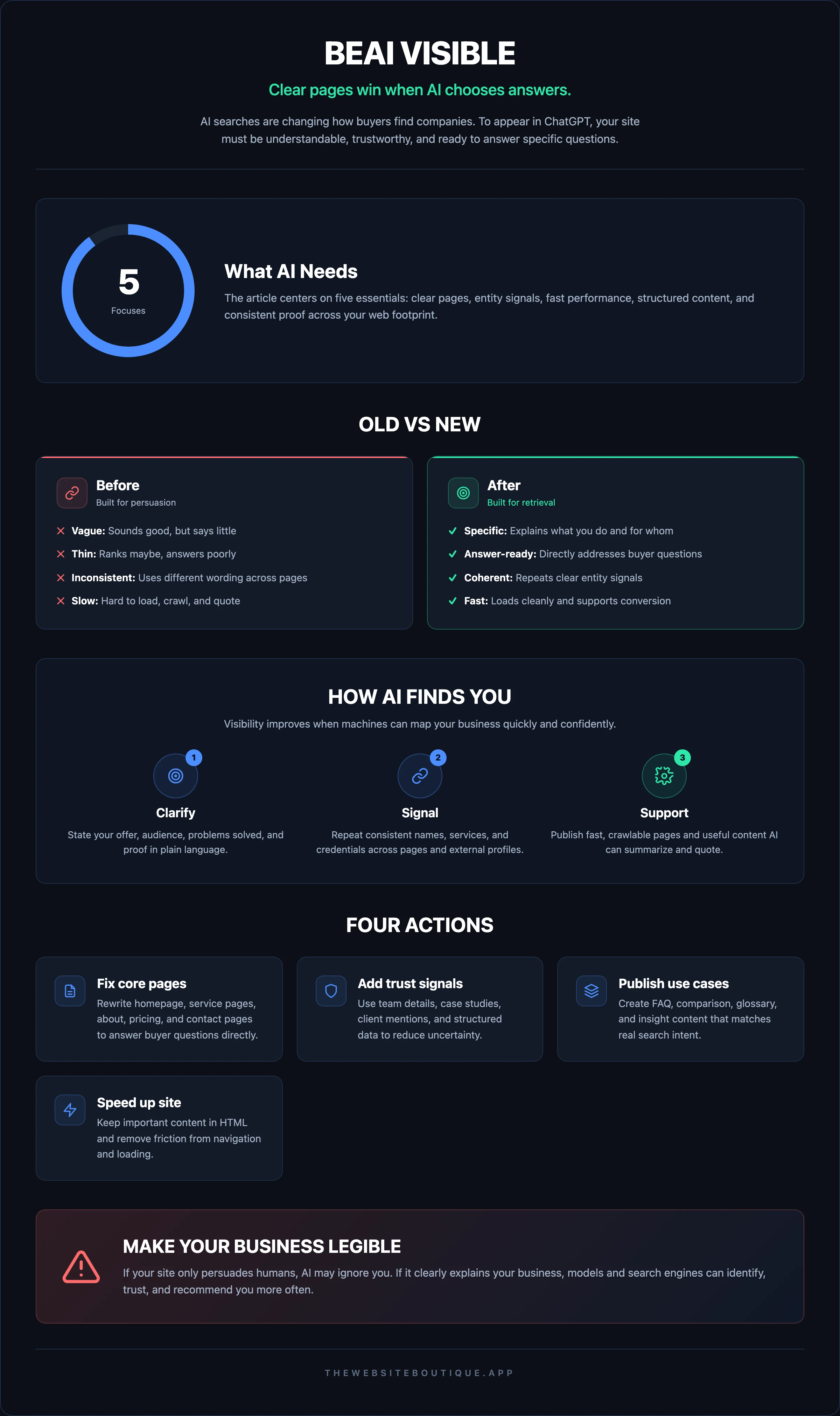
Why optimization for appearing in ChatGPT differs from traditional SEO
A standard Google result page still rewards pages that match a query well and earn authority over time. AI search adds another layer. The system is not only looking for a page that contains the topic; it is trying to assemble a useful answer, often by comparing how multiple sources describe the same business, service, or concept. That means vague positioning, thin pages, and inconsistent language can cost you visibility even if you have decent rankings.
For that reason, optimization for appearing in ChatGPT should be treated as a visibility problem, not just a traffic problem. If the model cannot confidently map your business to a category, a location, a service, or a use case, it will often skip you and lean on a clearer source. OpenAI’s own ChatGPT help center is a useful reminder that these systems are designed to respond from the information they can interpret and retrieve, not from intent alone.
Search engines still matter because many AI systems rely on indexed, well-structured, public web content. But the content needs to do more than rank. It has to explain your offer in language a machine can parse without guessing. If a page leaves too much unsaid, the model fills in the gaps with someone else’s wording.
Build pages that answer, not just advertise
The most common mistake is writing pages that sound polished but never directly answer the questions buyers ask. A service page that says “we help companies grow” is too broad. A better page says what you do, for whom, and under what business problem. That clarity is central to optimization for appearing in ChatGPT, because AI systems favor sources that reduce ambiguity quickly.
Start with your money pages: homepage, service pages, case studies, pricing, about, and any use-case pages. Each one should make the same business visible from a different angle. If you sell lead generation, the page should not only list channels; it should say whether you manage media buying, landing pages, tracking, and conversion improvements. If you build websites, explain the speed, process, and business outcome in plain English.
A useful test is to read each page as if you were building a prompt for a buyer. Can the page answer:
- What does this company do?
- Who is it for?
- What problems does it solve?
- Why would someone trust them?
- What makes the offer different from similar agencies?
If the answer is hidden inside clever copy, the page is weaker than it looks. And if your site has several pages that describe the same service using different terminology, you may be confusing both people and models. Consistency matters more than variety here.
For businesses that want a practical roadmap, a focused service like SEO + AI Search (GEO) can help align content, structure, and technical signals around how AI systems interpret your site.
Strengthen the signals AI uses to trust your business
AI models and search systems look for patterns that make a business easier to verify. They do not need perfection, but they do need coherence. If your company name, service descriptions, team details, and brand story are scattered across the web with different wording, the system has to work harder to connect the dots. That weakens optimization for appearing in ChatGPT because it reduces confidence.
Start with the basics on your own site. Make sure your business name, core services, and audience are repeated consistently across the homepage, about page, service pages, footer, and contact page. Use the same phrasing where it makes sense. If you offer “Meta Ads management” on one page and “paid social” on another, that is fine as long as the relationship is obvious. If the two pages seem to describe different companies, that is a problem.
External trust signals matter too. Profiles on reputable directories, partner pages, client mentions, and industry listings help reinforce who you are. Structured data can also make your site easier to interpret. The Schema.org documentation is the standard reference for marking up organizations, services, articles, reviews, and FAQs in a way machines can understand.
What to clean up first
If you need a fast audit, look for these issues:
- A homepage that talks about growth but never names the main services.
- Service pages that all sound interchangeable.
- An about page with no team, process, or proof of real work.
- Missing titles and meta descriptions that force search engines to guess.
- PDFs, images, or slides that contain important information but are hard to crawl.
These problems are common because teams build content for launch, not for retrieval. Yet AI discovery rewards pages that are explicit from the first screen. If a prospect can understand your offer in 10 seconds, an AI system usually can too.
Make your site fast, crawlable, and easy to quote
A slow site can still rank, but it is a liability when you want your information parsed quickly and reliably. AI systems do not care about pretty motion effects or oversized layouts. They care about what can be loaded, read, and summarized without friction. That is why optimization for appearing in ChatGPT often starts with performance, not copy.
Your important content should live in HTML, not hidden inside heavy scripts or embedded graphics. Headings should reflect the actual structure of the page. Navigation should make it simple to find your services, about page, pricing, and contact information. If a visitor has to fight the site to understand what you do, crawlers face the same friction.
Fast sites also make conversion easier. When a prospect follows an AI recommendation and lands on your page, the site needs to confirm the recommendation quickly. A delayed page creates doubt. A clear, lightweight, well-organized page creates momentum. If your current site is holding you back, a fast website built to convert is often the cleanest fix.
There is also a behavioral angle. AI-referred visitors tend to be intent-heavy. They are not browsing casually; they are checking whether your company fits a specific need. That means your page should surface the next step early: a contact path, a relevant use case, or a short explanation of how you work. A confusing layout wastes that moment.
Google’s own Search Central documentation is still the best reference for technical hygiene, and most of the same fundamentals help AI systems process your pages more effectively. Fast loading, accessible code, and clear indexing paths remain practical advantages.
Publish the content AI systems need to recommend you
One reason optimization for appearing in ChatGPT feels mysterious is that many businesses publish content that is too abstract to be reused. AI tools are more likely to surface pages that explain situations, not slogans. They need specific pages that match the language buyers use when they describe their problem.
That means you should build content around use cases, objections, service comparisons, and decision-stage questions. A prospect does not always search for “marketing agency.” They may ask how to get more qualified leads without hiring an internal team, how to speed up a website that converts poorly, or how to improve search visibility when the category is crowded. Content should reflect those real decisions.
A good publishing mix looks like this:
- Service pages that define what you do.
- Use case pages that show where it applies.
- FAQ content that answers recurring objections.
- Glossary-style content that clarifies terms buyers may confuse.
- Insight articles that explain tradeoffs and implementation details.
That last category is especially useful because it gives AI systems a richer set of language to pull from. A strong article does not just repeat keywords. It teaches the model how your company talks about your field. If the phrasing is precise, the system can connect your brand to the right topics more confidently.
You can see that approach in a content hub like Insights or a reference library like Free Resources, where educational pages support the commercial pages instead of replacing them.
Turn authority into a visible business profile
A lot of companies have authority in the real world but very little authority in the web graph. They have a good team, happy clients, and meaningful experience, but the public footprint is thin. AI systems do not know that unless the evidence is easy to find. That is why optimization for appearing in ChatGPT needs both content and credibility.
Case studies, client lists, team bios, and clear service explanations all help. So do pages that reveal how you think. An about page that names the team, process, and company focus is more useful than a generic mission statement. If you want a buyer to trust your advice inside a model-generated answer, the source material should feel grounded.
This is where proof pages matter. A Clients page gives the model another way to associate your brand with real businesses and delivered work. A detailed About page helps define the company as a distinct entity rather than a generic service provider. And a well-framed Use Cases page helps AI understand the situations where your services are relevant.
If you are choosing what to produce next, prioritize the pages that reduce uncertainty. Buyers do not need more adjectives. They need enough evidence to believe that your company can handle the exact problem they typed into an AI tool.
Measure visibility where the journey starts, not only where it ends
If you only look at form fills or last-click conversions, you will miss a lot of the signal from AI discovery. A prospect may first encounter your company in a ChatGPT answer, then visit your site later, then compare options, then convert through another channel. That path is messy, which is why attribution is tricky.
Still, you can look for patterns. Are more visitors landing on service pages after brand-oriented queries? Are prospects using the same phrases your content uses? Are people referencing your category in a way that matches your site language? Those are useful signs that your visibility is improving.
It also helps to watch the pages that support discovery rather than only the pages that close. If your homepage gets attention but your service pages are thin, the system may not have enough material to recommend you consistently. If your pricing page is vague, buyers may leave with too many open questions. A transparent Pricing page can remove friction and make your offer easier to summarize.
The business goal is not to chase every AI tool. It is to make your company legible wherever buyers ask for help. That means better pages, stronger structure, and a sharper explanation of what happens after someone clicks.
If you are trying to improve optimization for appearing in ChatGPT without rebuilding everything at once, start with the pages that most clearly define your company, then work outward into use cases and supporting content. That sequence usually creates visible gains faster than trying to publish more content with the same weak structure.
FAQ
How is optimization for appearing in ChatGPT different from SEO?
SEO focuses on ranking in search engines, while optimization for appearing in ChatGPT focuses on being easy for AI systems to understand, trust, and quote. The overlap is large, but AI visibility depends more on clarity, consistency, and answer-ready content.
Do I need a lot of content for AI search visibility?
Not necessarily. You need the right content first: strong service pages, clear about and pricing pages, relevant use cases, and a few high-quality supporting articles. Thin content spread across many pages usually performs worse than a smaller set of clear, useful pages.
Can a fast website improve AI visibility?
Yes. Fast, crawlable pages make it easier for search engines and AI systems to access your content. They also improve user trust when someone clicks through from an AI recommendation and lands on your site.
What page should I improve first?
Start with the page that defines your core offer, usually the homepage or the main service page. If that page is vague, no amount of blog content will fully fix the problem.
How do I know if my business is being mentioned by AI tools?
Watch for unusual branded traffic, direct visits after non-branded searches, and leads who repeat phrasing from your site. You can also test common buyer questions in AI tools and see whether your company appears naturally in the answers.
If you want help making your business easier to find in both Google and AI answers, The Website Boutique can audit your site, sharpen your pages, and build the structure that supports discovery. Start with SEO + AI Search (GEO) or explore Get leads if your priority is turning that visibility into pipeline.
For teams that need the site itself to do more work, Get a site that converts is the cleanest next move. If you prefer to see how the work is structured before taking action, visit the page and choose the path that fits your current bottleneck.