
Lead Generation Agency FAQs and Practical Advice
September 14, 2026 · 12 min read
- A good lead generation agency should fit your sales process, not force you into theirs.
- The best results usually depend on the handoff between ads, landing pages, follow-up, and CRM tracking.
- A weak offer or messy intake form can make even strong traffic look like a bad campaign.
- If you are buying leads, ask how they qualify them, where they come from, and what happens after form submission.
- For owner-operated businesses, a smaller, hands-on team often beats a large agency that spreads attention too thin.
You can have traffic, forms, and a CRM all live on the same dashboard and still feel like nothing is happening. That is usually the moment when a lead generation agency starts looking attractive: not because you need more buzz, but because the follow-up is slipping, the leads are inconsistent, or the handoff from ad click to booked call is too leaky to trust.
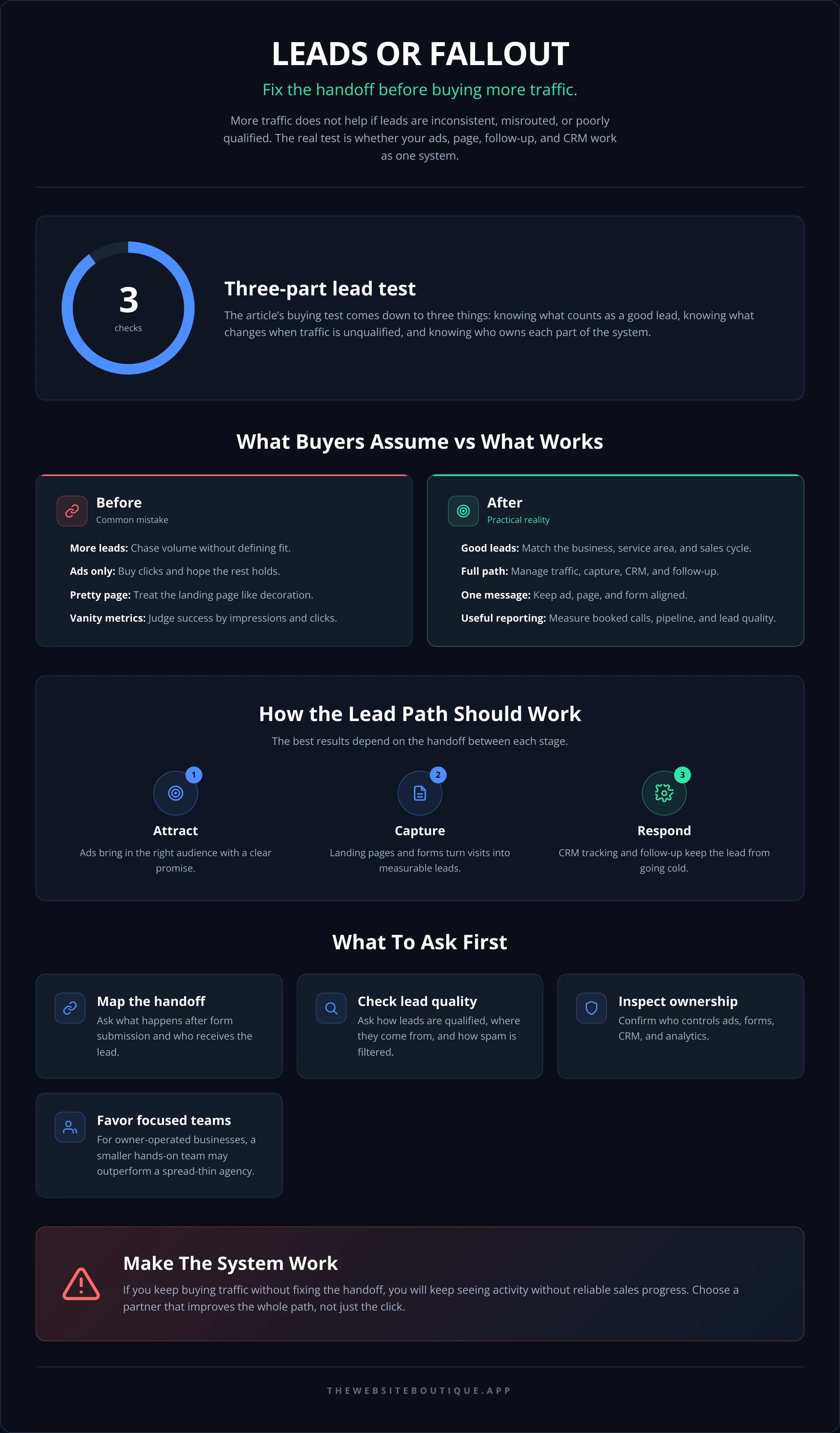
The hard part is that most buyers do not need “more leads” in the abstract. They need leads that match the business, the service area, the sales cycle, and the person who actually answers the phone. If you are comparing agencies, the right questions will tell you more than any portfolio page.
What a lead generation agency actually handles
A lead generation agency can mean very different things depending on who is selling. Some teams run ads only. Others build landing pages, manage forms, connect a CRM, and keep the follow-up process from falling apart when a visitor fills out a request.
That difference matters. If the agency is only buying clicks, then your results depend on your own pages, your own offer, and your own speed to respond. If they are managing the full path from traffic to lead capture to CRM, they are responsible for fewer handoff gaps and less guesswork.
For owner-operated businesses, that full path is often the real value. It is not about complexity for its own sake. It is about having one team think through message, page layout, ad intent, tracking, and what happens after someone reaches out. A lead generation setup that includes both marketing and follow-up is usually easier to improve than a stack of disconnected tools.
A useful way to think about any lead generation agency is this: are they building a system that can be measured, or are they just renting attention? The first option gives you something you can refine. The second gives you activity without much visibility.
Questions to ask before you hire
The first call should feel less like a pitch and more like a diagnostic. If the agency starts talking about channels before asking about your sales process, that is already a warning sign.
Ask what happens after the form is submitted. Ask who receives the lead, how fast the handoff occurs, and whether the agency helps you track calls, emails, booked appointments, or pipeline stages. If they cannot explain how lead quality is measured, they are probably optimizing for volume instead of fit.
A second set of questions should focus on the assets themselves:
- Do you build the landing page, or do we need to provide one?
- Will you manage the ad account directly, or work through our account?
- How do you distinguish a real lead from a spam submission?
- What reporting do we get, and how often?
- What changes do you make when the campaign is attracting clicks but not leads?
If the answers are vague, keep listening. Vagueness in the discovery call often becomes vagueness in the reporting. A strong lead generation agency should be able to describe the path from first click to booked conversation without sounding defensive.
You should also ask what the agency needs from you. If they say “nothing,” that sounds convenient and usually means they are not planning to learn the parts of your business that actually shape conversion. The best work usually depends on knowing which leads are worth pursuing, what objections appear most often, and what makes a request a poor fit.
How to judge lead quality instead of vanity metrics
A dashboard full of impressions and clicks can be useful, but it is not enough. The numbers that matter depend on the business, and the cheapest lead is not always the one that produces revenue.
One practical test is to look at the conversation that follows the lead. Are people asking the right questions? Are they in the right region, budget range, or service category? Do they understand what you do, or are they confused before you even answer the first email? If the same type of bad-fit lead keeps showing up, the problem may be the message, the targeting, or the form.
A lead generation agency should help you identify where quality breaks down. Sometimes the ad promise is too broad. Sometimes the landing page makes the offer sound generic. Sometimes the form asks for too little information and attracts unqualified contacts. If your team is still doing a lot of manual cleanup in the CRM, the issue is probably upstream.
For businesses that depend on speed, CRM tracking matters as much as ad strategy. A lead that is captured late, routed to the wrong inbox, or not assigned to anyone can look like a marketing failure when it is really a workflow problem. Tools like HubSpot’s CRM overview are useful references for understanding how lead tracking and pipeline stages should connect.
The most honest reporting is not always the prettiest. If a campaign generates fewer leads but those leads start more useful conversations, that may be a better result than a flood of form fills that never answer the phone.
Landing pages, ads, and follow-up need one message
Most lead problems are message problems.
A visitor clicks because the ad promised one thing, then lands on a page that says something broader, softer, or less specific. That mismatch costs you trust before the form even appears. If the page is not built for the exact offer, audience, and action you want, the traffic has to do too much work.
That is why the best agencies treat the landing page as part of the campaign, not a separate deliverable. If the page is slow, cluttered, or hard to scan on mobile, the campaign can underperform even when the targeting is correct. If you need a faster page built around a single conversion goal, a landing page or fast website approach can make the difference between “interesting traffic” and actual leads.
Follow-up matters just as much. A visitor who fills out a form is not yet a qualified opportunity. If the CRM does not trigger the right next step, the lead cools off fast. For some businesses, that means an automatic reply plus a human callback. For others, it means booking links, service-specific routing, or a tighter intake process.
If your agency says the campaign is working but your pipeline is still thin, ask where the handoff is failing. The problem may not be the ads at all. It may be the page, the form, or the response process after submission.
A good reference point for quality and technical alignment is Google’s own Search Central documentation. Even though it is focused on search, it is a useful reminder that page experience, clarity, and crawlable structure affect whether your site supports the campaign or fights it.
Signs you are working with the right type of team
A good team asks annoying questions early. What qualifies a lead? What are the service boundaries? Who follows up and when? Those questions may feel slower than jumping straight into ads, but they save time later.
The right partner is also comfortable saying no. If a request will not convert well, they should explain why. If a campaign needs a better page before more traffic makes sense, they should say that. If the site is the real bottleneck, they should address the site instead of pretending the media buy will fix everything.
For businesses that need close attention, a smaller studio can be easier to work with than a large agency. That is especially true when the project includes design, development, SEO, and lead capture. The advantage is not scale. It is focus. A team like The Website Boutique can keep the work tight when the number of active clients is intentionally limited.
You should also notice how the team handles the basics:
- Do they explain tradeoffs clearly?
- Do they talk about the next decision, not just the next deliverable?
- Do they show how the system will be measured after launch?
- Do they seem interested in your actual sales process?
If the answer is yes, you are probably dealing with people who understand that lead generation is an operating system, not just a media plan.
Common mistakes buyers make before signing
The most common mistake is buying before defining what a good lead looks like. Without that definition, every report becomes a debate. One person wants volume. Another wants quality. The agency tries to satisfy both, and the campaign drifts.
Another mistake is treating the landing page like decoration. A page can look polished and still convert poorly if it buries the offer, asks for too much too soon, or sends visitors to five different actions. The page should make one request obvious. If the next step is not clear within a few seconds, the lead cost will usually rise.
A third mistake is ignoring ownership of the account and the data. You should know who controls the ad platforms, the form submissions, the CRM, and the analytics. If those assets are locked away, you may be dependent on an agency long after the relationship stops making sense.
There is also a quieter mistake: expecting marketing to repair a weak business offer. If the service is hard to explain, the response time is slow, or the sales process drops the ball, more traffic only reveals the problem faster.
When businesses move into SEO and AI search, the same rule applies. Visibility helps, but only if the message and conversion path make sense once people arrive. Search can create demand, but it cannot fix a confusing offer.
Practical ways to compare agencies without getting lost
When you have two or three options, compare them on process, not personality.
Start with the path from visitor to lead. Ask each team to describe it step by step. One answer will sound abstract, one will sound operational, and one will probably sound like a real workflow. Choose the one that shows they understand handoffs, not just ad spend.
Then look at the deliverables. Are they providing the ad strategy only, or also the page, the tracking, the CRM setup, and the improvement cycle? If your business needs the whole path managed, the cheapest proposal may be the most expensive choice in practice because you will spend time stitching everything together.
This is where services pages and pricing pages should be read carefully. Good packaging tells you what is included, what is optional, and where responsibility starts and ends. If the offer is so broad that no one can tell what is actually being built, be cautious.
If your site already exists but is not converting, ask whether the agency can repair and improve the current setup rather than forcing a full rebuild. Sometimes a repair project or a targeted support engagement is the better move. The right comparison is not “which agency sounds smartest,” but “which partner can reduce risk while improving lead flow.”
When the work involves custom software, mobile apps, or unique lead routing, the same standard applies. You want a team that can connect marketing with the product, not treat them as unrelated problems. That is true whether the next step is custom tools, custom SaaS, or mobile apps.
If you want to see how different types of work are handled in one place, review a studio’s work page. You are looking for evidence of judgment, not just pretty layouts.
A simple buying test
If a lead generation agency cannot answer these three questions clearly, keep looking:
1. How will you know which leads are worth sales time?
2. What will change if the campaign gets traffic but not qualified inquiries?
3. Which part of the system do you own, and which part do we own?
That test sounds simple, but it separates teams that operate campaigns from teams that just launch them.
FAQs about lead generation agencies
How do I know if I need an agency or just a better website?
If the problem is that visitors are arriving but not converting, the website or landing page may be the first issue. If you are not getting enough qualified traffic, or if follow-up is broken after the form submission, a lead generation agency may be a better fit. Many businesses need both, because the ad, page, and CRM all affect the same outcome.
Should I hire an agency that only runs ads?
Only if you already have strong pages, tracking, and follow-up in place. If those pieces are still loose, ads alone can make the problems more visible without fixing them. A team that can manage the page and the lead flow usually gives you a cleaner path to improvement.
What is the biggest red flag in a sales call?
When the agency talks about leads without asking what counts as a good lead for your business. If they skip the qualification details, they may be optimizing for raw volume. That usually creates more noise for your sales team.
How important is CRM setup?
Very important if you want to know what happens after the form is submitted. A CRM helps you see response time, ownership, follow-up status, and where leads disappear. Without it, you are guessing about the stage where the pipeline breaks.
Can a small business work with a smaller studio instead of a large agency?
Yes, and for many owner-operated businesses that is the better fit. Smaller teams often give more direct attention and a more customized process. If the project needs strategy, design, development, and lead capture together, a focused studio can be easier to coordinate.
If you want a partner that treats lead flow like a system instead of a stack of disconnected tasks, start with a conversation about your offer, your intake process, and where leads get lost today. A short planning call can reveal whether you need lead generation, a better landing page, or a full rebuild of the path from click to CRM.
If that sounds like the kind of work you need, review the free resources and the glossary, then reach out to The Website Boutique when you are ready to improve the system that turns visits into real opportunities.