

Local SEO Costs and What’s Included
September 17, 2026 · 13 min read
What local SEO actually has to cover
When owners ask about local SEO for local businesses, they often want a price before they know what the work should include. That is backwards, but understandable. A useful scope starts with how people in one city or service area find businesses like yours, then moves to the parts of the site and listings that influence that visibility.
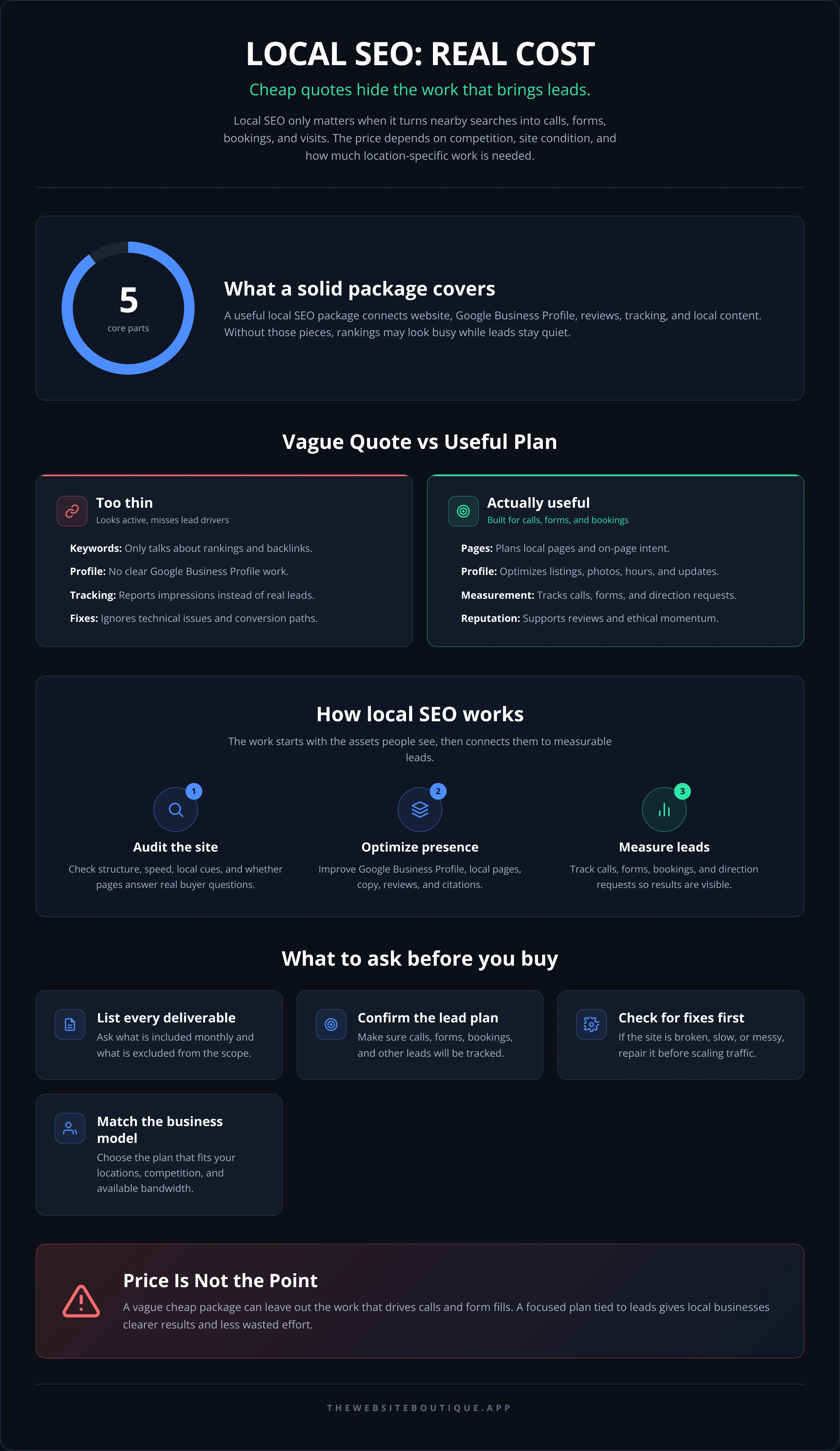
At minimum, the work should connect three things: your website, your Google Business Profile, and the signals that help search engines trust that you are relevant in a specific area. If a provider only talks about keywords and never mentions pages, listings, tracking, or conversion, the scope is too thin.
A solid scope usually includes some mix of the following:
- Google Business Profile optimization and ongoing updates
- Location or service-area page planning
- On-page copy changes for local intent
- Technical cleanup that affects crawlability and speed
- Review strategy and reputation support
- Local citation cleanup where needed
- Measurement setup for calls, forms, and direction requests
That list is not a shopping catalog. It is the difference between work that can be measured and work that merely sounds active.
If you want a broader picture of how search visibility connects to AI-powered discovery, SEO + AI Search (GEO) is worth reviewing, because a growing number of buyers now start with search results and recommendation tools, not just classic Google results.
What local SEO for local businesses usually includes
The first thing worth checking is the website itself. Many local sites are built with a generic home page and a contact page, which is rarely enough if the business serves multiple neighborhoods, cities, or service categories. Local SEO for local businesses usually requires clear page structure, service descriptions that match real intent, and location cues that do not feel stuffed into the copy.
That does not mean creating a page for every suburb on a map. It means making sure the pages you do have answer the questions a nearby buyer already has: where you work, what you do, who it is for, how fast you respond, and what makes you a better fit than the nearest alternative.
A good package often includes these layers:
Website and content work
The site needs a structure that can support local relevance. That can mean refining service pages, adding location signals in headers and body copy, improving internal links, and making sure contact paths are obvious on mobile.
For owners who need a site that does more than sit there, fast websites matters because slow pages hurt both search performance and lead conversion. If a visitor is comparing three providers on a phone, the slowest site often loses before the form even loads.
Google Business Profile and local presence
Your Google Business Profile is often the first thing people see, especially for service businesses and appointment-based companies. It needs accurate categories, service descriptions, photos, hours, and a steady pattern of updates if you want it to support visibility.
A strong setup also makes it easier to connect profile actions to business outcomes. If calls rise but form submissions do not, or if direction requests spike with no booked jobs, you need that visibility to understand what is happening rather than guess.
Tracking and lead measurement
If a provider cannot tell you how leads will be tracked, the package is incomplete. Local SEO for local businesses should not end at rankings. It should include call tracking, form tracking, and a way to distinguish real leads from random traffic.
This matters because owners usually do not need “more traffic” in a vacuum. They need the right visitors, and they need to know which page, which query, or which listing caused the contact.
Review and reputation support
Reviews are not a side task. They shape click behavior, trust, and conversion. A reasonable SEO plan should support a review process that is ethical, simple for customers, and consistent enough to create momentum without crossing policy lines.
For businesses that want a more complete lead engine, lead generation services can combine ads, landing pages, and tracking with SEO so the business does not wait months to see whether the market is responding.
What drives the cost
There is no honest flat answer to what local SEO for local businesses costs, because the price depends on how much work the current assets need and how crowded the market is. A local plumber, dentist, attorney, med spa, or contractor may all need different levels of content, technical cleanup, and location strategy.
The biggest cost drivers are usually these:
Competition in the market
A business in a crowded metro area will usually need more content depth, stronger site structure, and more consistent optimization than a business in a small town with little search competition. The work itself may be similar in type, but the level of effort to move the needle is not.
Current state of the site
A brand-new site is easier to shape than one that is slow, messy, or built on pages that cannot support local intent. If the site needs repair, migration cleanup, missing metadata, duplicate pages, or a redesign to make it usable, the budget should reflect that reality.
If you are already dealing with technical issues, repair is often a necessary step before local SEO can produce steady results. Pushing traffic to a broken or confusing site is wasteful, even if the rankings improve.
Number of locations or service areas
One service area is simpler than five. Multi-location businesses need consistent page templates, unique local details, and a strategy for avoiding thin duplicate pages. Each added location can increase the amount of content, tracking, and maintenance required.
Content and authority gap
Some businesses have almost no useful local content beyond a homepage. Others already have strong service pages, a healthy profile, and some links or mentions. The wider the gap between the current state and the target state, the more the work tends to cost.
Who is doing the work
A freelancer, a small studio, and a large agency all bring different economics. The cheapest option is rarely the best fit if the job requires both search strategy and site execution. Local SEO for local businesses usually works best when the same team can handle content, site changes, and measurement without handing the project across three departments.
A useful pricing conversation should make the scope visible, not just the monthly number. For a clearer way to compare plans, Pricing should show what happens each month, what gets delivered, and what the owner is expected to approve or provide.
Signs a quote is too vague or too cheap
Low prices can be attractive when marketing has not produced many leads. The problem is that the cheapest quote often trims away the parts you would later pay for anyway. If the provider says they will “handle SEO” but cannot explain how local visibility will improve, that is not a lean package; it is an undefined one.
Watch for these warning signs:
- The scope mentions only keywords and backlinks.
- There is no discussion of the Google Business Profile.
- Reporting is limited to impressions or ranking screenshots.
- The provider does not ask about your service areas, margins, or lead quality.
- Content changes are promised without mentioning who writes, approves, or publishes them.
- There is no explanation of what happens if the site needs technical fixes.
A quote can also be too cheap if it assumes every local business needs the same formula. That tends to create generic pages, vague copy, and reporting that looks active while the phone stays quiet.
This is where strong execution matters more than a large menu of services. A small team that can build, optimize, and maintain the site may deliver more value than a broad vendor list. That is the logic behind The Website Boutique, where work is kept focused so each project gets real attention instead of a diluted process.
What cheap SEO often leaves out
Cheap packages commonly leave out conversion work. A page may rank, but if the contact form is hidden, the call button is weak, or the offer is unclear, the traffic does not become business.
They also tend to skip measurement setup. Without tracking, you cannot tell whether the campaign is helping the right pages, the right queries, or the right listings. At that point, even a visible ranking improvement can be misleading.
How to judge value, not just price
The right question is not “What is the monthly fee?” It is “What outcome is this price trying to produce?” Local SEO for local businesses should be judged against the business model: one booked job, one quote request, one consultation, one in-store visit, or one repeat customer can matter more than a pile of low-intent visits.
A good vendor will talk about workflow, not just deliverables. They should be able to tell you what gets done first, what gets reviewed monthly, what depends on your input, and how the plan adapts if the market changes or the website needs more work than expected.
A useful comparison framework looks like this:
Scope
Are you getting strategy, content, technical work, listing management, and tracking, or just one piece of the puzzle?
Fit
Does the approach match your business model? A local service business and a storefront with walk-in traffic do not need identical priorities.
Visibility into results
Will you see calls, form fills, and meaningful actions—or only broad traffic numbers?
Speed of execution
Can the provider actually make site changes, or do they rely on sending recommendations into a queue?
Ongoing ownership
Who owns the website, the content, the tracking, and the accounts after the work is done?
If your business also relies on paid channels, Meta & Google Ads + lead generation can complement SEO while the organic work ramps up. That can be especially useful when a service area has high competition and the owner needs leads sooner rather than later.
What a smart local SEO setup looks like for a small business
For many owner-operated businesses, a smart setup is not the biggest package. It is the one that matches available bandwidth. If you run the business day to day, the SEO plan should reduce friction, not create a new part-time job for you.
That usually means a few practical decisions:
- Keep the site structure simple enough to maintain.
- Focus on the services and locations that actually make money.
- Use reviews and proof points that reflect real customer experience.
- Make calls, forms, and booking paths obvious.
- Update only the pages and listings that can move results.
If the business needs a new site before SEO can work well, it may make sense to start with a site rebuild rather than patching a weak one. Landing pages can also help when one service or offer deserves its own focused conversion path instead of forcing every visitor through the same homepage.
There is also a growing search behavior change worth keeping in mind. Some buyers now ask tools and assistants for recommendations before they ever browse multiple sites. If that describes your market, a page built for SEO + AI Search (GEO) is not optional fluff; it is a practical way to stay visible where discovery is happening.
How to ask for a quote the right way
The fastest way to get a useful estimate is to describe the problem, not demand a generic package. Tell the provider what kind of leads you want, where you operate, what your current site is missing, and whether you already have a Google Business Profile, reviews, or tracking in place.
You can make the conversation more useful by asking:
- What exactly is included in the monthly work?
- Which tasks depend on my approval or content input?
- What will you do if the site needs technical changes first?
- How will you measure calls, forms, bookings, or other leads?
- How often will you update or refine the plan?
- What does success look like after the first 90 days?
The best answers are specific without sounding scripted. If the response is full of broad promises and no process, the price is not the real issue—the uncertainty is.
For owners who need a partner that can handle both the website and the search layer, Services is the place to compare options, and About helps explain how a small, hands-on studio works differently from a high-volume agency.
FAQs
How much does local SEO for local businesses usually cost?
It depends on competition, the number of locations, the state of the site, and how much content or technical work is needed. A quote should reflect the actual scope, not just a generic monthly retainer.
What should be included in a local SEO package?
At minimum, you should expect Google Business Profile optimization, website improvements, local content support, tracking, and some form of reporting. If none of those are mentioned, the package is probably incomplete.
How long does it take to see results from local SEO?
That depends on the starting point and the market. Some changes can improve visibility and lead quality faster than others, but local SEO usually works best as an ongoing effort rather than a one-time fix.
Is cheaper local SEO worth it?
Only if the scope is honest and the business does not need much work. A cheap offer that skips tracking, content, or technical cleanup often costs more later because it fails to produce usable leads.
Do I need SEO if I already run ads?
Yes, often you do. Ads can create immediate visibility, while SEO builds a more durable source of demand. The two can work together, especially when the site and landing pages are built to convert.
Can a small business handle local SEO without a large agency?
Absolutely. Many small businesses do better with a focused team that can move quickly, keep communication simple, and work on the website and search presence without unnecessary overhead.
If you want a clearer estimate for local SEO for local businesses, start with a scope review instead of a generic proposal. A short call can reveal whether the issue is the website, the local profile, the tracking, or all three—and that changes the budget far more than a flat rate ever will.
If your site is part of the problem, or if you need the whole search-to-lead path rebuilt with less guesswork, Get a site that converts and use it as the base for better local visibility. If you also want the search layer handled with a smaller, hands-on team, The Website Boutique can help you plan the work, build what is missing, and keep it moving without turning your business into a project management exercise.