

Meta Ads agency for lead generation management
August 11, 2026 · 10 min read
Meta Ads agency for lead generation starts with the sales motion
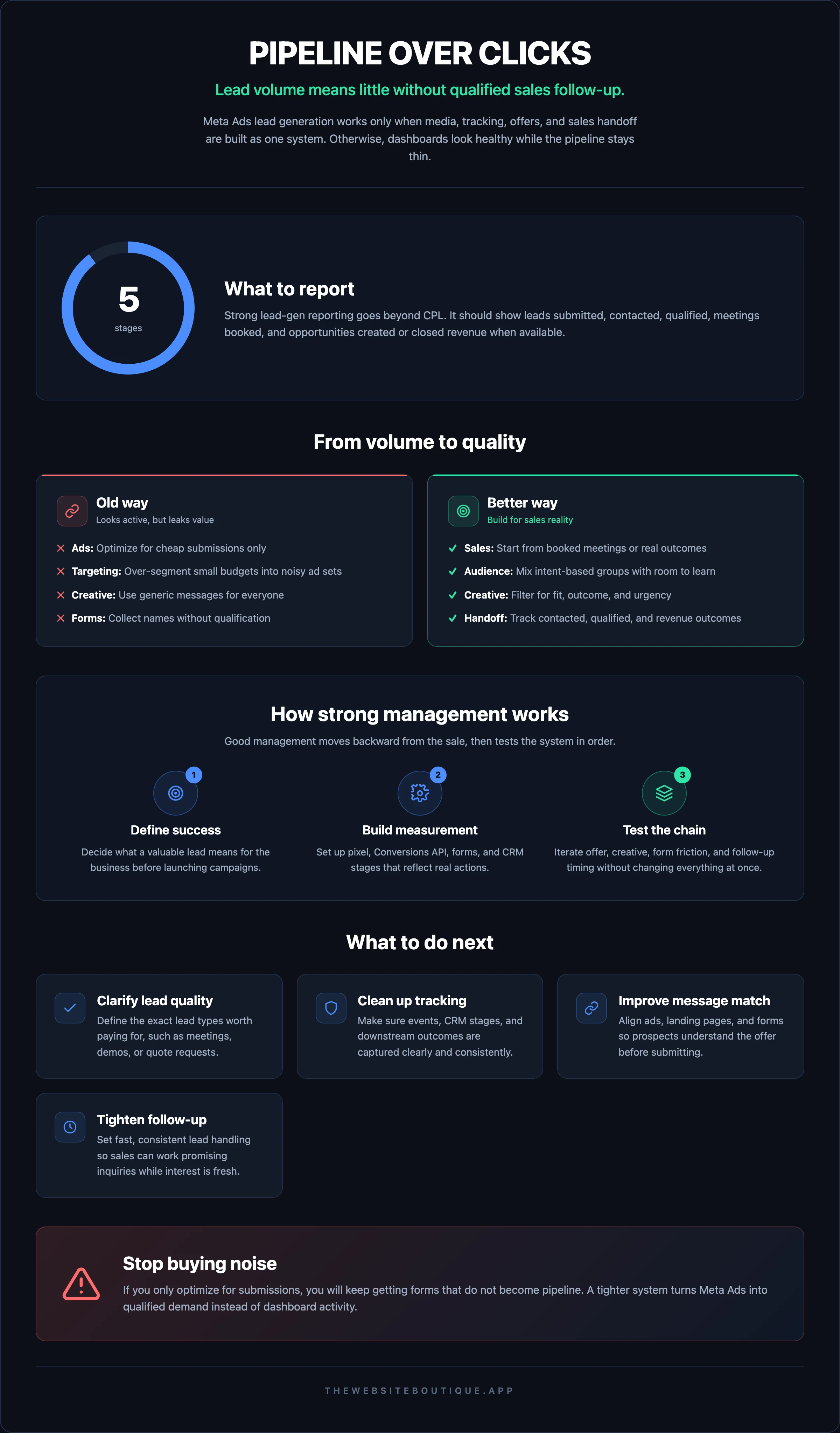
A good lead generation account is built backward from how the business sells. Before audiences or creatives, someone needs to answer a simple question: what makes a lead worth paying for here? For some businesses, that means booked meetings. For others, it means completed quote requests, demo applications, or high-intent form submissions that sales can actually work.
That framing changes everything. A campaign optimized for volume will happily deliver cheap submissions that go nowhere. A campaign optimized for quality may cost more per lead but produce a better pipeline. Good management decides which outcome matters, then aligns offer, targeting, and follow-up around it.
This is where many accounts drift. They launch with a broad promise, a generic form, and a budget split across too many ad sets. Then they spend weeks optimizing the wrong metric. A serious Meta Ads agency for lead generation should be able to explain how the funnel is designed, where qualification happens, and what signal defines success.
The tracking setup has to be cleaner than the ad account itself
If tracking is weak, optimization becomes guesswork. Meta can only improve what it can measure, so the first responsibility is making sure events, forms, and downstream data are captured properly. That includes the pixel, the Conversions API where applicable, and a clean event structure that reflects real business actions.
Meta’s own lead ads documentation is useful here because it makes clear that lead capture is only part of the workflow. The operational side matters just as much: how fast do new leads reach sales, how are duplicates handled, and where does the CRM mark a lead as qualified or disqualified?
If you want a stronger lead-gen system, the reporting should show more than CPL. A good dashboard separates:
- Leads submitted
- Leads contacted
- Qualified leads
- Meetings booked
- Opportunities created
- Closed revenue, when available
That is the difference between media reporting and business reporting. A Meta Ads agency for lead generation should push for the second one, even if it takes more setup effort. Without that, you only know which ads produce forms—not which ads produce sales conversations.
A small but important warning: when tracking is unclear, teams often “optimize” by changing too many things at once. That makes learning impossible. Better management keeps the measurement layer stable long enough to read the data with confidence.
Audience design should reflect buying intent, not just demographics
Meta targeting has changed enough that rigid audience thinking rarely helps. The question is not whether a narrow audience is “better” than a broad one. The real question is whether your targeting setup gives the algorithm useful boundaries while still leaving room to find qualified prospects.
A useful account usually mixes different audience types. That might include remarketing, lookalikes based on high-quality customers, interest-based testing where relevant, and broader prospecting when the offer is clear enough. The point is not to force a single audience philosophy; it is to separate audiences by intent and stage.
A good Meta Ads agency for lead generation should also know when not to over-segment. Splitting a limited budget into too many ad sets often creates noisy data and starves the algorithm. In smaller accounts, broad structure with strong creative often works better than trying to micromanage every segment.
The most common audience mistake is assuming the right person is the same as the right lead. They are not always the same. A visitor can match your demographic profile and still be a poor prospect if the offer attracts curiosity rather than purchase intent. That is why the structure has to test both the audience and the offer.
Creative is not decoration; it is the filter that shapes lead quality
People often ask for “better ads” when what they really need is a better message filter. Creative is where prospects decide whether they belong in the conversation. If your ad sounds like it is for everyone, you will get responses from everyone—including the people least likely to buy.
The best-performing lead-gen creative usually does one of three things: it names a specific problem, it clarifies a specific outcome, or it disqualifies the wrong fit early. That last option is underrated. A straightforward ad that says who the offer is for can save a sales team from wasting time on low-intent inquiries.
Different offers need different creative treatments:
- Service businesses often need trust signals and clarity around the process.
- High-consideration offers need proof of competence and a reason to speak now.
- Faster-moving offers need a crisp value proposition and fewer distractions.
This is why creative testing should not be random. A Meta Ads agency for lead generation should test angles, hooks, formats, and calls to action systematically. One ad might lead with a pain point, another with a concrete result, and another with a qualifier. The objective is not to make the ad prettier. It is to make the first step more selective and more persuasive.
The landing page and form decide whether clicks turn into usable leads
A lot of accounts chase the wrong villain. The ads may be fine, but the landing page is slow, unclear, or packed with distractions. Or the instant form is too easy to submit, which means you get more volume but less seriousness. Good management treats the click destination as part of the campaign, not as an afterthought.
If you use landing pages, the page should answer three things quickly: what the offer is, who it is for, and what happens after submission. If you use native lead forms, the questions should qualify without creating friction that blocks good prospects. In both cases, the form should help sales, not just collect names.
That is also where speed matters. A slow page hurts conversion and weakens the campaign’s learning loop. And if the page is not mobile-friendly, you are quietly losing a large share of potential leads before the form even loads. For teams building from scratch, a fast website designed to convert can change the quality of the entire acquisition system.
There is a second issue that gets ignored too often: message match. If the ad promises one thing and the landing page speaks in generalities, the prospect hesitates. That hesitation shows up as lower conversion, weaker lead quality, or sales calls with people who never understood the offer.
Management quality shows up in testing discipline, not in busy dashboards
A strong management partner is not being paid to keep the account active; it is being paid to make decisions. The best accounts have a testing rhythm. They know what is being tested, why it is being tested, and how long the team will wait before calling something a winner or a failure.
Testing should cover a few core variables:
Offer
Different offers can change lead quality faster than any audience tweak. A consultation, audit, estimate, or demo request each attracts different intent.
Creative angle
One message may attract problem-aware prospects while another attracts solution-aware prospects. That difference matters more than cosmetic design choices.
Form friction
Short forms increase volume. Longer forms improve qualification. The right balance depends on sales capacity and lead value.
Follow-up timing
A lead contacted within minutes behaves differently from one contacted hours later. If the sales process is slow, ad performance can look worse than it really is.
The danger is testing so much that nothing is learnable. Strong management reduces noise. It isolates one meaningful change at a time, keeps notes on what was changed, and uses results to guide the next round. That discipline matters more than daily activity inside the account.
If you want to compare how a senior team approaches this kind of work, it can help to review lead generation services managed end to end and see how ads, landing pages, and qualification fit together.
Lead quality depends on the handoff between marketing and sales
Many businesses blame Meta when the real problem is follow-up. A lead that sits untouched for a day, or one that gets a vague first message, can look like a bad lead even when it was promising from the start. The handoff is part of campaign performance.
That means the process should define who receives leads, how quickly they are contacted, what counts as a valid attempt, and how outcomes are sent back to marketing. If your team uses a CRM, the pipeline stages should be consistent enough to compare campaigns over time. If they are not, you will end up judging spend based on incomplete information.
A mature Meta Ads agency for lead generation should ask uncomfortable questions here. Are leads being worked fast enough? Are salespeople marking them correctly? Are there repeated objections that should influence the ad copy or qualification questions? Those answers often unlock more improvement than a new audience test.
For businesses building this system with outside help, it is worth reviewing clients and examples of work to understand whether the team has experience connecting acquisition to conversion, not just to clicks.
The same logic applies to reporting. The report should not only say what happened inside Meta. It should tell you where leads drop off after submission. When that visibility exists, media decisions become much sharper.
What a strong management partner should be able to explain clearly
You do not need a vendor who fills the calendar with jargon. You need one who can explain tradeoffs. If the team cannot tell you why the account is structured a certain way, what they are testing, and how they are using lead-quality feedback, then the management is probably more reactive than strategic.
A good partner should be able to answer questions like:
- Why this offer instead of another one?
- Why this audience structure and not a more fragmented one?
- What signal tells you a lead is good?
- How will you know when creative fatigue starts?
- What is the plan when CPL improves but quality drops?
If those answers are vague, the account will usually drift toward vanity metrics. If they are clear, the work becomes easier to trust. That matters even more when a business is balancing Meta with other channels like Google Ads, SEO, or AI search visibility.
For teams comparing broader growth support, The Website Boutique’s SEO and AI search approach is relevant because the same mindset applies: visibility is only useful when it converts into real demand.
A final signal of quality is whether the team documents what it learns. Lead-gen accounts improve faster when the process, the message, and the qualification rules are written down. Without that, the business keeps rediscovering the same lesson every month.
FAQs
What should a Meta Ads agency for lead generation focus on first?
It should start with lead quality, the sales process, and tracking. Media buying matters, but only after the business defines what counts as a useful lead.
Are instant forms better than landing pages?
Neither is universally better. Instant forms can reduce friction and increase volume, while landing pages often give you more control over qualification and messaging. The right choice depends on your sales motion.
Why do some campaigns get leads that never convert?
Usually because the targeting, offer, or form is attracting the wrong intent. In other cases, the issue is weak follow-up or poor handoff to sales.
How often should Meta Ads creative be refreshed?
It depends on spend, audience size, and performance, but creative should be reviewed regularly for fatigue. If response quality or click-through starts slipping, it is time to test new angles.
What is the most overlooked part of Meta lead generation?
The post-lead process. Fast follow-up, clean CRM stages, and feedback from sales often determine whether campaigns produce revenue or just submissions.
If your team is getting leads but not enough real pipeline, the next step is not another random ad test. It is a tighter system. Talk with The Website Boutique about a setup that connects Meta Ads, landing pages, and qualified lead flow with a team that works in your time zone and handles the process end to end.