

Meta Ads Lead Generation Agency: FAQs and Practical Tips
August 28, 2026 · 11 min read
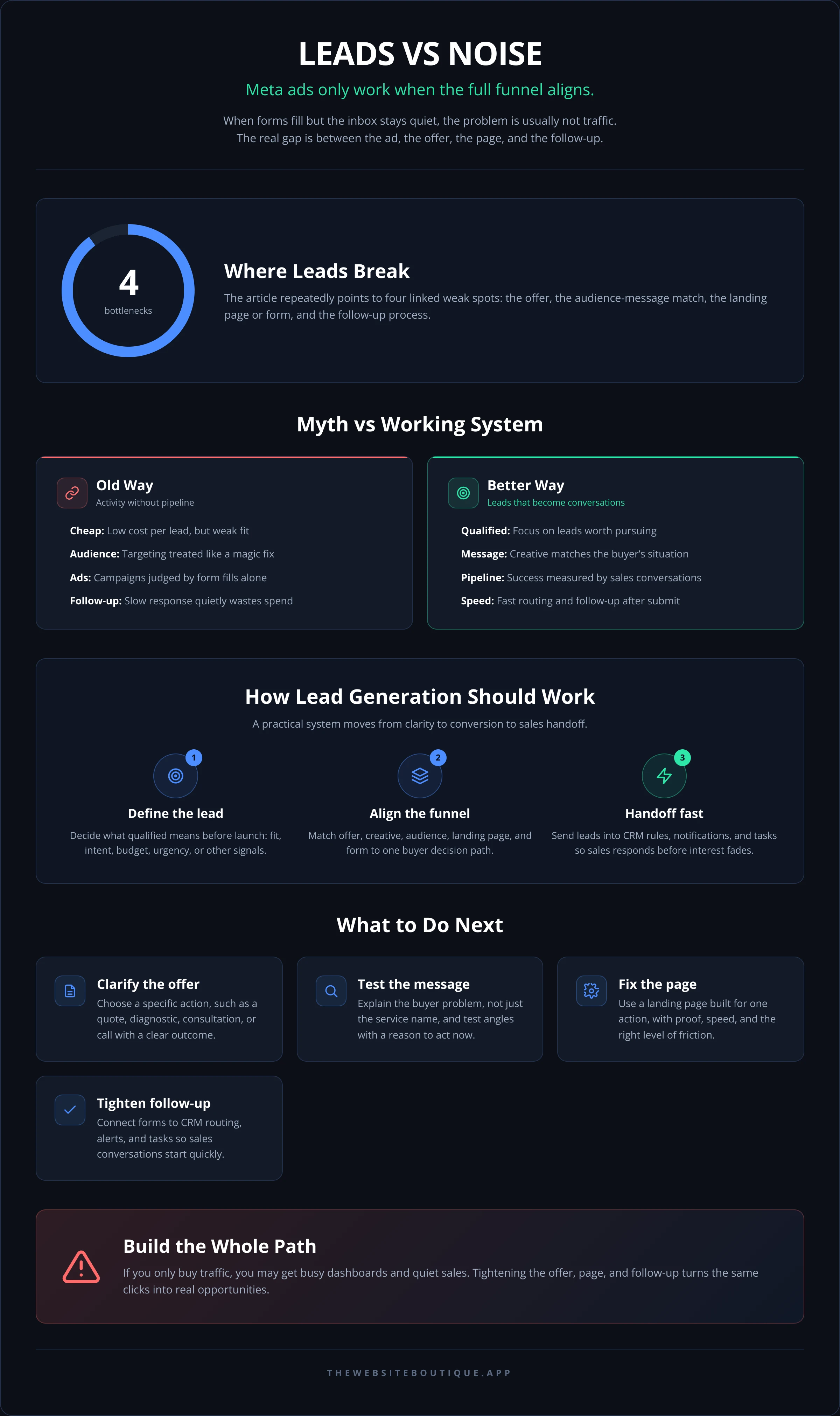
When a lead form starts filling up but the inbox stays quiet, the issue is usually not traffic. It is the gap between the ad, the offer, the landing page, and the follow-up process. That gap is where a good Meta Ads lead generation agency earns its fee.
- Cheap leads are not the same as qualified leads.
- Creative, targeting, and landing page alignment matter more than clever audience hacks.
- If the follow-up is slow, the ad account is probably wasting money no matter how good the campaign looks.
- A proper lead system should be judged by sales conversations, not form submissions alone.
- The best campaigns are built around the buyer’s decision process, not around the advertiser’s preference.
What a Meta Ads lead generation agency should actually do
A strong agency does more than launch campaigns inside Ads Manager. It helps define the lead you want, the message that attracts that person, and the path from click to booked call. If those pieces are disconnected, the campaign may still produce activity, but it will not produce a pipeline you can trust.
The first sign of a competent Meta Ads lead generation agency is how it handles the offer. If the only question is “What audience should we target?” before the offer is clear, that is a warning sign. Meta can distribute demand, but it cannot fix a weak hook, a vague promise, or a landing page that does not answer basic objections.
A practical agency should also think beyond the platform itself. Meta can create attention, but the landing page has to convert that attention into an identifiable lead, and the CRM or follow-up flow has to turn that lead into a conversation. If you want a fuller view of that system, the structure behind Meta & Google Ads + lead generation is a better model than treating ads as a standalone service.
That is why the best agencies tend to work like operators. They ask what makes a lead worth pursuing, how fast the team responds, what the sales team needs to know before calling, and whether the funnel creates enough signal to improve over time. A campaign that ignores those questions may look busy while your sales team quietly loses time.
Choosing the right offer, audience, and message
Most lead campaigns fail because the message is too generic for the person reading it. “Book a free consultation” may be a valid CTA, but it rarely carries enough weight on its own. The reader needs a reason to act now, and that reason has to match the stage they are in.
A good agency will look at three things together:
Offer
The offer should feel specific enough to justify a click. That might be a quote request, a consultation, a diagnostic, a downloadable guide, or a call with a clear outcome. The right choice depends on how much trust the market already has in your business.
Audience
Audience settings matter, but they should not be treated like magic. Meta’s strength is the quality of its delivery system and creative learning, not some hidden audience list that guarantees leads. If you are selling a service with a narrow buyer profile, broad targeting can still work when the message and landing page do the filtering.
For reference, Meta’s own business help center is useful when you want to verify account setup, lead forms, or campaign options directly from the source.
Message
The message should speak to the buying situation, not just the service. A business owner does not wake up wanting “Meta Ads management.” They want more inquiries, more booked calls, or a steadier flow of customers. If your creative does not reflect that reality, the campaign may attract clicks from the wrong level of intent.
A Meta Ads lead generation agency should be able to explain why a particular angle is being tested. That explanation should sound grounded in the buyer’s concern, not in platform jargon. If the agency cannot say what problem the ad is solving for the prospect, you are probably buying activity instead of demand.
Landing pages, forms, and the handoff that most teams miss
The landing page is where many campaigns lose their edge. A user who clicks an ad has already shown interest, but that interest is fragile. If the page loads slowly, repeats the ad without adding proof, or asks for too much too soon, the lead count may drop fast.
This is where the connection between ads and web design matters. A campaign can only perform as well as the page behind it, and pages built for lead generation need a different structure than a homepage. If that distinction is unclear, the ad spend will often compensate for a page problem that should have been fixed earlier. That is why a landing page built for one action is often more effective than pushing paid traffic to a general site.
Form design deserves its own attention. Short forms can improve completion rates, but they may also reduce lead quality if the sales team needs more context to qualify the contact. Longer forms can work when the offer is strong and the buyer expects a more serious conversation. The right setup depends on how much friction your market will tolerate before dropping off.
A good agency will also think about the handoff after the form fill. If the contact goes into a spreadsheet or sits in a shared inbox for hours, response time suffers. When speed matters, the lead generation process should connect cleanly to CRM rules, routing, notifications, and follow-up tasks. If you need a broader framework for that, Get leads is the kind of system-level page worth reviewing, not just for ads but for the full lead path.
If you are using Meta lead forms instead of landing pages, the same rule still applies. Simpler forms can reduce friction, but they must be paired with better qualification and tighter follow-up. A form that is easy to submit but impossible to work efficiently is not a win.
How to judge lead quality without fooling yourself
A campaign can deliver a lot of leads and still fail the business. That usually happens when teams look at volume before looking at fit. The better question is whether the leads create real sales opportunities.
A practical Meta Ads lead generation agency should help you define what counts as a good lead before launch. That definition may include service area, project size, urgency, industry, budget range, or any other signal that matters to your sales process. Without that agreement, reporting becomes a debate after the fact.
Useful lead-quality signals usually include:
- how many leads respond to the first outreach
- how many book a call or request a quote
- how many are disqualified for reasons you could have filtered earlier
- how many ask relevant questions that match the offer
- how often the same type of unqualified lead appears in the same campaign
The last point matters more than many advertisers admit. One bad lead is noise. A repeated pattern is a message problem, an audience mismatch, or a page that invites the wrong clicks. Good optimization does not mean pushing down the cost per lead at all costs. Sometimes the better move is to make the ad less broad so fewer low-intent users enter the funnel.
It also helps to separate marketing-qualified leads from sales-qualified leads. Meta can help create the first category. Your process creates the second. When a team blames ads for weak sales follow-up, the diagnosis is incomplete. When the sales team blames ads for poor fit without reviewing the creative or the form path, that is incomplete too.
Optimization habits that keep campaigns from going stale
Most lead campaigns do not fail on day one. They drift. A creative that worked for a while starts losing its edge, a landing page slowly becomes too familiar, or the account begins optimizing toward easier-to-convert but less valuable leads. That is why weekly management matters.
A skilled agency should review the account with a practical eye, not just report numbers. They should ask which creative angles are still fresh, which placements are attracting the right behavior, and whether the conversion path is still aligned with the audience. If a campaign is producing leads but the sales team keeps saying the quality dropped, that is a signal to inspect the funnel, not to celebrate the volume.
The pacing of changes matters too. Changing too many variables at once makes it hard to learn anything useful. Changing nothing for too long lets the account go stale. A well-run Meta Ads lead generation agency knows how to test without breaking the campaign’s memory.
It also helps to compare Meta with other channels instead of treating it like the only source of demand. Google may capture existing intent while Meta creates demand earlier in the buying cycle. If you want an outside comparison point, Nika Media is an example of a specialist agency where paid media is treated as part of a broader performance system, not a disconnected tactic.
For businesses that also care about search visibility and AI discovery, it can be smart to connect paid campaigns with organic and GEO work. The audience that ignores an ad today may search tomorrow, and a site that is structured well can support both paths. That broader approach is why SEO + AI Search (GEO) often belongs in the same planning conversation as ads.
Questions to ask before you hire
A lot of buyers ask whether an agency “has experience.” That is too vague to be useful. Experience with what? Lead forms, landing pages, service businesses, local markets, or sales teams that need qualified appointments rather than raw form submissions?
These questions usually reveal more:
How do you define a qualified lead?
If the answer is only “someone who fills out the form,” keep going. A serious agency should talk about fit, intent, and downstream conversion, not just form completion.
What do you change first when performance drops?
Good agencies have a sequence for diagnosis. They do not randomly swap creatives, budgets, and targeting on the same day.
How do you work with landing pages and follow-up?
If the answer is “we just run ads,” the service is incomplete. The best results usually come when the ad, page, and CRM logic are handled together.
What kind of reporting do you provide?
Reporting should help a business owner make decisions. Screenshots of Ads Manager are not enough. You need to understand which campaigns created qualified conversations and which ones did not.
What should I prepare before launch?
A reliable agency will ask about your offer, your sales process, your capacity, and the objections buyers usually raise. If those questions never come up, the campaign may be built on assumptions that fail the moment real traffic arrives.
If you are still shaping the site around the offer, it can help to review Get a site that converts before investing more in traffic. Ads can accelerate demand, but they cannot repair a weak first impression.
FAQs about hiring a lead generation ad agency
How long does it take to know if a campaign is working?
You can often see early signals quickly, but real judgment takes enough time to gather meaningful data across creative, audience, and follow-up. A campaign should be evaluated on lead quality and sales outcomes, not on early excitement alone.
Is Meta better than Google for lead generation?
They solve different problems. Meta is often stronger for creating demand and reaching people before they search. Google is often better when intent is already active. Many businesses use both because they support different parts of the buying journey.
Should I use lead forms or landing pages?
Both can work. Lead forms reduce friction; landing pages usually give you more room to qualify and persuade. If your offer needs explanation or proof, a landing page often performs better. If speed matters more than detail, forms can be useful.
What usually lowers lead quality?
Vague ads, broad offers, weak qualification, slow follow-up, and pages that attract people who were never a fit. In many cases, lead quality drops because the campaign is optimized for cheap submissions rather than useful conversations.
Do I need a website before running Meta ads?
You need some form of conversion destination. It does not have to be a large site, but it does need to support the offer and capture the lead cleanly. If your current site is not helping the ad convert, that problem should be addressed first.
If the campaign already feels messy, the fastest improvement is usually not another tweak to the targeting. It is tightening the offer, the page, and the follow-up so the same clicks have a better chance of becoming real opportunities. A focused team like The Website Boutique can help with that end-to-end structure when you want the ads, page, and lead system to work as one.
If you want a cleaner lead engine, start with a review of the current funnel, not just the ads account. Services and Pricing can help you see which pieces need attention first, whether that is the landing page, the campaign setup, or the follow-up path. A better lead flow is usually built by fixing the bottleneck closest to the buyer, not by spending harder on the same weak process.