

Meta Ads Lead Generation Agency Mistakes
September 07, 2026 · 12 min read
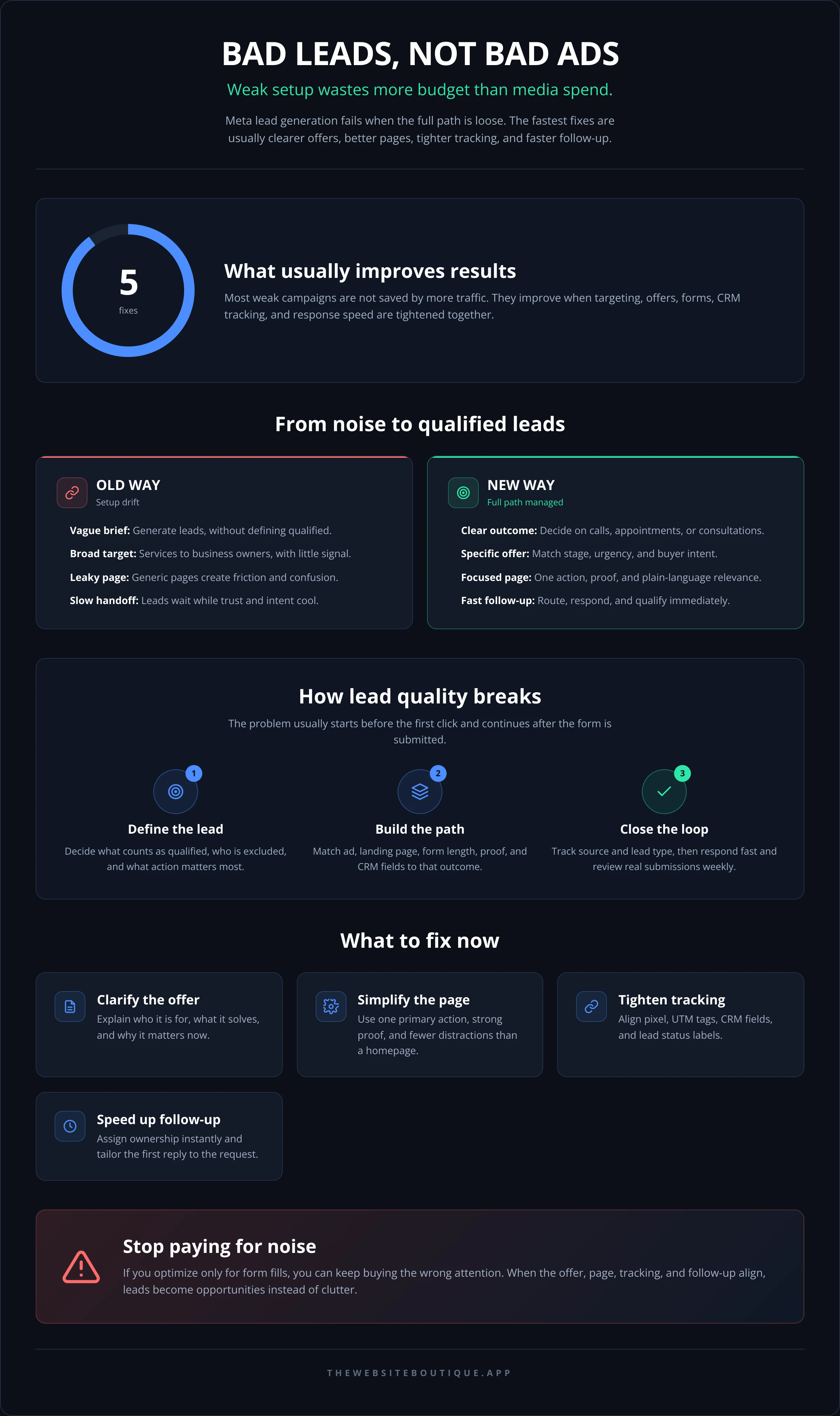
- Cheap leads are often a setup problem, not a traffic problem.
- A Meta Ads lead generation agency should own the full path from ad click to booked call.
- Weak landing pages, vague offers, and bad follow-up usually waste more budget than the ads themselves.
- If your team cannot answer speed-to-lead and lead quality questions, campaigns will drift.
- The best fixes are usually practical: better targeting, clearer offers, simpler forms, and tighter CRM tracking.
If you have ever looked at a campaign dashboard and thought, "We got leads, but not the right ones," the problem usually started before the first click. A Meta Ads lead generation agency can drive volume fast, but if the offer, landing page, tracking, or follow-up process is loose, the lead list fills up with people who were never likely to buy.
That is the frustrating part. The ad may be doing its job. The business outcome still misses the mark.
For owner-operated businesses, that gap is expensive because time is limited. Sales calls, callbacks, quote requests, and CRM cleanup all compete with the actual work of running the business. If your Meta campaigns are creating more noise than opportunities, the issue is rarely one single mistake. It is usually a stack of small decisions that never got challenged.
What goes wrong before the first ad is launched
A lot of campaigns begin with a request that sounds simple: generate leads. That request is too vague to guide the work. A good Meta Ads lead generation agency needs to know what counts as a qualified lead, what the offer is, who should see it, and what happens after someone submits a form.
When those answers are fuzzy, the campaign defaults to convenience. The ad platform optimizes for form fills, not business value. That is how you end up paying for curiosity, price shoppers, job seekers, or people who clicked because the creative looked interesting rather than because they need the service.
The most common planning mistake is skipping the math of the funnel. If your team wants booked appointments, the campaign cannot be judged only by CPL. If your sales process depends on phone calls, a form-only setup may not be enough. If the offer is too broad, the agency will spend extra effort trying to rescue weak positioning with targeting hacks that rarely hold up.
A better setup starts with decisions, not assets:
- What outcome matters most: form fills, calls, booked appointments, or qualified consultations?
- What buyer should be excluded, even if they are cheap to reach?
- What question should the ad answer that the website does not?
- What happens in the first 10 minutes after the lead arrives?
If those questions are not settled, the campaign is being built on assumptions.
Mistakes a Meta Ads lead generation agency makes with targeting and offer design
The first visible mistake is usually targeting too broadly. Broad targeting can work, but only when the offer is specific and the account has enough structure to read the data. If the campaign sells "services" to "business owners," the platform has little signal to work with. You get leads, but they are hard to classify.
The other extreme is over-segmentation. Some agencies slice audiences so tightly that the campaign never collects enough useful data. They keep changing interests, locations, and age bands while the real issue sits elsewhere: the message is too generic or the offer does not create urgency.
Offer design matters more than many businesses expect. A lead magnet that sounds safe can also sound forgettable. "Free consultation" is not always persuasive by itself. The offer has to match the buyer's stage. Someone who already knows they need help may respond to a clearer next step, such as a review, audit, assessment, or quote. Someone earlier in the journey may need more education first.
One practical way to test the offer is to ask whether a stranger would understand three things in five seconds:
1. Who the service is for.
2. What problem it solves.
3. Why the action is worth taking now.
If the answer is no, the campaign is not ready for optimization yet. It needs positioning work before more budget goes into it.
This is also where local context and trust signals matter. For some businesses, a local page or market-specific page can improve relevance more than another audience tweak. A landing page that speaks like the visitor, shows the service clearly, and removes guesswork usually does more for lead quality than clever audience layering.
Landing pages that leak leads
A weak landing page is one of the fastest ways to waste a good campaign. The ad may attract attention, but the page loses it with too many choices, too little proof, or too much copy that never gets to the point.
Many businesses send paid traffic to a generic services page or home page because it feels efficient. It is not. The visitor has a task: understand the offer and decide whether to act. A page that forces them to search, compare, or interpret multiple services creates friction. Every extra click reduces the odds that the lead will be worth the spend.
A useful landing page does a few specific things well:
- Matches the ad promise immediately.
- Repeats the core offer in plain language.
- Shows enough proof to reduce hesitation.
- Uses one primary action, not several competing ones.
- Keeps forms short enough to invite completion without collecting junk.
The form itself deserves attention. Longer forms can improve quality, but only if the value is high enough to justify the effort. Short forms usually raise volume. That does not automatically make them better. If the campaign needs serious prospects, a short form with no qualification can create a pile of low-intent submissions that the sales team must sort through manually.
Speed also matters. Google's page experience guidance is about search, but the user behavior lesson applies here too: slow, clunky pages lose trust fast. For paid traffic, that loss happens before the conversation even starts.
If the page is doing its job, the lead should not need a follow-up email to understand what they requested. They should know what happens next and why responding is worth their time.
Tracking gaps that hide the real problem
A lot of campaign debates are really tracking debates in disguise. The lead volume looks fine, but the business says quality is weak. The agency says the platform data looks healthy. Both may be telling the truth, because neither system can see the whole journey.
This is where a Meta Ads lead generation agency should be comfortable with more than campaign setup. It needs to know how leads move from ad click to form submission to CRM stage to booked call to closed deal. If that chain is broken, optimization becomes guesswork.
A common mistake is treating the platform's conversion count as the final truth. In reality, a submitted form is only a step. If the same lead appears in your CRM with missing phone numbers, duplicate records, or no source data, you cannot tell whether the campaign attracted the wrong people or the follow-up process is failing them.
Useful tracking usually includes:
- Meta pixel and conversion setup aligned with the actual business outcome.
- Clean UTM conventions so traffic can be traced outside the ad account.
- CRM fields that preserve source, campaign, and lead type.
- A way to mark qualified, unqualified, contacted, and booked leads.
- A manual review process for a sample of leads every week.
That last item matters more than people like to admit. You can learn a lot by reading the actual submissions. Are people asking the same irrelevant question over and over? Are competitors submitting forms? Are the leads describing a need that the ad never mentioned? The answer points to what needs fixing.
For businesses that want a stronger search and discovery footprint too, it often helps to pair paid traffic with a clearer site structure and content strategy. SEO and AI search (GEO) can support the same trust signals that make paid visitors convert, especially when buyers compare you against other options before reaching out.
Why lead quality depends on follow-up speed and sales handoff
One of the biggest mistakes in lead generation has nothing to do with media buying. The campaign generates a lead, but nobody responds quickly enough, or the follow-up message is generic, or the sales handoff assumes too much context.
That is how good leads go cold.
People who submit a form are often in a short decision window. If your team waits until later in the day, the lead may already be comparing alternatives or moving on. If the first message is vague, it creates more work for the prospect. If the sales process repeats information they already gave, trust drops.
A Meta Ads lead generation agency should be asking how the lead is handled after submission, not just how many forms were filled. That means reviewing:
- Who receives the lead first.
- Whether the notification is instant.
- Whether the CRM assigns ownership automatically.
- Whether the first reply references the service requested.
- Whether the sales process is built for the type of buyer the campaign attracts.
If a business sells high-consideration services, the handoff should be intentional. Someone who filled out a contact form because they wanted pricing should not receive the same follow-up as someone who downloaded a general resource. The message, timing, and next step should match intent.
This is also where many businesses discover the value of a tighter system rather than a bigger budget. Better routing, better qualification, and better response habits can improve results faster than another round of audience changes.
A decent benchmark is simple: if the team cannot explain what happens to a lead in the first hour, the process is not stable enough for scaling.
How to spot a bad Meta Ads lead generation agency early
Most problems are visible before the account is even mature. You just have to know what to listen for.
Be cautious if the conversation stays stuck on impressions, clicks, or platform features while avoiding the website, offer, CRM, and sales process. Those metrics matter, but they are not the whole job. If the agency cannot explain how it will judge lead quality, it probably plans to optimize for easy numbers.
Another red flag is overpromising certainty around creative or audiences. Meta can be powerful, but lead generation is still shaped by market demand, offer strength, and page quality. Anyone who talks like the platform alone will solve a weak funnel is setting the wrong expectation.
Watch for these patterns:
- They want to launch without reviewing the landing page.
- They treat every lead source as equal, even when intent is different.
- They do not ask who should be disqualified.
- They avoid discussing CRM or sales handoff.
- They report on leads without asking which ones moved forward.
A better partner will ask sharper questions. What is the ideal lead? What should the ad pre-qualify? What does a bad lead look like? What is the fastest way to tell whether the campaign is bringing the right people?
If you are comparing options, it can help to review the agency's own work and process before you commit. A clear About page, transparent Services, and practical Pricing often reveal more than a polished pitch.
For businesses wanting to see how a small, hands-on studio works across websites, paid traffic, and follow-up, The Website Boutique keeps that process intentionally lean. The goal is not to run more campaigns for the sake of activity. It is to build a cleaner path from click to customer.
A better way to evaluate your next campaign
When results feel mixed, the temptation is to ask for more changes in the ads. Sometimes that is right. Often it is not. A better review starts by separating volume from value.
Ask these questions in order:
- Did the ad make the offer clear enough for the right person to click?
- Did the landing page remove friction or add it?
- Did the form collect enough detail to filter noise?
- Did the CRM capture the lead cleanly?
- Did someone respond quickly and consistently?
That sequence usually reveals where the leakage happens. It also stops the blame game between ads, web, and sales. If the ad is driving the wrong people, fix the message. If the page is confusing, fix the structure. If the follow-up is slow, fix the process.
Sometimes the best move is to simplify. Fewer campaigns. Fewer audience experiments. Fewer page distractions. Stronger offer. Cleaner tracking. Faster reply. That combination often produces better lead quality than a more complicated account that looks impressive in screenshots.
A Meta Ads lead generation agency should be able to support that kind of discipline. Not by hiding behind jargon, but by connecting the media plan to the actual customer journey. If the agency cannot do that, the campaign may still generate leads, but it will keep generating confusion too.
Frequently asked questions
Why do Meta Ads generate leads that never become customers?
Usually because the campaign is optimizing for submissions, not qualified interest. A vague offer, weak landing page, or slow follow-up can all create leads that look fine in the ad account but never move forward in the CRM.
Should a lead generation campaign always use a landing page?
In most cases, yes. A focused landing page gives the visitor one clear action and makes it easier to match the ad promise. Sending paid traffic to a general homepage usually adds friction and lowers lead quality.
How often should lead quality be reviewed?
At least weekly at first. Reviewing actual leads, not just platform metrics, helps you catch bad traffic sources, confusing offers, or broken follow-up before the budget drifts too far.
What matters more: targeting or offer?
For many campaigns, the offer matters more. Good targeting cannot fully rescue a weak message, and broad targeting can work when the offer and page are clear enough to attract the right buyer.
How can I tell if my agency is focused on the right metrics?
If the reports only discuss clicks and form fills, that is a warning sign. A stronger partner will also ask about qualified leads, booked calls, CRM stages, and response speed.
Does better tracking really improve lead quality?
It improves decision-making first. Once you can see where leads come from and what happens after they submit, it becomes much easier to cut waste and reinforce the parts of the funnel that actually convert.
If your current setup is producing leads but not enough qualified conversations, the next move is not another round of guesswork. It is a cleaner funnel: a sharper offer, a page built to convert, and follow-up that matches buyer intent.
If you want help tightening that path, Get leads and Get a site that converts are the most direct places to start. If the issue is the page itself, a focused Landing page can remove a lot of wasted spend before it starts.