

Meta Ads Lead Generation Agency Pricing and Inclusions
September 02, 2026 · 12 min read
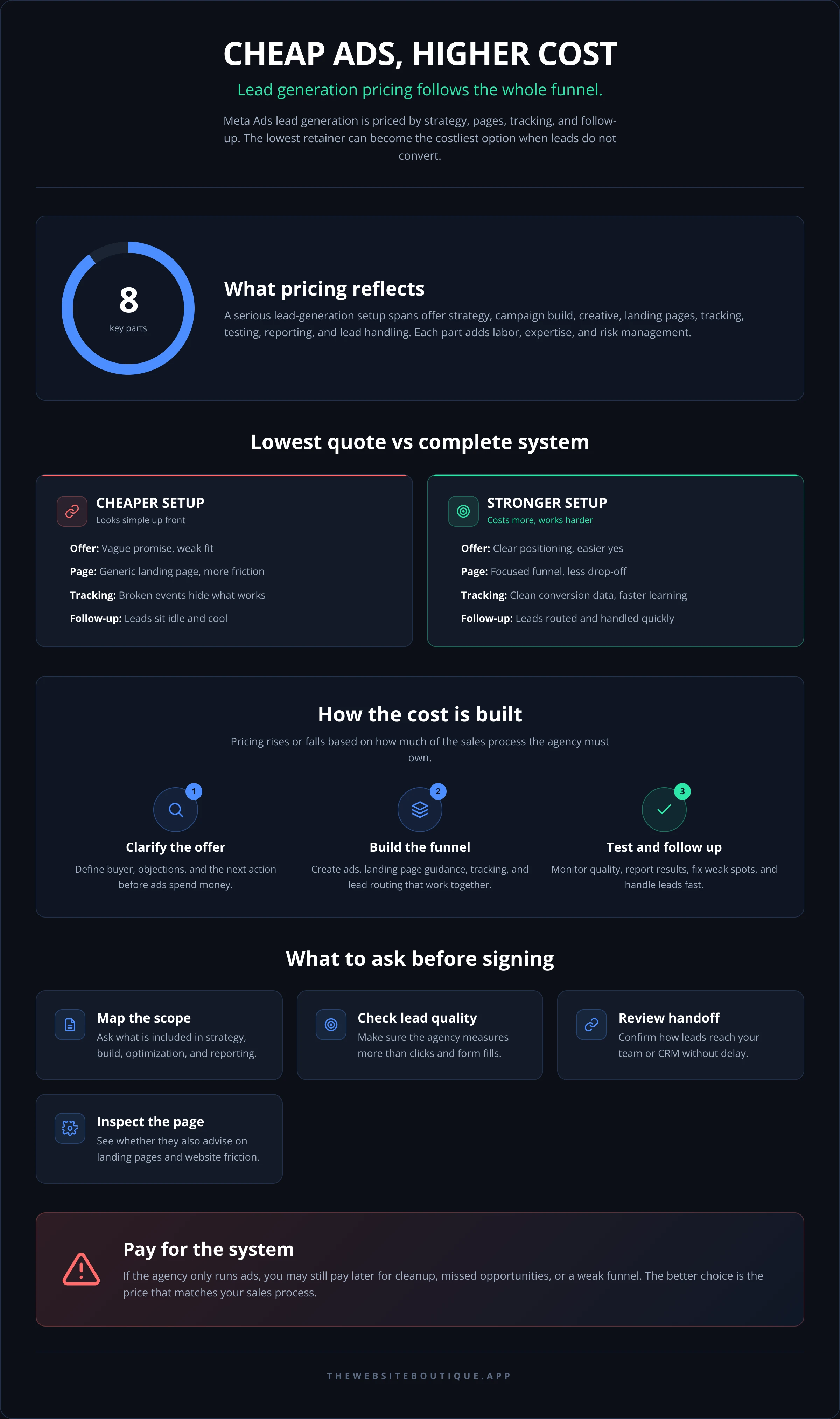
- Costs depend on scope, not just ad spend: strategy, creative, landing pages, tracking, and follow-up all change the price.
- The cheapest setup is often the most expensive one once you factor in wasted clicks and unqualified leads.
- A serious Meta Ads lead generation agency should include offer strategy, conversion tracking, testing, reporting, and lead handling.
- If your landing page and CRM are weak, paid traffic usually exposes the problem fast.
- The best pricing is the one that matches your sales process, not the one with the lowest monthly retainer.
Meta Ads lead generation agency pricing starts with the offer
You can usually tell within a few minutes whether a lead campaign is going to struggle. If the offer is vague, the landing page is generic, and the form asks for too much too soon, a Meta Ads lead generation agency is mostly being asked to rescue a weak system. That is where cost starts to rise, because the real work is not just managing ads; it is building a path that makes a stranger willing to raise their hand.
Price is shaped first by how much clarity already exists. A business that knows its target buyer, service area, top objections, and main sales question usually needs less strategy work than one that is still guessing. If you are comparing agencies, the fastest way to distort pricing is to compare media buying alone while ignoring the offer, the page, and the follow-up.
For owner-operated businesses, this matters even more. When every lead has to be worth somebody's time, cheap traffic is not a win if the lead never becomes a call, estimate, or booked appointment. A tighter setup costs more up front because it forces decisions about positioning, qualification, and speed to lead.
The parts that usually change the price
A serious quote for a Meta Ads lead generation agency often includes some mix of:
- Audience and offer strategy
- Campaign structure and account setup
- Creative direction or ad copy writing
- Landing page or form funnel support
- Tracking setup for leads and conversions
- Testing and optimization
- Reporting and callouts on lead quality
- CRM or lead routing support
If the agency is only touching one of those pieces, the monthly fee may look lower, but the system is incomplete. A landing page can be beautiful and still fail if the tracking is broken or the form submission never reaches the CRM. Meta's own Business Help Center is a useful reminder that campaign setup, pixel events, and optimization are not optional details; they are part of whether the ads can learn at all.
What a lead generation setup should include
The phrase "management" gets used loosely. In a real service, the agency should be handling the things that influence both lead volume and lead quality, not just pausing ads and changing a few headlines. If you are hiring a Meta Ads lead generation agency, ask what happens before launch, during the first two weeks, and after the first leads come in.
A complete setup usually includes a short but meaningful discovery process. That should surface the audience you actually want, the offer that is easiest to say yes to, the objections that slow people down, and the next action you want them to take. If that conversation is skipped, the campaign can still spend money, but it will spend it on assumptions.
The other part people forget is response handling. If leads sit in a spreadsheet for half a day, the campaign may still look active while the business quietly loses the best opportunities. A good Meta Ads lead generation agency should at least be thinking about how leads are routed, acknowledged, and tracked after the form fill.
What should be included versus sold separately
Some items belong inside the core engagement. Others can be separate depending on the scope.
Commonly included:
- Campaign build and management
- Ad copy and basic creative guidance
- Conversion tracking and event setup
- Landing page recommendations
- Reporting and testing cadence
Often sold separately:
- Full landing page design and development
- CRM setup and automation workflows
- Advanced creative production
- Multi-channel nurture sequences
- Complex custom integrations
A business that wants everything bundled should expect the price to reflect that. A business that already has a strong website and a functional CRM can often buy a narrower service. If you need the page itself built, that changes the job entirely; a lead page that converts is not the same product as ad management.
For teams that want a broader marketing view, it can help to review agency positioning and service depth before you sign. The About and Services pages should make it obvious whether the provider is actually built for lead generation or just offers it as an add-on.
What you are really paying for each month
Monthly pricing is usually a blend of labor, expertise, and risk. The labor is obvious: someone has to build, monitor, test, and report. The expertise is less visible: knowing which metrics matter, which audiences are too broad, and when a creative problem is actually a landing-page problem. The risk comes from the fact that paid traffic can consume budget quickly if the funnel is weak.
A lower retainer may be fine if your account is simple and your lead flow is already stable. Once the campaign needs regular testing, better creative angles, or a landing page refresh, the work expands. That is why two agencies can quote very different numbers for what sounds like the same service.
There is also a difference between "running ads" and "building a lead system." The first can be done cheaply. The second usually includes message refinement, page adjustments, and enough scrutiny to tell whether the leads are merely cheap or genuinely useful. A company like The Website Boutique tends to fit businesses that want fewer clients, more attention, and a custom build rather than a templated handoff.
A simple way to judge whether the price is sensible
Ask yourself three questions:
1. Will this engagement improve more than one part of the funnel?
2. Will the agency tell me what is happening with lead quality, not just click-through rate?
3. Will the work continue after launch, or does it stop once the ads are live?
If the answer is no to most of those, the quote may be cheap for a reason. You may still end up paying for cleanup later through a fast website, a revised funnel, or missed opportunities because leads were never tracked properly.
A useful benchmark is not "How little can I pay?" It is "How much of the sales process is this vendor actually owning?" The more responsibility they take for measurement, page quality, and lead handoff, the more justifiable the price becomes.
Pricing models and what they usually signal
Most buyers see three familiar structures: flat monthly retainers, project-based fees, or hybrid models. Each has a place, but the model itself tells you something about the work. A simple retainer can make sense when the account is steady. A project fee can fit a one-time build or audit. A hybrid usually appears when the agency is handling both ads and funnel assets.
The wrong model is the one that hides the real scope. If the agency says one price but expects the client to supply strategy, copy, landing pages, tracking, and CRM logic, the invoice may look clean while the workload is not. If you are evaluating a Meta Ads lead generation agency, ask for the boundary lines in plain English.
A useful comparison is to look at the service stack rather than the label. For example, some buyers need only campaign management because they already have a good page and follow-up system. Others need the full path: landing page design, ad management, and connection to a CRM or sales process. The second buyer will almost always pay more because there are more ways to fail.
Hidden costs that appear later
These are the items that often surprise business owners:
- Creative revisions beyond the original scope
- Additional landing pages for separate offers
- CRM troubleshooting or integration work
- Tracking repair after a site change
- Copy rewrites when the offer is not converting
- Extra reporting for multiple stakeholders
One of the most common surprises is that the ads themselves are not the full cost of acquisition. The campaign may be working, but if the site is slow or the form is awkward, the lead volume can drop. Google Search Central's SEO Starter Guide is not about Meta Ads, but it reinforces a point advertisers sometimes ignore: the page experience matters because the page is part of performance, not a separate department.
If your business also needs visibility outside paid traffic, some teams combine ads with SEO and AI search (GEO) so inbound demand does not depend entirely on media spend. That is not required for every buyer, but it changes the long-term economics.
How to compare agencies without getting fooled by the lowest quote
The lowest quote usually wins attention because it is easy to compare. It is also the easiest way to miss what is missing. A bare-bones offer may include campaign setup and a few optimizations, but no real ownership of the landing page, lead routing, or testing cadence. That can be fine if you already have those assets covered; it is risky if you do not.
A better comparison is to ask each Meta Ads lead generation agency to explain exactly what happens from click to booked lead. Who writes the ads? Who checks the form? Who notices when conversion tracking breaks? Who decides whether the problem is audience, offer, page, or follow-up? If those answers are fuzzy, the price is probably not the real issue.
There is also a difference between production and partnership. A production vendor executes what you request. A partner helps you make better decisions when the campaign reveals weak spots. For owner-led businesses, that second role matters because the bottleneck is often not traffic; it is clarity. When a page needs to be rebuilt or a message needs to be simplified, a custom team can be more useful than a generic media buyer.
Questions worth asking before you sign
- What is included in strategy, build, and optimization?
- How do you measure lead quality?
- What happens if the landing page underperforms?
- Who owns the ad account, data, and creative assets?
- How quickly are leads delivered to my team or CRM?
If you want a provider that handles the site and the lead flow together, it can be useful to review their work and the way they present pricing. The best fit is usually the one whose process matches your business reality, not the one with the broadest promise.
For additional context on local service businesses and demand generation, Nika Media is another example of an agency site that helps clarify how a marketing service is framed. Seeing how different providers structure their offers can make it easier to spot what is essential and what is just packaging.
When an ad agency should also touch the website
A campaign can only convert as well as the page it lands on. If the page is slow, confusing, or disconnected from the ad promise, the cost of each lead goes up even when the targeting is fine. That is why a Meta Ads lead generation agency is often more effective when it can also advise on the page, not just the media.
This is especially true for businesses that rely on owner involvement in the sale. The lead usually needs to understand the offer fast, trust the business, and know what happens next. If the landing page does not do that, people abandon it before the form. In those cases, website strategy and ads should be planned together.
There is a practical reason some studios keep the client list small. When the team can look at copy, page layout, form friction, and ad messaging in one sitting, fewer issues get handed off and ignored. That tighter loop can be more valuable than a larger agency structure where media, design, and CRM work live in separate silos.
When to pair ads with another service
Consider a broader build if:
- Your current page is slow or generic
- The form is too long for cold traffic
- Leads are coming in but not booking calls
- Your CRM follow-up is manual or inconsistent
- You are launching a new offer and need positioning help
If that sounds familiar, a single vendor for both the ads and the conversion assets can reduce friction. It also makes it easier to diagnose where the breakdown is happening. That is often the difference between a campaign that "runs" and one that actually supports revenue.
FAQ
How much does a Meta Ads lead generation agency cost?
It depends on scope, but the price is driven by strategy, creative, landing pages, tracking, and follow-up support. A simple campaign management-only engagement will cost less than a full lead system.
What should be included in the service?
At minimum, you should expect strategy, account setup, campaign management, tracking, testing, and reporting. If the agency is also responsible for the landing page or CRM flow, that should be spelled out clearly.
Is ad spend included in the agency fee?
Not always. Many agencies charge their service fee separately from media spend. Ask whether the quote includes only management or also design, development, and automation work.
Why do some agencies charge much less than others?
Lower prices often mean a narrower scope, less strategic involvement, or fewer support tasks after launch. That can be fine for a simple account, but risky if your page or follow-up process is weak.
Should the agency build the landing page too?
If your current page is not converting well, yes, it is often worth having the same team handle both sides. A page and ads built in isolation usually create more troubleshooting later.
How do I know if the leads are good?
Track more than the form fill. Look at booked calls, sales conversations, and whether the lead matches the audience you wanted. A good agency should help you define and monitor those signals.
If you are ready to fix the whole path instead of patching one piece at a time, The Website Boutique can help you build the page, tracking, and ad flow around the way your business actually sells. The next step is a simple one: review your current funnel, decide where leads are getting stuck, and ask for a setup that addresses that exact problem rather than a generic monthly ad package.