
Meta Ads Lead Generation Agency: What to Know
August 23, 2026 · 12 min read
If your pipeline looks busy on paper but sales keeps complaining about lead quality, a Meta Ads lead generation agency may be the missing layer. The problem is rarely “more traffic” by itself; it’s usually a mix of weak targeting, generic creative, slow follow-up, and landing pages that never earn the click.
- A good lead generation setup connects ads, landing pages, and sales follow-up.
- The best agency should improve lead quality, not just lower cost per form fill.
- Creative matters as much as targeting because Meta rewards engagement and relevance.
- Reporting should separate leads, qualified leads, and actual opportunities.
- If your team cannot respond fast, even strong campaigns will underperform.
What a Meta Ads lead generation agency actually does
A strong Meta Ads lead generation agency is not just a pair of hands inside Ads Manager. It is responsible for the full chain between attention and booked conversations: audience strategy, offer framing, creative testing, landing page alignment, form optimization, tracking, and iteration.
That distinction matters because Meta can produce cheap volume that never turns into revenue. If the agency is only watching cost per lead, it may be optimizing for the easiest form fills, not for the leads your sales team wants. The better approach is to build campaigns around the real buying motion in your business: who needs to hear the message, what proof they need, and what happens after the click.
For teams evaluating partners, it helps to read Meta’s own guidance on lead ads and conversion tracking through Meta Business Help Center. Those resources won’t replace strategy, but they show how much depends on setup, not just budget.
Signals that you need better lead quality, not just more leads
A lot of businesses start searching for a Meta Ads lead generation agency after the same pattern repeats for a few weeks: sales says the leads are weak, marketing says the CPL is acceptable, and nobody can explain where the mismatch starts. When that happens, the issue is usually upstream.
Look for these signs:
- Sales is spending time on prospects who do not match your ideal customer.
- The same objections appear over and over on first calls.
- Leads arrive, but booked meetings stay flat.
- Many forms are submitted by people who clearly wanted something broader, cheaper, or unrelated.
- Your ads generate clicks, but the landing page or form feels disconnected from the promise.
These symptoms do not always mean the media buying is wrong. Sometimes the offer is too broad. Sometimes the form asks for too little and attracts curiosity instead of intent. Sometimes the follow-up speed is slow enough to let warmer prospects go cold. A strong agency should be able to diagnose which part of the system is leaking before scaling spend.
If your team also relies on organic discovery, search visibility can influence how paid campaigns perform. People often interact with your brand in more than one place before they convert. That is why a broader growth partner like The Website Boutique may connect paid media, fast sites, and search visibility in one plan instead of treating each channel in isolation.
What separates a useful partner from a media buyer
The most useful Meta Ads lead generation agency behaves more like a growth operator than a traffic vendor. Media buying is only one skill in the stack. The real value comes from how the partner handles tradeoffs between audience size, message specificity, creative fatigue, landing page friction, and internal sales workflow.
A weak partner usually starts with ad formats and audience interests. A stronger one starts with the customer journey. They ask what happens after the form submit, how fast leads are contacted, which leads become opportunities, and what kind of proof removes hesitation. That context shapes everything else.
This is where seniority shows up. A junior operator may know how to launch campaigns. A senior team knows when to pause an ad set that looks efficient but attracts the wrong people, when to simplify the offer, and when the bottleneck is actually the website. If you are building a fuller lead system, it may be worth comparing scope with a lead generation service rather than buying ads alone.
Questions worth asking before you sign
Ask how they define success beyond CPL. Ask whether they optimize for form fills, booked calls, or qualified opportunities. Ask how they will test creative angles, and what they need from your sales team to learn quickly. Ask what they will do when volume increases but quality drops.
If the answer is mostly platform mechanics, keep looking.
The parts of the funnel that decide lead quality
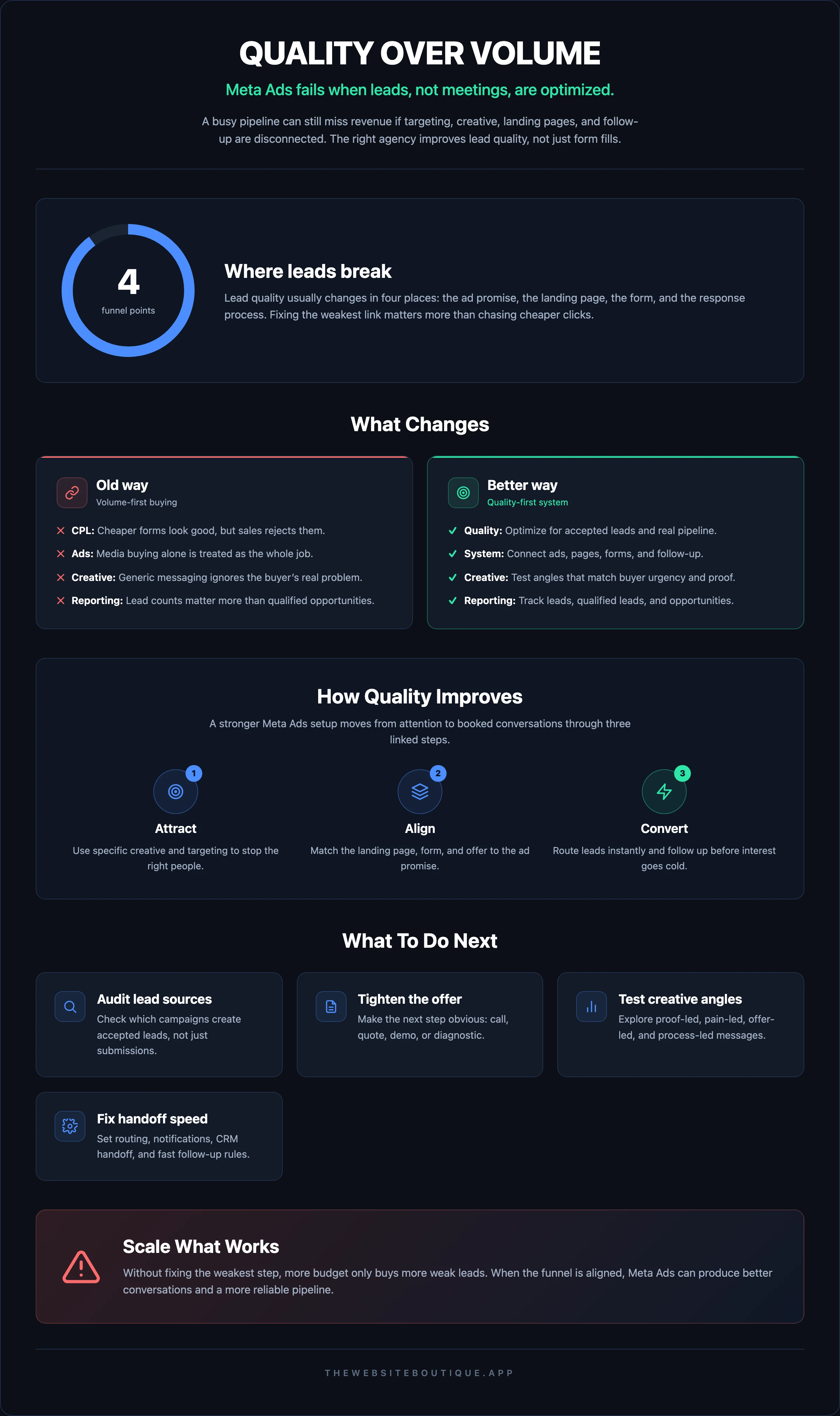
A Meta Ads lead generation agency can only improve so much if the funnel itself is messy. The path from scroll to sale usually breaks in one of four places: the ad promise, the landing page, the form, or the response process.
The ad has one job: make the right person curious enough to continue. The landing page has a different job: confirm that the offer is relevant, specific, and worth a minute of attention. If those two pieces do not match closely, the click may be cheap but the lead often will not be worth much.
Forms matter more than many teams expect. Too many fields can crush completion rates. Too few fields can invite poor-fit leads. The right balance depends on your sales cycle and the value of the offer. If your team sells a complex service, a shorter form with strong qualification logic may work better than a long interrogation. If you need high intent, a bit more friction can protect sales time.
The response process is just as important. Even a good lead degrades quickly when no one contacts them fast enough. That is why routing, notifications, CRM handoff, and follow-up rules need to be designed before scale, not after it. Teams that want to tighten this whole path should also look at fast websites built for conversion, because load speed and page clarity directly affect campaign efficiency.
When landing pages are the bottleneck
If clicks are healthy but forms are weak, the page may be doing too much talking and not enough guiding. Visitors need to understand what they get, who it is for, and what happens next. They also need proof that the offer is real and relevant without reading a wall of copy.
That is why a lead campaign often needs a dedicated page rather than sending traffic to a generic homepage. The homepage can still support trust, but a campaign page should keep one message, one action, and one audience in focus.
How creative and targeting should work together
A lot of teams treat creative and targeting as separate workstreams. A better Meta Ads lead generation agency treats them as one system. On Meta, the message often does part of the targeting by making the right people stop and the wrong people move on.
That means the creative should reflect the actual buyer problem, not just your internal service categories. People do not respond to “digital marketing solutions” the way they respond to a specific outcome, concern, or moment of urgency. A founder looking for more appointments, an operations lead trying to reduce manual follow-up, and a sales manager needing cleaner leads may all live in the same audience but react to different messages.
Creative testing should therefore explore different angles, not just different colors or hooks. You might test proof-led messaging, pain-led messaging, offer-led messaging, or process-led messaging. Each one can attract a different quality of lead. The wrong winner can look efficient while creating more work downstream.
It is also worth remembering that Meta’s machine learns from the signals you send it. If your campaign is filled with broad interests and weak creative, the algorithm will find easy responders, not necessarily buyers. A useful partner keeps refining the input so the output gets better over time.
For teams that want to improve their discoverability beyond ads, The Website Boutique’s SEO + AI Search page is relevant because paid and organic often reinforce each other. People who see you in search and on social tend to arrive with more context and less skepticism.
Reporting that tells the truth about performance
If your current dashboard celebrates lead count without showing what happened next, you are probably making decisions with partial information. A mature Meta Ads lead generation agency should report on stages, not only top-line volume.
At minimum, reporting should help you see:
- which campaigns create leads that sales accepts,
- which audiences create repeatable pipeline,
- which creative themes produce meaningful conversations,
- and where drop-off happens after the form submit.
That does not mean every report must be complicated. It means every report must be useful. If the team cannot answer whether the campaign is attracting the right buyer profile, the data is not operational enough.
The best reporting also reflects timing. Lead quality can look different in the first few days of a campaign than it does after the system has enough conversion history. Decisions made too early can kill a message that needed more data, while decisions made too late can waste spend on a weak angle. A disciplined team knows which signals are worth acting on now and which need more sample.
If you want a reality check on the people behind the work, review The Website Boutique’s team and approach and compare it with the output you expect from any partner. Seniority should show up in the quality of questions, not just the presentation.
When to hire a partner instead of building it all in-house
Some companies can run effective lead campaigns internally. Others have the tools but not the cross-functional time. The difference is rarely ambition; it is bandwidth and experience.
A Meta Ads lead generation agency makes sense when your team needs faster learning, tighter coordination between media and landing pages, and someone who can spot weak links before they absorb budget. It is especially useful when your internal team is already juggling sales operations, content, CRM, and website updates. In that case, the ads are not failing alone; they are competing with too many unfinished dependencies.
There is also a practical timing issue. If your website is slow, your forms are inconsistent, or your tracking is unstable, launching and hoping for the best is not a sound plan. A partner that can handle paid media, site performance, and conversion flow together can reduce that friction. The Website Boutique’s clients page gives you a sense of the kinds of businesses that look for that kind of support, while use cases can help you map your own situation more clearly.
What a clean handoff looks like
A useful handoff between marketing and sales is simple: lead source is tracked, form fields are meaningful, notifications arrive instantly, and the team knows what to say next. If the process depends on memory or manual cleanup, the campaign is carrying hidden operational debt.
That is why many growing teams eventually want a system, not just an ad account.
Building the offer around the buyer’s next step
The strongest lead campaigns usually do one thing well: they make the next step obvious. A generic inquiry form leaves too much uncertainty. A focused offer gives people a reason to act now.
That offer might be a discovery call, a quote request, a diagnostic, a consultation, or a demo. The right choice depends on your sales cycle and what your buyer needs to feel safe. A high-consideration service often performs better when the value is clear and the follow-up is structured. A simpler service may convert better with a direct request.
If your business also needs stronger brand presence or a more credible site, it can be worth aligning paid media with website design and development and even broader brand work. When the site looks fast, focused, and trustworthy, the ad has less work to do.
For teams exploring knowledge internally, The Website Boutique’s blog, free resources, and glossary can be useful for building shared language between marketing and sales.
Choosing the right partner without getting distracted by vanity metrics
The easiest agency to sell is not always the right one to keep. A persuasive deck can make weak fundamentals look polished. What matters is whether the partner understands your funnel, your buyer, and your sales constraints.
A good Meta Ads lead generation agency will talk about decision quality, not just platform hacks. They will care about how leads are handled after submission, whether the landing page is doing its job, and how creative and offer changes affect lead quality. They will not promise instant magic, and they will not hide behind impressions when your pipeline needs real conversations.
If you are still comparing options, it can help to review an actual working model like The Website Boutique’s lead generation service and then decide whether you need ads only or a broader growth system. For some teams, the best next move is a focused audit. For others, it is a full rebuild of the path from click to close.
If you want a team that can look at your Meta Ads, landing page, follow-up flow, and site speed together, start a conversation with The Website Boutique. The fastest way to improve lead quality is usually not to add more budget blindly; it is to fix the weakest step before scaling the next one.
FAQs
What should a Meta Ads lead generation agency optimize for?
It should optimize for qualified leads and sales outcomes, not just low cost per form fill. That means aligning the offer, creative, landing page, and follow-up process.
How long does it take to judge performance?
You can usually spot early signs quickly, but real judgment depends on enough data to see patterns in lead quality, not just initial clicks or submissions.
Should I use lead forms or landing pages?
Both can work. Lead forms can reduce friction, while landing pages can improve qualification and messaging control. The right choice depends on your offer and sales cycle.
Why do some cheap leads never convert?
Cheap leads often come from broad targeting, vague creative, or weak qualification. If the campaign invites curiosity instead of intent, sales usually feels the gap.
Do I need a new website before running Meta ads?
Not always, but if the site is slow or unclear, ads will struggle. A fast, focused page can materially improve the campaign experience.
Can Meta Ads work for complex services?
Yes, but the funnel usually needs stronger proof, tighter audience messaging, and better follow-up. Complex offers rarely perform well with generic ads and generic pages.
How do I know if the agency is doing a good job?
Look for better lead quality, clearer reporting, faster learning, and a tighter connection between ad performance and sales feedback. If the dashboard looks good but sales sees no improvement, something is off.