

How to Optimize for ChatGPT Answers
August 29, 2026 · 13 min read
What ChatGPT can and cannot do with your website
People often talk about AI search as if it were one thing, but the behavior depends on the product, the prompt, and whether the system is using a live retrieval layer. Sometimes the model pulls from current web content. Sometimes it leans on patterns, summaries, or trusted sources it has already seen. That means there is no single “ranking trick” that guarantees mention.
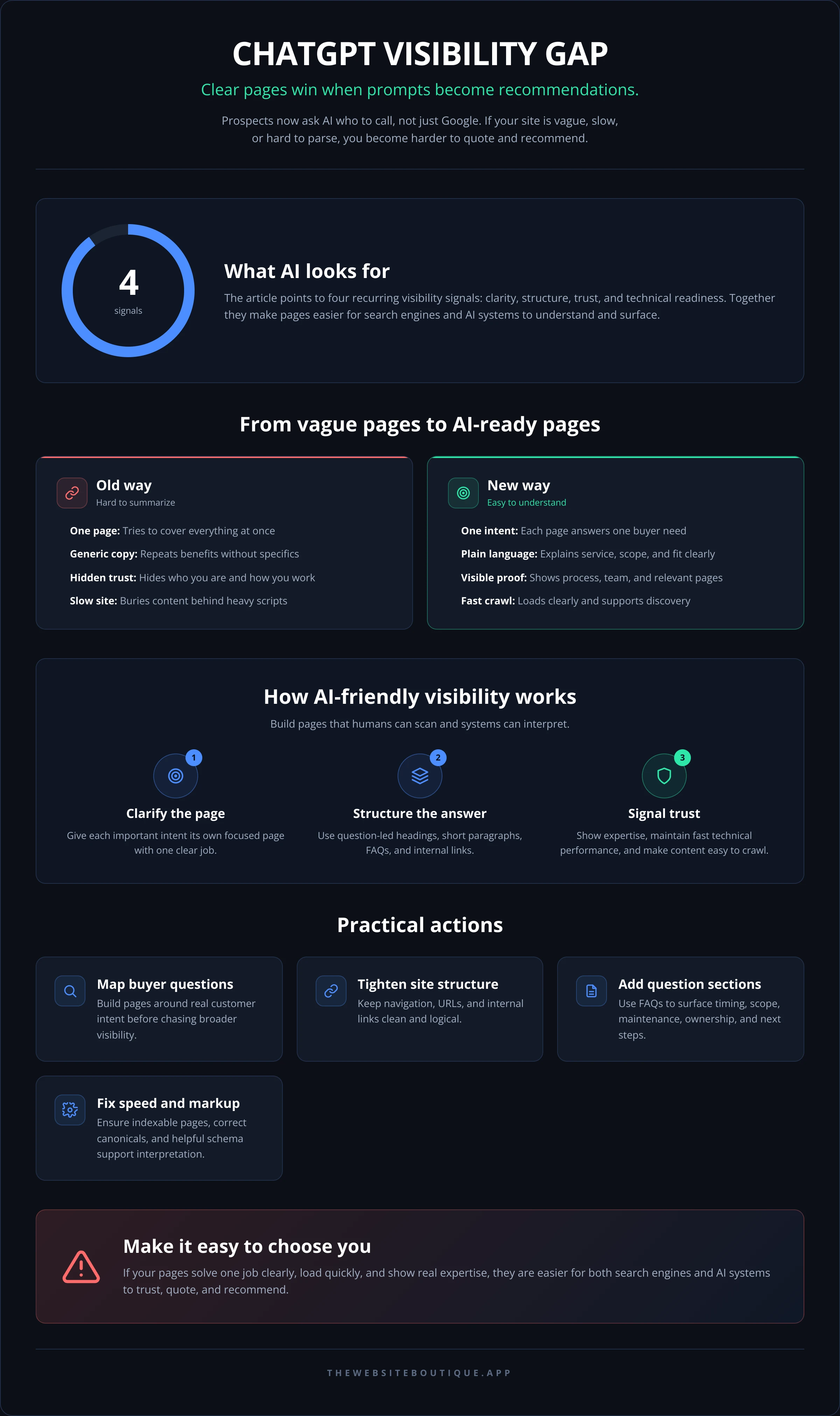
A useful mindset is to think in terms of visibility signals. Your pages should make it obvious what you do, who it is for, and why a human would choose you. If a page forces a model to guess, paraphrase around missing details, or stitch together meaning from scattered text, it becomes a weaker candidate for AI-driven recommendations.
That is why the best approach to optimize for ChatGPT answers looks a lot like good SEO, with a sharper focus on clarity. A clean service page, a helpful FAQ, a detailed use-case page, and a fast site are all easier for AI systems to interpret than a clever homepage with little substance. If you want a broader roadmap, SEO + AI Search (GEO) is the kind of strategy that connects search visibility with AI discovery.
Pages that AI systems can actually understand
The most common mistake is trying to make one page do everything. A homepage that talks about services, industries, locations, awards, process, and philosophy in a single long scroll gives readers too much to scan and too little to trust. For AI systems, it can be even worse, because the page lacks a strong center of gravity.
A better structure is simple: each important intent gets its own page. A service page should explain what the service is, who needs it, what the deliverable looks like, and what makes it different. A landing page should focus on one offer and one outcome. A support page should answer common account or maintenance questions without trying to sell the whole company again.
This is where thoughtful site architecture pays off. If your navigation is clean and your URLs make sense, you give search engines and AI crawlers a map. When that map includes pages like Services, Landing page, Support, and About, the site reads less like marketing noise and more like a real business with defined offerings.
If you are deciding what to build first, start with the pages that answer buyer intent before you chase broader visibility. The Use Cases section is useful because it forces specificity: a page that speaks to a known problem is much easier to optimize for ChatGPT answers than a page full of generic claims.
What to include on each page
Each core page should contain plain language descriptions, proof of process, and enough context for a reader to know whether the service fits. A custom software page should explain what “custom” means in your process. A mobile app page should make the scope obvious. A lead generation page should say how leads are captured and followed up, not just promise more leads.
The more a page behaves like a useful document, the easier it becomes for AI systems to extract meaning. That does not mean writing for machines first. It means writing in a way that leaves less room for confusion.
Optimize for ChatGPT answers with content structure
A page that is technically “optimized” but hard to read will usually underperform. AI systems and humans both benefit from structure that makes scanning effortless. That starts with one primary topic per page, then supporting sections that answer adjacent questions in a logical order.
Use headings that sound like questions people actually ask, not like internal marketing language. “How long does a landing page take?” works better than “Delivery timeline.” “What happens after launch?” works better than “Post-project workflow.” That phrasing gives the model cleaner material to summarize, and it gives the reader fewer excuses to leave.
Short paragraphs also matter. A wall of text hides important details and makes it harder to quote or extract a useful answer. When a page includes examples, checklists, and a few concise explanations, it becomes easier to reuse in AI-generated responses.
Think of your page as something that should answer a question with confidence even if the visitor never clicks a second link. That is especially true when you want to optimize for ChatGPT answers, because the system often rewards content that reduces ambiguity quickly.
Add question-led sections
A strong FAQ can do more than clean up objections. It can expose the exact phrasing customers use when they are comparing options. If your service page says “How do you work with clients?” and “What do you need from me before starting?” you are shaping how the page may be summarized later.
That does not mean stuffing every possible question onto every page. It means choosing the questions that reveal decision-making friction: timing, scope, maintenance, ownership, revisions, and what happens after the first delivery. Those are the questions that often determine whether someone reaches out.
If you need a library of plain-language terms for content planning, Glossary can help you standardize how you describe services without drifting into jargon. That consistency matters more than most people think.
Trust signals that influence AI recommendations
A model is far more likely to recommend a business that looks credible, specific, and current. That credibility does not come from decorative badges or exaggerated promises. It comes from consistent evidence that a real team is responsible for the site.
Show who you are. Show what you build. Show how you work. If the site hides basic details, uses generic stock language, or makes every service sound identical, the trust signal weakens. A lean studio can still look credible if it is transparent about process, careful with scope, and clear about what happens next.
This matters for AI search because systems tend to reward content that reduces uncertainty. If someone asks for help with a website, a landing page, or SEO, a page that spells out delivery, communication, and maintenance is easier to surface than one that only repeats benefits. That is one reason a well-maintained Clients page or a project story page can support visibility, even if it is not your main sales page.
If you work with a smaller team or want to see how a boutique studio frames its approach, the About page should do more than tell a brand story. It should clarify process, focus, and the kind of client fit that leads to good outcomes.
External credibility also helps
When relevant, link to stable, authoritative references rather than burying the reader in claims. For example, Google’s own guidance on search essentials is useful when you are aligning content with helpfulness, and OpenAI’s help center is a stable reference point for understanding product behavior without guessing.
If your content mentions accessibility, page performance, or structured data, those references can make the article feel more grounded. They also remind you that optimization for AI is still built on fundamentals: clear content, accessible markup, and pages that solve a real problem.
Technical details that support AI visibility
A fast website is easier to crawl, easier to render, and easier to trust. Slow pages do not just annoy visitors; they often create friction for discovery as well. If your site loads sluggishly on mobile, buries content behind heavy scripts, or makes basic navigation difficult, you are asking AI systems to work harder than necessary.
Technical SEO still matters, but the priorities are practical. Make sure key pages are indexable, canonicals are correct, internal links are clean, and metadata matches the intent of the page. If you are using JavaScript-heavy elements, verify that the core content is still present in the rendered page. A polished design does not help if the words never show up clearly.
Schema markup can also support interpretation, especially for organization, services, articles, and FAQs. It is not magic, but it gives crawlers a cleaner summary of what the page contains. For a business that wants to optimize for ChatGPT answers, schema is worth the effort when it complements strong on-page content rather than replacing it.
If performance is a known weakness, a focused site rebuild may be more useful than months of patchwork edits. The idea behind Fast websites is straightforward: a site that loads quickly and presents the message clearly gives every other effort a better chance to work.
Do not ignore formatting and accessibility
Readable font sizes, semantic headings, descriptive links, and alt text all improve the way a page is understood. They are also a sign that the site was built for people who need to get information quickly. That kind of discipline tends to show up in AI-friendly pages too.
If your site is difficult to navigate with a keyboard, or if headings are used just for styling rather than structure, fix that first. It often improves both usability and discoverability.
Practical ways to optimize for ChatGPT answers on your site
The strongest pages usually come from a small set of deliberate choices rather than a massive content sprint. First, identify the questions prospects ask before they hire you. Then build or improve pages that answer those questions without filler. A service page should explain the service, not just praise it.
Second, make the page easy to scan. Use concise headings, short paragraphs, and one clear next step. If a visitor reaches the bottom and still does not know what to do, the page has not done its job. The same is true when you want to optimize for ChatGPT answers: if the content cannot be summarized cleanly, it will usually not be the best candidate for recommendation.
Third, connect your content to the rest of the site. Internal links should point to relevant pages, not random announcements. A landing page can link to pricing. A service page can link to case studies. A glossary article can link to a deeper resource. If you need a model for clean service packaging, Pricing is often where the offer gets clarified.
A separate but related move is to publish content that answers a real niche. If you serve owner-operated businesses, your pages should reflect that. If your audience needs lead follow-up, say so. If they need a website that can be launched quickly, make that promise concrete rather than vague.
Signals that your content is too generic
If every page says the same thing with different nouns, you probably have a problem. Generic pages repeat phrases like “high-quality solutions,” “tailored service,” and “customer-focused approach” without showing what those claims mean. AI systems can detect that kind of sameness more easily than many owners expect.
A better test is simple: could a reader tell the difference between your offer and a competitor’s after reading one page? If not, the content is too thin. If yes, you are getting closer to something worth surfacing.
A content plan that supports both search and AI discovery
The easiest way to keep momentum is to publish in layers. Start with your core service pages, then add supporting assets that make those services easier to choose. A landing page article, a case story, and an FAQ can all reinforce the same topic without sounding repetitive.
Think in terms of decision stages. Early-stage readers want clarity about the problem. Mid-stage readers want comparison points. Late-stage readers want proof, process, and next steps. A site that helps across those stages gives you more opportunities to optimize for ChatGPT answers because it supplies the exact kinds of explanations these systems tend to summarize.
If you want a place to publish supporting content, Blog and Free resources can carry deeper explanations, while your main pages stay focused on conversion. That balance matters. Too much education on the homepage can blur the offer; too little anywhere else can make the site feel thin.
Some businesses also benefit from a more direct lead path. If your service depends on a phone call, form fill, or booked consult, then Get leads: Meta & Google Ads + lead generation can complement the content strategy by turning visibility into a measurable intake process.
When a dedicated landing page beats a long article
If the goal is one action, one landing page often outperforms a sprawling content page. A landing page can be tightly aligned with one service, one audience, and one conversion path. It is also easier to update when your offer changes.
That is especially useful if you are testing a new service or comparing different messages. A landing page can reveal what prospects respond to before you invest in larger site changes.
Common mistakes when trying to optimize for ChatGPT answers
One mistake is chasing keywords without improving the page itself. If the copy is thin, the structure is weak, and the offer is unclear, a few keyword changes will not change the result. Another mistake is writing for “AI” so aggressively that the text loses personality. That usually creates bland content that neither people nor systems find memorable.
A third mistake is neglecting the site’s basics while adding more content. If the page is slow, inconsistent, or hard to navigate, more writing will not fix it. It may even make the problem worse by adding clutter.
The last mistake is assuming AI visibility is separate from the rest of digital marketing. It is not. The same page that helps a visitor compare options can help a model summarize your offer. The same site that feels sharp and current to a human usually sends better signals to AI.
If you are not sure where your gaps are, a focused review is often more effective than guessing. A small studio like The Website Boutique can help when you need a site that is built around clarity, not just appearance.
FAQ
How do I optimize for ChatGPT answers without sounding robotic?
Write for the person who asked the question, not for a system. Use clear headings, short explanations, and plain language. If a sentence would sound odd in a conversation with a customer, rewrite it.
Does longer content help more than shorter content?
Not automatically. A page should be as long as needed to answer the intent well. A focused 900-word page can outperform a 2,000-word page if it is clearer, better structured, and more relevant.
Should I add FAQs to every page?
No. Add them where they answer real objections or clarify purchase decisions. A service page, pricing page, or landing page often benefits from FAQs more than a broad homepage.
Is structured data enough to get mentioned by ChatGPT?
No. Structured data can help clarify meaning, but it does not replace useful content, clear site architecture, or trust signals. It works best as a support layer.
Can a small business compete for AI visibility?
Yes, especially when the site is specific and credible. Small businesses often have an advantage when they speak directly to a narrow audience and show real process instead of generic claims.
How often should I update content for AI discovery?
Update pages when the offer, process, or customer questions change. You do not need to rewrite everything constantly, but stale content can weaken trust and relevance over time.
If you want help making your site easier to understand, easier to trust, and easier to recommend, start with the pages that matter most: your main service page, one strong landing page, and the FAQ that answers the questions prospects keep asking. We can help you shape those pages into something clearer, faster, and more useful through SEO + AI Search (GEO) and Landing page work built for real buyer intent.
If your current site is doing a lot of talking but not much guiding, it may be time to rebuild the parts that matter first. Explore the process, compare the options, and see how a tighter structure can support better discovery on The Website Boutique.