

SEO Service for U.S. Businesses That Actually Converts
August 21, 2026 · 9 min read
A lot of companies do not notice their SEO problem until sales slow down. The traffic is still there, the site still looks fine, and marketing reports still have numbers—but the leads are lower quality, the pages are ranking for the wrong queries, or competitors keep showing up where your brand should be.
That is usually the moment people start looking for an SEO service for U.S. businesses that can do more than “improve rankings.” They need visibility that supports sales, a site that loads fast enough to keep attention, and content that matches how buyers search now—whether that search starts on Google, a map result, or an AI answer.
- Good SEO starts with the business model, not with keywords.
- If your site does not convert, more traffic can make the problem more expensive.
- Search visibility now includes Google results and AI-driven discovery.
- Technical issues, weak content, and poor internal linking can block growth even when demand exists.
- The best SEO decisions are usually practical: fix what limits revenue first.
What an SEO service for U.S. businesses should really cover
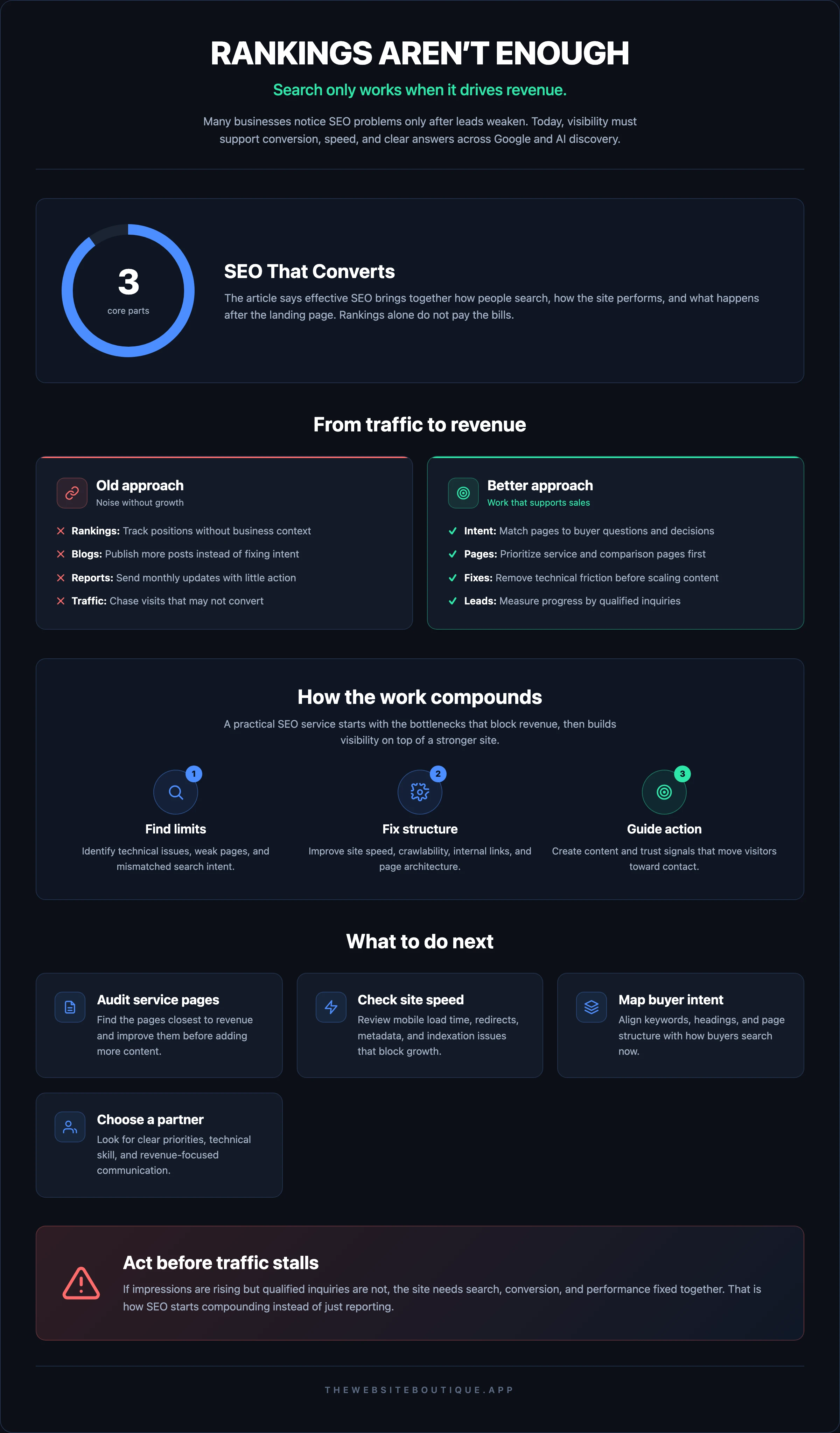
A serious SEO service for U.S. businesses should look at three things together: how people search, how your site performs, and what happens after someone lands on a page. If any one of those breaks, rankings alone do not pay the bills.
That means the work should include keyword research tied to buyer intent, page structure that makes sense to both users and search engines, technical cleanup, content strategy, and conversion support. If an agency only sends monthly reports with position changes, you are probably buying noise, not growth.
For companies serving the U.S. market, timing and communication matter too. Teams in the same time zone can move faster when a page needs to be updated, a technical issue appears, or a new service page needs to go live before a campaign launch. That operational speed is part of the service, even if it does not show up in a dashboard.
The SEO service for U.S. businesses that buyers actually notice
People often assume search optimization means writing more blog posts. In reality, the pages that make the biggest difference are usually the ones closest to revenue: service pages, location pages, comparison pages, case studies, and pages that answer buying objections.
A useful SEO service for U.S. businesses should identify the pages that deserve attention first. If you already have demand, the job is to capture it better. If you are still building trust, the job is to help your site explain your value quickly enough that visitors keep reading.
That is where many sites lose opportunity. The message is vague, the service page tries to say everything, and the site architecture hides the pages people actually need. Search engines are not the only ones confused; buyers are too.
What strong page strategy looks like
Think about the path a buyer follows. They may search for a problem, compare providers, check pricing expectations, then look for proof. A practical strategy maps pages to those steps instead of stuffing every term into one homepage.
A healthy structure usually includes:
- a clear homepage message
- service pages written around intent, not jargon
- supporting content for objections and comparisons
- internal links that guide visitors toward contact or a quote
- trust signals that help people move forward without friction
If you want to see how this connects with broader growth work, the SEO + AI Search (GEO) page is useful because modern search is no longer only about blue links on Google.
Technical quality decides whether SEO compounds
A lot of SEO campaigns fail because the site itself gets in the way. Slow pages, broken redirects, weak mobile layout, duplicate content, missing metadata, and messy indexation all create drag. You can publish useful content and still lose if search engines cannot crawl or understand the site well.
This is also why fast websites matter so much. A page that takes too long to load can push people away before they read a single line. Google’s Search Central documentation is a good reminder that technical basics still matter: crawlability, indexing, page experience, and structured content are not optional details.
For businesses serving multiple services or regions, technical architecture becomes even more important. Pages should be easy to find, easy to update, and easy to expand without creating duplication. If the site was built in a rush, SEO work often starts by fixing the foundation instead of publishing more content.
Signs the site is blocking growth
You do not need to be a developer to spot trouble. Some warning signs are obvious:
- important service pages are buried deep in navigation
- blog posts get traffic while service pages stay invisible
- the site feels slow on mobile
- titles and descriptions are repeated across pages
- forms work, but few qualified leads come through
When those issues appear, an SEO service for U.S. businesses should not jump straight into content production. The first move is usually to remove friction, then build traffic on top of a site that can actually hold attention.
Content and authority that support real buying decisions
Content works when it helps a buyer make a decision faster. That is different from writing for volume. A well-planned SEO service for U.S. businesses should create pages that answer specific questions, show expertise, and reduce hesitation.
That might mean explaining your process, clarifying timelines, comparing service options, or showing how a team works. It may also mean building trust with pages like Clients, Use Cases, and About so visitors can see how you operate before they talk to sales.
Authority is not just about backlinks, though links still matter. It is also about whether your site demonstrates real understanding of the problem. Search engines and buyers both notice when a page sounds generic.
A useful test: if a competitor copied your page structure and your content still felt replaceable, the page probably is not strong enough yet.
How SEO and AI search now overlap
Search behavior has changed. Many buyers still start on Google, but more people now encounter answers in AI tools that summarize, compare, or recommend options. That means visibility is no longer limited to rankings in one search result page.
An SEO service for U.S. businesses should account for this shift. It should help your pages answer questions clearly, structure information in a way machines can interpret, and build enough topical clarity that your brand can appear in more than one discovery surface. That is the logic behind SEO + AI Search (GEO).
This does not mean chasing every new platform or rewriting everything for robots. It means making your expertise easier to extract and trust. Clear headings, factual language, consistent terminology, and specific service descriptions all help.
If you are curious how AI tools are reshaping discovery, iam-eva.ai is a helpful external reference point for understanding how conversational interfaces are changing search behavior and user expectations.
Where many teams get this wrong
Some companies create content that sounds broad and safe, then wonder why AI tools or Google do not surface it. The problem is often clarity, not effort. If your page never states who you help, what you do, and why it matters, it becomes hard for any system to classify.
That is why search optimization and AI search optimization should be planned together, not as separate projects with different goals.
Picking a partner without buying reports you will not use
The hardest part is not finding an agency. It is finding one that understands business context and can work like a partner, not a vendor. An effective SEO service for U.S. businesses should make decisions with revenue in mind, not vanity metrics.
Ask how they decide what to fix first. Ask how they measure progress beyond rankings. Ask how they handle technical issues, content updates, and page priorities when opportunities change. If the answers are vague, expect vague outcomes.
You should also pay attention to how the team communicates. Fast feedback matters when pages are being revised, offers change, or new opportunities appear. The work moves faster when the people doing it can actually speak to your team in real time.
A practical selection checklist
A strong partner should be able to show you how they think, not just what they sell:
- They connect SEO to leads, not just traffic.
- They explain what gets fixed first and why.
- They know how to improve service pages, not only blogs.
- They understand technical basics and content strategy.
- They can support work across search, site speed, and conversion.
If you are comparing options, the Pricing page can help you understand how a growth-oriented team frames services. And if you want a broader sense of the relationship between marketing and delivery, the Insights section is useful for seeing how the team thinks.
When SEO should connect with paid media and site redesign
SEO does not always need to stand alone. Sometimes the fastest path is to pair it with paid media, landing pages, and a cleaner site structure. If you are launching a new offer or trying to improve lead flow quickly, waiting for organic gains alone may be too slow.
That is where an SEO service for U.S. businesses becomes part of a wider growth system. A clear content strategy supports landing pages. A better site helps ads convert. Search visibility reinforces trust after a prospect has already seen your brand elsewhere. If the site is outdated, the Fast Websites offer may be the right companion to the SEO work.
The same logic applies to demand generation. Some companies need a stronger mix of search, ads, and conversion assets before SEO can fully compound. Others need one or two critical pages fixed before anything else makes sense. There is no prize for doing the work in the most complicated order.
If you want to see how these pieces fit together in real business situations, the Lead Generation page and Free Resources can help you compare approaches without guessing.
FAQs about SEO service for U.S. businesses
How long does SEO usually take to show results?
It depends on the starting point, the competitiveness of the market, and how much technical work is needed first. Sites with a solid foundation and clear service pages often move faster than sites that need structural cleanup.
Should SEO focus on blog content or service pages?
Both can matter, but service pages usually deserve priority because they are closer to revenue. Blog content helps when it supports decision-making, answers objections, or builds topical authority around the services you sell.
Is SEO still worth it if AI search is growing?
Yes, but the work should reflect how people now discover information. Strong search visibility, clear page structure, and specific expertise help you show up in both traditional search and AI-assisted discovery.
What makes one SEO partner better than another?
Look for a partner that ties strategy to business outcomes, understands technical issues, and improves pages that influence leads. A good team can explain what they are doing in plain language and why it matters.
Do I need a new website before starting SEO?
Not always. Some sites only need targeted fixes. But if the site is slow, hard to update, or weak at conversion, improving the website can make SEO much more effective.
If your site is getting impressions but not enough qualified inquiries, that is usually the right moment to review the pages, structure, and speed together. Talk to The Website Boutique if you want an SEO service for U.S. businesses that treats search, conversion, and site performance as one system—and can move at the pace your team actually works.