

SEO Service Pricing for US Businesses: What It Includes
August 31, 2026 · 11 min read
- A good SEO proposal should explain deliverables, not just promise “more traffic.”
- Pricing depends on the site’s condition, competition, content needs, and how much technical work is required.
- If an offer does not cover tracking, page intent, and AI search visibility, it is usually incomplete.
- The cheapest option often delays progress because you pay later to fix weak content, missing pages, or poor site structure.
- For owner-led businesses, SEO works best when it is tied to leads, local demand, and a site built to convert.
You may be looking at two SEO quotes that look nothing alike, and that is usually where the real decision starts. An SEO service for businesses in the United States can mean a monthly retainer, a one-time setup, a content package, or a mix of all three. If one proposal feels vague and the other feels expensive, the gap is often in what is actually included.
For a small business owner, the issue is not whether SEO “works.” The issue is whether the work behind the price matches the kind of leads you need, the time you have, and the condition of your website. A service that only adds keywords to pages is not the same as one that improves site architecture, search intent, internal linking, and reporting. The price should reflect that difference.
What an SEO service for businesses in the United States should include
A serious SEO engagement should start with diagnosis. That means reviewing the site’s technical health, current rankings, indexing, page speed, content quality, and search intent alignment before anyone talks about publishing more pages. If the provider skips this and jumps straight into “monthly optimization,” you are paying for activity, not strategy.
At a minimum, the service should cover the work that makes search visibility possible:
- Technical audit and fixes for crawlability, indexing, redirects, metadata, and broken pages
- Keyword and intent research based on how customers actually search
- On-page optimization for priority pages
- Content planning or page creation when the site lacks enough relevant material
- Internal linking and site structure improvements
- Reporting tied to traffic, visibility, and lead quality
For local and service businesses, the package should also address Google Business Profile, location signals, and service area relevance when those are part of the business model. If a provider claims to do SEO but never mentions the site’s structure or the customer journey, the deliverable list is incomplete. Google’s own Search Central documentation is useful here because it reinforces that discoverability depends on sound technical foundations, not guesswork.
A good SEO service for businesses in the United States should also account for how search is changing. Some searches still happen on Google, but many buyers now ask AI tools for recommendations, comparisons, and shortlists. If your pages are written only for keyword matching and not for clarity, usefulness, and entity recognition, they may miss those newer discovery paths. That is where GEO, or AI search visibility, starts to matter.
SEO service for businesses in the United States: what drives the price
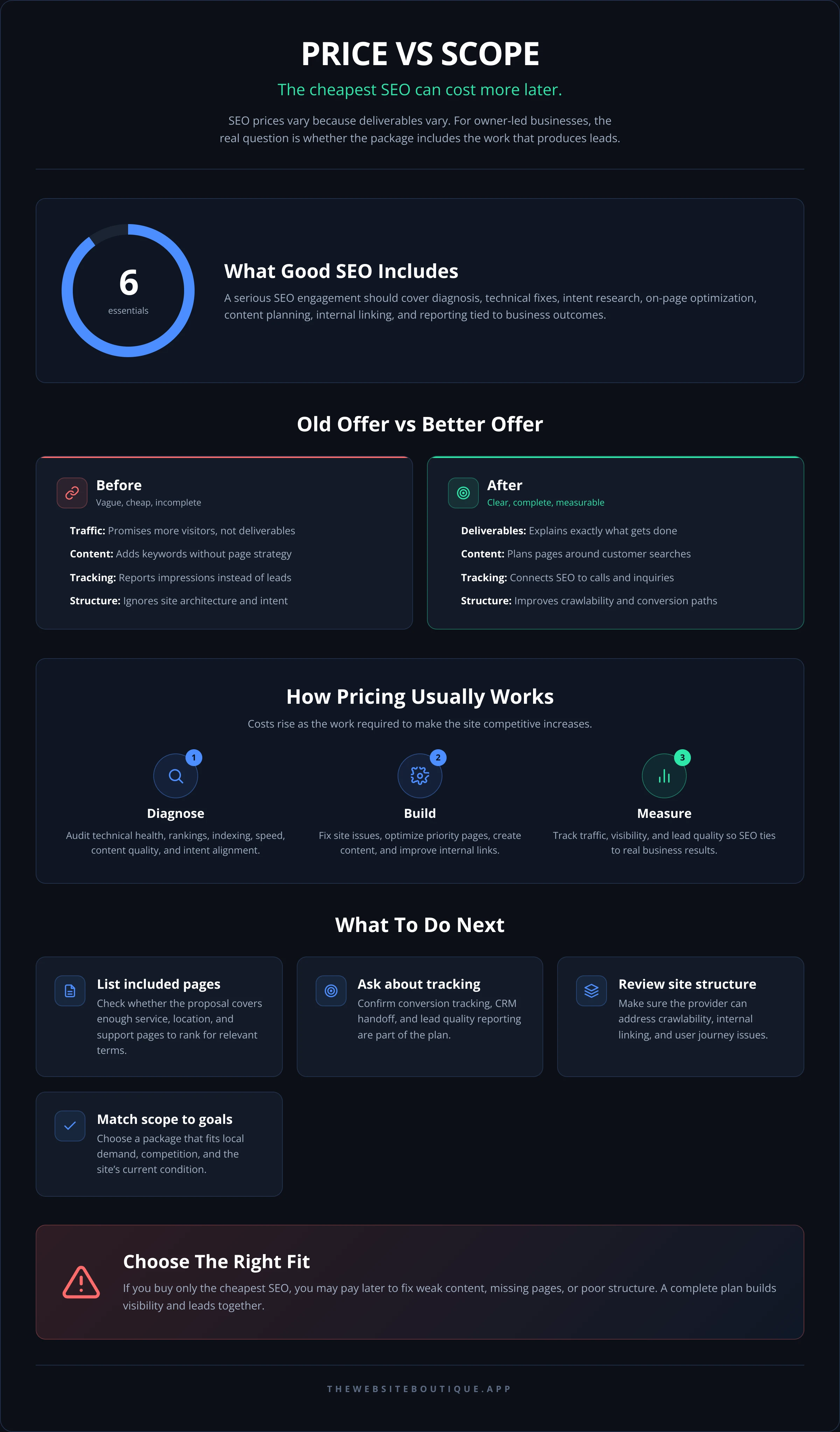
Pricing usually tracks the amount of labor required to make the site competitive. A business with a clean site, a few service pages, and decent existing content needs a very different level of effort than a business with technical problems, thin pages, and no search history. The more the provider has to build from scratch, the more the cost rises.
The main cost drivers tend to be these:
Site condition
If the site has poor structure, slow pages, duplicate content, or missing basics like titles and headings, the work begins before content improvements can help. Technical cleanup can take meaningful time because each issue affects the next one. A site that is hard for search engines to read is also hard for users to trust.
Competition level
A local service business in a narrow niche faces a different SEO challenge than a broad national offer in a crowded category. Competitive markets usually demand stronger content, better page differentiation, and more consistent publishing. That means the effort per month is higher, even if the deliverables sound similar on paper.
Content volume
Some businesses need a handful of strong service pages and a few supporting articles. Others need a full content architecture before they can rank for anything meaningful. If content creation is included, the price should reflect the planning, writing, editing, and internal linking that make those pages useful rather than bloated.
Measurement and lead tracking
An SEO program that includes proper conversion tracking, CRM handoff, and lead quality monitoring costs more than a package that simply reports impressions. But the second option is often cheaper only because it ignores the part that matters most: whether the traffic becomes inquiries. If you already use CRM-based follow-up, a provider that understands that flow can make the investment more actionable. Google Tag Manager and Google Search Central are worth knowing because both influence how search and measurement work together.
Strategy scope
A narrow SEO checklist is less expensive than a broader search strategy that includes structured content, landing pages, AI search visibility, and support for lead generation. That broader scope is often what a small business really needs, especially if the website has to do real selling, not just rank.
The right price is not the lowest number. It is the number that matches the work required to close the gap between where the site is now and where it needs to be to generate leads.
What a cheap SEO package usually leaves out
Low-cost SEO offers often look attractive because they use simple language. They may promise monthly “optimization,” a few backlinks, or vague ranking improvements. The issue is not that every inexpensive package is bad; it is that many omit the work that makes rankings durable.
Watch for missing items like:
- No technical audit or fix plan
- No explanation of target pages
- No content strategy beyond blog posts
- No mention of internal linking or site architecture
- No conversion tracking setup
- No reporting tied to leads or calls
- No plan for branded, local, and service-based searches
If the proposal does not say what will be improved, where, and how progress will be measured, you are buying uncertainty. A few keyword placements on existing pages may move the needle slightly, but they rarely create enough momentum for a small business that depends on inbound leads.
This is also where many owners get trapped: they buy an SEO retainer for months, then realize the website itself is the bottleneck. If the pages are slow, cluttered, or confusing, more SEO only sends more visitors into a weak conversion path. In that case, the better investment may be a faster site or focused landing pages, such as fast websites built in 2 weeks or dedicated landing page design.
The same applies to AI search. If your pages do not answer questions clearly, they are less likely to be referenced by tools that summarize the web for users. That is why a modern SEO service for businesses in the United States should include content that is easy to parse by people and machines.
How to compare proposals without getting lost in deliverables
The simplest way to compare offers is to separate scope from promises. A proposal can say “SEO” and still mean very different things. One might include technical cleanup, page strategy, and ongoing content; another might only include a monthly report and a few edits.
Ask these questions before you decide:
Which pages are included?
If the package only covers the homepage and one service page, you may not have enough surface area to rank for relevant terms. Most service businesses need multiple pages that each target a distinct intent: one for the core service, one for location relevance, and one or more for supporting topics.
Is content creation part of the service?
Some providers optimize existing pages only. That works when the site already has enough useful content. When it does not, the team should be able to plan and build new pages instead of recycling the same copy across the site.
What does reporting show?
Traffic alone does not tell you whether the work is helping. Better reporting shows rankings, page performance, leads, and which pages contribute to conversions. If a provider cannot explain how they connect SEO to business outcomes, they are probably reporting vanity metrics.
What happens if the site needs redesign work?
Sometimes SEO reveals that the current site needs a structural fix before growth is realistic. That is not a failure; it is information. A provider that can adapt the plan to a site that converts can save you from paying twice.
Is the work aligned with current search behavior?
Search results are changing, and users are asking more specific questions than before. A modern SEO + AI search visibility service should consider how pages read in search summaries, not just where they rank in a list.
One useful habit is to compare proposals line by line and translate each bullet into a business action. “Optimize metadata” is not very useful by itself. “Rewrite title tags and page headings for three service pages, then test the pages in search” is much clearer.
If a provider cannot make their scope concrete, the relationship tends to drift. First you get updates about activity. Then you get a ranking screenshot. Then you realize no one has looked closely at what turned those visits into inquiries.
What good SEO looks like for owner-led businesses
Owner-led businesses usually do not need the largest SEO program. They need the cleanest one. That means a smaller set of high-intent pages, tighter messaging, and a site that makes it obvious what the business does and who it serves.
For that kind of business, the most useful SEO work often looks like this:
- Fix the pages people already visit most
- Build or refine core service pages
- Create landing pages for specific offers or locations
- Strengthen headings, internal links, and calls to action
- Align search traffic with a clear lead capture path
That mix works because it respects the owner’s time. It also avoids the common problem of spending months writing general blog posts that attract readers but not customers. A blog can help, but only when it supports a real page strategy and not when it becomes a substitute for one.
A small studio like The Website Boutique is built around that reality: a few clients at a time, custom work, and attention from day one. That is a different model from high-volume SEO retainers, and it matters because the business owner often needs both the site and the search plan handled together.
If your current site is already decent, the right move may be a focused SEO sprint rather than a long retainer. If the site is not ready, a better first step may be a rebuild, a landing page, or a targeted lead generation setup such as Meta & Google Ads plus lead generation. SEO and paid acquisition work best when the pages behind them are built to convert.
Choosing the right partner for SEO, not just the right price
The best provider for an SEO service for businesses in the United States is not always the one with the biggest promise or the longest list of deliverables. It is the one that can explain how the work will fit your site, your market, and your sales process.
A strong partner should be able to talk through tradeoffs clearly. If they recommend content before a redesign, they should explain why. If they recommend redesign before content, they should explain that too. If they mention free resources or a glossary, that is a good sign they care about educating clients instead of hiding behind jargon.
When you review options, pay attention to how the provider responds to questions about lead quality, tracking, and site structure. If those topics are treated as afterthoughts, SEO may never become a real growth channel. If they are treated as part of the service from the start, you are looking at a more mature offer.
For some businesses, especially those building on a custom site or planning broader digital systems, the right partner may also need to handle things beyond search, such as custom SaaS, custom tools, or mobile apps. Not every business needs that breadth, but it helps to know whether the provider can support growth as the business changes.
FAQs
How much does an SEO service for businesses in the United States usually include?
It usually includes a technical audit, keyword and intent research, page optimization, content planning or creation, internal linking, and reporting. Better services also connect the work to lead generation and conversion tracking.
Is a monthly SEO retainer better than a one-time setup?
It depends on the site. A one-time setup can help clean up major issues and establish a structure, while an ongoing retainer helps maintain and grow visibility over time. Many businesses need both in sequence.
Why do some SEO proposals cost much more than others?
Usually because the scope is different. One proposal may include content, technical fixes, tracking, and strategy. Another may only include basic edits and reporting. The price usually reflects the amount of work required.
Should SEO include AI search visibility now?
Yes, if your buyers are using AI tools to research options. A modern SEO plan should consider how pages appear in search summaries and recommendation systems, not just traditional search rankings.
What is the biggest red flag in an SEO offer?
A vague scope. If the provider cannot tell you which pages will be improved, what will be tracked, and how success will be measured, the offer is probably too weak to support meaningful growth.
If your current site is getting some traffic but not enough inquiries, the next step is probably not “more SEO” in the abstract. It is a sharper plan for the pages that matter, the search terms your buyers actually use, and the conversion path behind the visit.
If that sounds like the situation you are in, contact The Website Boutique to review the site, the search gap, and whether the fix is SEO, a landing page, or a faster website built around leads from the start.