

SEO Services for U.S. Businesses: FAQs
August 26, 2026 · 12 min read
Key points
- The right SEO services for U.S. businesses should match how your buyers search, not just how your website is built.
- If your site loads slowly, has weak pages, or mixes up intent, SEO will feel expensive no matter how good the strategy sounds.
- Good SEO for a U.S. company usually needs technical fixes, content decisions, local or national targeting, and measurement that ties to leads.
- Agencies that promise fast rankings without asking about margins, sales cycles, and service areas are usually selling shortcuts, not growth.
- If AI search is already shaping how customers discover vendors, SEO should include structured content and brand signals that help you show up beyond Google.
A lot of business owners notice the same thing at the same time: traffic is not the problem, but the right traffic is still missing. You can have a decent website, run ads, and post on social media, yet the calls are inconsistent and the leads are uneven. That is usually when people start looking for SEO services for U.S. businesses with a more practical lens: not “Can we rank?” but “Can we attract buyers who are ready to talk?”
For U.S. companies, that question gets more complicated fast. Search behavior changes by region, industry, and intent. A person comparing software in Texas searches differently from a homeowner looking for a contractor in Florida, and both behave differently from a founder searching for a strategic partner. If the SEO plan ignores that, it can create visibility without revenue.
The Website Boutique works with U.S. companies from the same time zone, so these decisions are usually discussed with the people who actually feel the impact: the founder, the marketing lead, or the sales team that has to follow up. If you want the broader company context before getting into SEO, the About page is a useful place to start, and the Clients page shows the kind of work the team supports across growth and conversion.
What SEO services for U.S. businesses should actually cover
Many teams think SEO means a few blog posts and some keyword placement. That view breaks down quickly once a site has more than a handful of pages, a sales team, or multiple service lines. A real SEO program has to deal with how people land, evaluate, and convert.
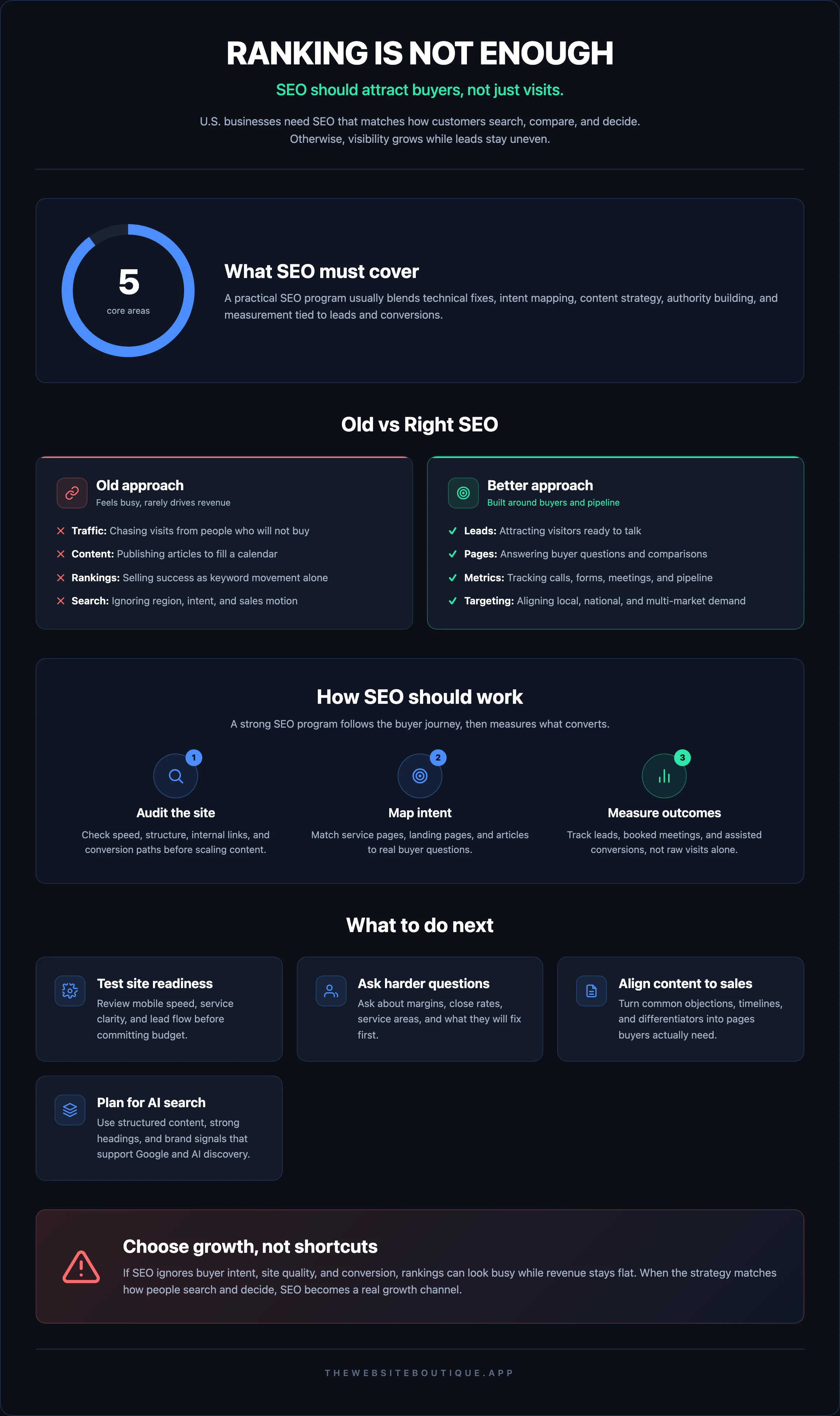
For most U.S. businesses, the work usually includes five areas:
- Technical SEO: crawlability, indexation, site speed, internal linking, and clean architecture
- Search intent mapping: matching service pages, landing pages, and articles to actual buyer questions
- Content strategy: creating pages that answer commercial searches instead of filling a calendar
- Authority building: earning mentions, links, and brand signals that help the site look legitimate
- Measurement: tracking calls, forms, booked meetings, and assisted conversions instead of raw visits alone
That last point matters more than many teams expect. If a page attracts 1,000 visits from people who are not buyers, the traffic report looks healthy while the pipeline stays flat. If a smaller set of pages attracts the right visitors and those visitors convert, SEO has done its job.
If you are already thinking about how search is changing with AI summaries and assistant-driven recommendations, The Website Boutique’s SEO + AI Search (GEO) service is worth reviewing. It is relevant when you want to be visible not only in Google results, but also in the places where users now ask for recommendations and comparisons.
How to judge whether your site is ready for SEO
A lot of SEO budgets get burned on websites that were never ready to rank well. The issue is not always the algorithm. Sometimes the site has thin service pages, confusing navigation, duplicated sections, or a checkout/lead flow that loses visitors before they act.
Before committing to SEO services for U.S. businesses, look at these signals:
Speed and page experience
If your site feels heavy on mobile, it is likely losing visitors before they read a single paragraph. Google’s own Search Central documentation is a good reference for technical basics, but the business question is simpler: does the page load fast enough for a distracted buyer to stay?
Clear service architecture
Can a visitor understand what you sell in one pass through the menu? If the answer is no, the SEO team will spend time repairing structure instead of growing demand. One strong page per service usually outperforms ten vague pages with overlapping promises.
Conversion path
A ranking page that does not guide the visitor to the next step is a leaky asset. If your site has forms, booking flows, or calls as the main conversion point, those need to be simple enough that someone can use them without thinking too hard.
Content quality
Useful content is specific, not decorative. A page should help a buyer compare options, understand scope, or make a decision. If the copy reads like a general marketing sheet, it may never hold attention long enough to convert.
If the site needs a rebuild, SEO alone is usually the wrong first move. In cases like that, a fast website can matter more than publishing another article. The Website Boutique’s Fast websites page is relevant if the current site is slowing down lead generation or making every marketing channel more expensive than it should be.
Choosing SEO services for U.S. businesses without wasting months
A good SEO partner should ask uncomfortable questions early. What are your margins? Which services are most profitable? Which leads are good but hard to close? Where do sales conversations stall? Those questions shape the work more than a generic keyword list ever will.
When evaluating SEO services for U.S. businesses, pay attention to how the provider talks about scope. If they only discuss rankings, they may not understand lead generation. If they only discuss content volume, they may not understand technical constraints. If they only talk about “traffic growth,” they may be avoiding the harder issue of conversion.
A stronger partner usually does three things well:
- Connects SEO priorities to revenue drivers, not vanity metrics
- Explains what will change on the site and why
- Shows how progress will be measured over time
It also helps to see whether the team can work alongside your sales and paid media efforts. Search rarely lives alone. If ads are already bringing in demand, SEO should help capture the intent that paid campaigns miss or make more expensive to buy. If social and email are doing the heavy lifting, SEO should support that demand with pages that answer buying questions.
If you are comparing costs and deliverables, The Website Boutique’s Pricing page can help you understand how the work is packaged. For use cases across growth, conversion, and automation, the Use Cases page is also useful because it shows how SEO fits into broader business goals.
One practical sign of quality: the team should be able to tell you what they would *not* do in the first 60 days. That answer reveals judgment. It usually means they understand that SEO has tradeoffs, not just tasks.
Content, authority, and the role of AI search
The best content strategy for a U.S. business is not a blog machine. It is a set of pages that help a buyer move from problem awareness to vendor evaluation without having to search again and again. That may include service pages, comparison pages, FAQs, industry pages, and supporting articles.
Search is also changing because users are starting to ask AI tools for recommendations, summaries, and vendor shortlists. That does not make SEO obsolete; it makes structure more important. Clear headings, specific claims, strong internal linking, and brand consistency help search engines and AI systems interpret what your business does.
If you want a practical benchmark for how people are using AI in search and recommendations, the homepage of iam-eva.ai is a helpful example of a product designed around that behavior. It is not a substitute for SEO, but it does show why answer-ready content and recognizable positioning matter more than ever.
For U.S. companies, the content question is usually not “How many posts can we publish?” It is “Which pages help buyers decide?” That answer changes by business model:
- A service firm may need location or industry pages that show relevance fast
- A B2B company may need comparison and solution pages that speak to procurement concerns
- A consumer brand may need educational pages that reduce hesitation before purchase
That is why the content plan should be tied to actual sales conversations. If the same objection comes up on every call, that objection should probably appear on a page. If prospects ask how long implementation takes, who owns the project, or what makes the offer different, the site should answer it before the form fill.
The Website Boutique’s Insights section is useful if you want to see how broader search and growth topics are discussed in a more applied way, not as abstract theory. For teams that need practical templates and checklists, the Free Resources library can be a faster starting point.
Local, national, and multi-market SEO needs different decisions
Not every U.S. company needs the same kind of search strategy. Some businesses sell in one state, some sell nationwide, and some do both. The mistake is treating all of them as if a single keyword list can solve the problem.
A local service business needs credibility, service-area clarity, and pages that reflect nearby demand. A national B2B company needs topical authority, strong landing pages, and content that addresses different stakeholder questions. A business with multiple offices or service regions needs consistency without creating copy that feels duplicated.
This is where many SEO efforts get messy. The site grows, but the message becomes less clear. Pages start competing with one another. Internal links point nowhere useful. Local pages sound copied and national pages sound generic. The result is visibility with weak conversion.
If your company works in a defined market, it can help to study how location-based positioning is handled. The Website Boutique has separate pages for Florida and Texas, which shows how regional relevance can be framed without turning the site into a pile of repetitive location pages.
For businesses that depend on leads, search should fit the real geography of demand. If most buyers are in a specific state or metro area, the site should make that obvious without overdoing it. If the market is national, the pages should explain why the offer is relevant across regions and industries.
One simple test: if a visitor landed on your page from a search result, would they know whether your business serves them, solves their problem, and works at their scale? If not, the SEO work may be attracting the wrong audience.
Questions U.S. business owners should ask before hiring SEO
The best client conversations are not about trends. They are about fit. A provider can have strong technical skills and still be the wrong match if they do not understand your sales motion or the way your buyers make decisions.
Before hiring, ask these questions:
What will you fix first, and why?
The first month should not be a mystery. You want to know whether the priority is technical cleanup, page rewriting, internal linking, or content planning. A clear order shows the team can diagnose rather than guess.
How will success be measured?
Traffic alone is not enough. Ask whether the report will include leads, form submissions, calls, booked meetings, or pipeline influence. If the answer is vague, the engagement may stay vague too.
What do you need from our team?
Some agencies overpromise because they assume the client will supply everything. A serious partner will tell you what they need to move faster: access, approvals, product knowledge, sales notes, or analytics.
How do you work with conversion and paid media?
SEO should not sit in a corner. If you are also investing in ads, landing pages, or a new site, the search strategy should support those efforts instead of competing with them.
What happens if the site is not the right vehicle?
Sometimes the honest answer is that the current site cannot support the result you want. That is useful information. It may mean the best next step is a redesign, a new set of landing pages, or a stronger lead-generation foundation before scaling content.
When a partner can answer these questions without hiding behind jargon, you usually learn a lot about how they operate. The Website Boutique’s Get leads service is relevant for businesses that want SEO to work alongside ads and landing pages as one system, not as separate projects.
FAQ: SEO services for U.S. businesses
How long does SEO usually take to show results?
It depends on the site’s condition, the competitiveness of the market, and how much needs to be fixed before growth can start. If the website already has a solid structure and clear pages, progress can appear sooner than on a site that needs a rebuild.
Should a U.S. business start with blog content or technical SEO?
Usually technical issues and page structure should come first if they are blocking visibility or conversion. Blog content helps when the core pages are already solid and you need to build topical relevance or answer buyer questions that support sales.
Is local SEO enough for a business that serves multiple states?
Not always. A multi-state business often needs a mix of regionally relevant pages, broader service pages, and content that speaks to different buying situations. Local SEO alone can be too narrow if the company sells beyond one market.
How do SEO and AI search fit together?
They overlap more than people think. Strong SEO content helps AI systems understand your offer, your expertise, and your relevance. If your pages are vague, AI search tools have less to work with and less reason to recommend you.
What is a red flag when talking to an SEO agency?
Any promise of quick rankings without a serious discussion about the site, competition, and conversion path should raise caution. Another warning sign is a report that focuses on traffic growth but never connects to leads or sales.
Do I need a new website before investing in SEO?
Not always, but sometimes yes. If the current site is slow, confusing, or hard to convert, SEO will have a limited effect until the foundation improves. A better site can make every other channel more efficient.
If your current site is already generating visits but not enough qualified inquiries, The Website Boutique can help you connect search, ads, and conversion work with a senior team that operates in your time zone. Start with the Get found SEO + AI Search (GEO) page if visibility is the main gap, or explore Get a site that converts if the bottleneck is the website itself. If you want to see how the team thinks before reaching out, the About page and Insights section are the quickest next stop.