

Small Business Google Ads Management: Cost and Inclusions
September 18, 2026 · 11 min read
Key takeaways
- The price of small business Google Ads management usually depends more on scope than on ad spend alone.
- A useful package should include account setup, keyword work, ad copy, conversion tracking, search term review, and ongoing changes.
- The cheapest option is rarely the lowest-risk option if no one is watching waste, tracking, or landing page quality.
- If your sales process is simple but your lead value is high, a tight campaign can outperform a broader one.
- You should know exactly what is covered before work starts, including communication cadence and what counts as extra work.
The first warning sign is usually not the ad account itself. It is the moment a business owner looks at spend, sees clicks coming in, and still has no idea whether the phone calls, forms, or booked appointments were worth it. That is where small business Google Ads management either becomes a practical growth channel or turns into a monthly mystery.
For owner-operated businesses, the question is rarely “Should we run ads?” It is usually: what does the management actually cover, how much should it cost, and what kind of attention will it take to keep it useful? If you are also improving your site, a fast website that converts often matters just as much as the ads themselves.
What small business Google Ads management usually includes
A good service starts before the first ad goes live. Someone needs to understand what the business sells, which leads are worth chasing, and what a qualified inquiry looks like. Without that, campaigns tend to collect traffic that looks busy but does not help revenue.
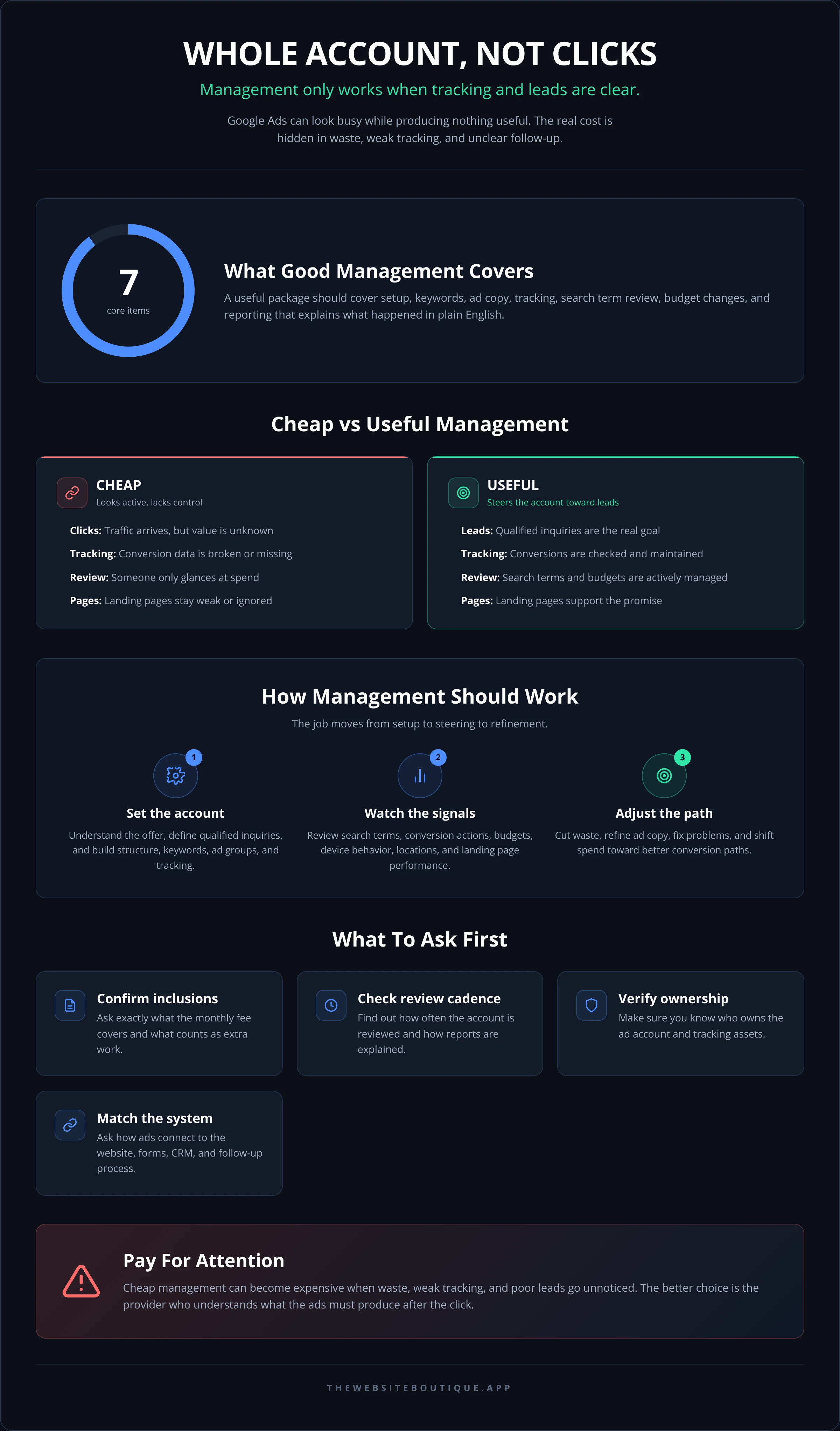
At minimum, small business Google Ads management should include account structure, keyword research, ad group organization, ad copywriting, and conversion tracking. It should also include search term review, negative keyword cleanup, bid or budget adjustments, and basic reporting that explains what happened in plain English.
Here is the part many owners miss: management is not just “turning ads on.” It often includes practical judgment about landing pages, search intent, device behavior, location settings, and whether a campaign should even keep running. If you want the same campaign to feed a broader pipeline, lead generation with Meta and Google Ads may be a better fit than isolated ad management alone.
The core work that should be visible
A service worth paying for usually touches these areas:
- Keyword research and audience intent analysis
- Campaign and ad group setup
- Writing and testing ad copy
- Conversion tracking setup or review
- Search term monitoring and negative keywords
- Budget pacing and performance adjustments
- Reporting with useful recommendations
That list matters because it separates active management from passive maintenance. If someone only logs in once a month to glance at spend, that is not really management. It is account babysitting.
What changes the cost of small business Google Ads management
Price is shaped by complexity, not just by the ad platform. A plumber with one service area and one core offer is a very different account from a law firm, med spa, or local service business that needs multiple campaigns, multiple conversion actions, and tighter qualification rules.
The biggest cost drivers are usually account size, number of campaigns, how many landing pages are involved, whether conversion tracking is already working, and how often creative needs to change. If a business is also trying to connect ads with a CRM, sales pipeline, or call tracking, management takes more setup time and more ongoing oversight.
A useful way to think about small business Google Ads management is this: the fee is not just for ad clicks. It is for the thinking required to stop bad spend, push the right searches, and keep the campaign aligned with how your business actually sells.
What you may pay for indirectly
Some businesses underestimate the hours hidden behind “simple” work. For example, a campaign may need tracking fixes, landing page adjustments, a review of call quality, or a new offer because the current one attracts the wrong leads.
That does not mean every service should be expensive. It does mean that very low management fees can become costly if they ignore the work that keeps the account healthy. A cheap campaign that burns budget without producing clean data is still expensive.
For owners comparing service providers, it helps to look at the broader stack. A provider that also handles Google Ads and lead generation may reduce coordination problems, while a standalone advertiser may rely on your team to fix the website, forms, or follow-up process.
Cost models: flat fee, percentage, or custom scope
There is no single correct pricing structure. What matters is whether the model matches the amount of work and the size of the opportunity.
A flat monthly fee is common for smaller accounts because it is easy to understand. It works well when the campaign structure is relatively stable and the advertiser knows how much attention the account will need. A percentage of ad spend is more common in larger or fast-scaling accounts, but it can be awkward for small businesses if spend is low and the actual workload is still significant.
Custom scope tends to be the best fit when the job includes more than ad management. If you need landing pages, tracking cleanup, CRM setup, or a redesign tied to campaign performance, a broader engagement is often cleaner than trying to buy pieces separately. That is one reason many business owners also review services and pricing together instead of judging the ads in isolation.
How to judge whether the price makes sense
Ask what the fee is buying in weekly or monthly work, not just what it is buying in theory. If the service includes strategic review, testing, and clear recommendations, the price may be reasonable even if it is not the cheapest number on the page.
Also ask what happens when the campaign needs extra work. For example, if tracking breaks, a landing page stops converting, or the account needs to be rebuilt, is that included or billed separately? Those details matter more than polished sales language.
What a real management plan should look like month to month
Once campaigns are live, the work becomes less about setting and more about steering. The account should be checked for search quality, budget waste, conversion trends, and changes in performance across devices, locations, and times of day.
For most small businesses, the useful rhythm is steady and boring: review what people searched, cut irrelevant queries, adjust bids or budgets, refine ad copy, and decide whether the landing page is helping or hurting conversions. If the ads are driving traffic but the page is weak, the issue is often not the campaign. It is the page the traffic lands on. A dedicated landing page can solve a lot of that friction.
Google’s own Google Ads Help is a useful reference when you want to verify platform terminology or understand an account setting, but it will not tell you how to prioritize a local business budget. That judgment still has to come from the person managing the account.
Signs the account is being actively managed
You can usually tell when someone is paying attention because the campaign changes for reasons that make sense.
- Irrelevant search terms get excluded.
- Poor-performing ads are replaced.
- Budgets shift toward better conversion paths.
- Conversion actions are checked, not assumed.
- Landing page issues are raised quickly.
If nothing changes for weeks except spend, management is probably shallow. Good small business Google Ads management should feel like a series of informed adjustments, not a monthly status check.
When the cheapest option becomes the expensive one
Many small businesses shop for price first because cash flow matters. That is understandable. But Google Ads is one of those channels where weak management can silently multiply cost because the waste hides inside clicks, not invoices.
The expensive part is not only wasted ad spend. It is also the time spent chasing poor leads, the sales calls that go nowhere, and the confidence hit that makes owners stop testing the channel before it has a fair chance. If tracking is incomplete, you may even optimize toward the wrong outcome and make the problem harder to detect.
There is also a structural issue: if your website loads slowly, your offer is unclear, or your follow-up process is inconsistent, even decent campaigns can underperform. In those cases, SEO and AI search (GEO) or site improvements may help the business more than throwing more budget at ads.
What poor management often misses
Poorly managed accounts usually miss one or more of these:
- Search intent mismatch
- Broken or incomplete conversion tracking
- Weak or generic ad copy
- Too broad geographic targeting
- No negative keyword strategy
- Landing pages that do not match the promise of the ad
If you see two or three of those at once, the issue is not small. It is usually a sign that the campaign needs more than light tuning.
What to ask before you hire anyone
The best way to avoid disappointment is to ask direct questions before you sign. A confident provider should be able to explain the work without hiding behind jargon.
Ask what they need from you to get started, how often they review the account, what they consider a conversion, how they handle landing page issues, and what reporting you will receive. If the answer sounds vague, you are probably buying activity rather than accountability.
It also helps to ask whether they are only managing ads or whether they are helping connect the campaign to the rest of the sales process. For a lot of owner-operated companies, that difference matters. A campaign that drives form fills but leaves response times and CRM follow-up untouched may still underperform. If you need help across the whole path, The Website Boutique works best when the website, ads, and lead flow are treated as one system.
A simple checklist for the sales call
Before you commit, make sure you have clear answers to these questions:
- What exactly is included in the monthly fee?
- How often will the account be reviewed?
- Who owns the ad account and tracking assets?
- What counts as a lead or conversion?
- What happens if the landing page needs work?
- How are reports shared and explained?
You do not need a perfect answer to every question. You do need a provider who can speak clearly about tradeoffs, timing, and what they will not do.
Choosing the right scope for a small business
The right scope is not always the broadest one. Sometimes a single campaign with solid tracking and a decent landing page beats a bigger, messier setup. Other times the business needs more: stronger site messaging, an updated offer, or follow-up automation so the leads do not go cold.
If you are comparing options, look at the fit between management, creative, and website quality. A strong campaign can only do so much if the page is slow or the message is unclear. That is why some owners pair ad work with support, repair, or a new site that converts fast instead of treating ads as a standalone fix.
For businesses that want a more complete build, other useful services include custom tools, custom SaaS, and mobile apps when the lead process or client experience needs more than a simple brochure site.
The smartest buying decision is usually not “Who is cheapest?” It is “Who understands what the ads need to produce, and what has to happen after the click?” That answer is what separates basic small business Google Ads management from a campaign that can actually support growth.
FAQs
How much does small business Google Ads management usually cost?
It depends on the scope, complexity, and whether tracking or landing pages also need work. A simple account generally costs less to manage than one with multiple services, locations, or conversion paths.
What should be included in the monthly fee?
At a minimum, you should expect account monitoring, keyword and search term review, ad updates, conversion tracking oversight, budget adjustments, and reporting. If those pieces are missing, the service may be too light to be useful.
Do I still need a landing page if I run Google Ads?
Often, yes. A focused landing page can improve lead quality and make the ad promise clearer. If your homepage is doing too much, the campaign may struggle even when clicks are coming in.
Is ad spend included in management fees?
Usually not. Management is the service fee, while ad spend goes directly to Google. Make sure you know how the two are separated before you start.
How do I know if the campaign is working?
Look at qualified leads, call quality, booked appointments, and cost per conversion in context. Clicks alone are not enough. If you are not sure whether the data is being read correctly, ask the manager to explain the tracking setup.
If you want help turning ad spend into actual leads instead of just traffic, get leads with Meta and Google Ads and make the landing page, tracking, and follow-up work together from day one. The Website Boutique can help you build that system without overloading your team.
If you are ready to review your current setup, start with the pages that receive traffic and the forms that should convert it. Then talk through the campaign scope, the tracking, and the next fixes before another month of spend goes by.