

Small Business Website Design: Cost and Inclusions
September 15, 2026 · 12 min read
Small business website design can feel easy to postpone until the moment a lead asks for your link and you realize the current site is slowing you down, confusing people, or missing the basics entirely. That’s usually when the cost question becomes urgent, because the real decision is not whether to build a site, but what kind of site will actually help the business.
- The price of a website depends on scope, strategy, content, and whether the build is custom or template-based.
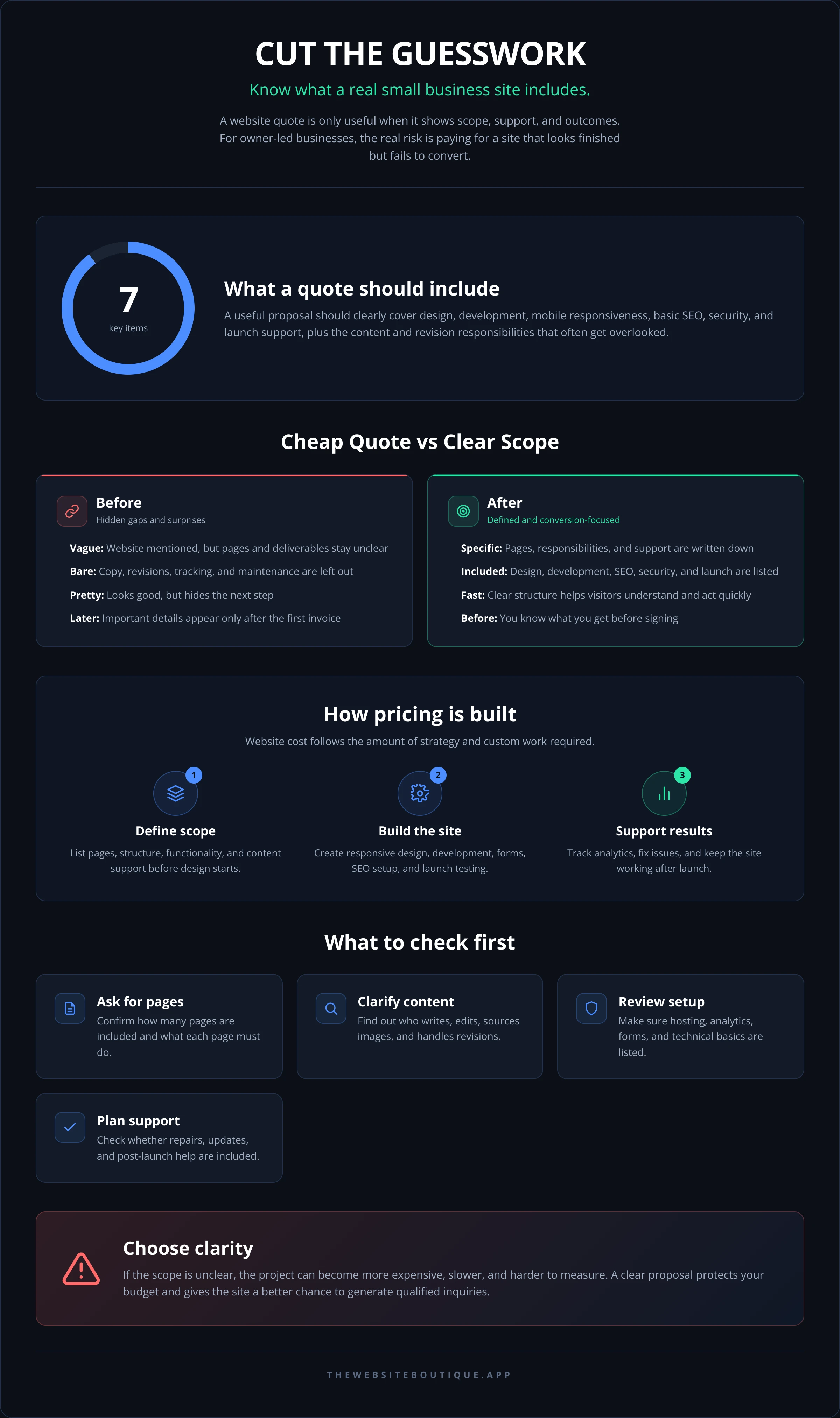
- A useful proposal should spell out design, development, mobile responsiveness, basic SEO, security, and launch support.
- Cheap quotes often leave out copy, revisions, tracking, or maintenance, which creates hidden cost later.
- For owner-operated businesses, the best investment is usually a site that is fast, clear, and built around conversions, not decoration.
- The right partner should explain what is included before you sign, not after the first invoice.
What small business website design usually includes
A solid small business website design project is more than a homepage and a contact form. At minimum, it should cover strategy, structure, copy support, visual design, development, mobile optimization, and launch setup. If a provider skips those pieces, you may still get a website, but it may not do much for the business.
For most owner-led companies, the practical question is whether the site helps a visitor understand three things quickly: what you do, who you help, and how to take the next step. That means the project should start with page planning, not colors. A good scope also addresses performance and search visibility from day one, which is where SEO + AI Search (GEO) can matter if you want to show up in Google and in AI-driven recommendations.
A complete deliverable list often includes:
- Sitemap and page structure
- Visual design tailored to the brand
- Development in a modern, maintainable stack
- Mobile-friendly layout across screen sizes
- Basic on-page SEO setup
- Contact forms and lead capture
- Analytics and search console setup
- Security essentials and launch testing
If the proposal mentions “website design” but does not say what pages are included, who writes the content, or what happens after launch, assume those items are not included. That is where many projects become more expensive than they first appeared.
How small business website design pricing is actually built
Pricing is usually shaped by the amount of thinking and custom work required, not just the number of pages. A five-page site can be simple or complex depending on how many revisions, special layouts, animations, forms, integrations, or content decisions are involved. The same is true for a landing page: a single page can be quick to produce or surprisingly involved if it needs conversion strategy and careful tracking.
The biggest cost drivers are usually:
Scope and page count
A website with a few straightforward pages costs less than one with multiple service areas, location pages, or custom templates. More pages also mean more copy, more design decisions, and more QA before launch.
Custom design versus theme adaptation
A heavily customized site takes more time than starting from a template. That does not automatically make it better, but it often creates a more cohesive experience and a cleaner fit for businesses that want to stand out.
Content support
If the client provides polished copy, organized images, and clear offers, the project moves faster. If the team has to help shape the message, rewrite sections, or organize assets, that time should be included in the quote.
Functionality
Forms, booking tools, gated content, multilingual pages, payment flows, or custom calculators all add complexity. If you need Custom tools, Custom SaaS, or Mobile apps, you are no longer in basic website territory.
Speed and launch process
Fast delivery is not just about working quickly. It depends on how decisions are managed, how feedback is collected, and whether the scope is tight enough to avoid drift. If speed is important, a service like Fast websites is often more realistic than a vague “we’ll get to it when it’s ready” process.
The most useful quote is the one that clearly separates design, development, content help, revisions, and launch support. If everything is bundled into one line item, you do not really know what you are buying.
What changes the price most for owner-operated businesses
Owner-operated businesses usually do not need enterprise complexity. They need clarity, trust, and a path to inquiry. That changes what matters in small business website design and what can be safely left out.
A solo attorney, contractor, consultant, clinic, or local service brand often needs fewer pages than a larger company, but the stakes are still high because every lead matters. In those cases, the site should be built to answer objections before they become phone calls. A homepage that looks nice but buries the service area, pricing cues, or next step can cost more than a simpler site with sharper messaging.
Here are the factors that most often move the budget:
- A custom brand direction instead of using existing visuals
- Copywriting support instead of client-provided text
- Multiple service pages with different buyer questions
- Lead tracking connected to a CRM or follow-up workflow
- Local SEO and search structure for service-area visibility
- Ongoing support after launch rather than a one-time handoff
A lot of business owners are comparing three things at once: cost, speed, and certainty. You can usually optimize two of those, but not all three at full force. If a proposal is unusually cheap, ask which part of the process has been removed.
A useful gut check is to look at the business outcome you want. If the site only needs to establish credibility and route inquiries, it should not be priced like a custom software build. If it also needs lead segmentation, automation, or campaign landing pages, then the scope should reflect that.
The hidden costs people miss in website projects
The biggest surprise in small business website design is rarely the design itself. It is everything around it. Businesses often budget for the build and forget the work needed to make the site usable, measurable, and stable.
Common missed costs include domain setup, hosting, email configuration, copy cleanup, image sourcing, legal pages, accessibility adjustments, form testing, and post-launch fixes. If any of these are assumed rather than listed, they can turn into change requests later. That is one reason a project that looks affordable at first can become frustrating in week three.
Another quiet cost is time. If the process requires too many rounds of approval, unclear feedback, or repeated content rewrites, the project slows down and your team spends more hours on it than expected. That matters even if the invoice itself stays fixed.
There is also the cost of not tracking performance. If a site launches without analytics, conversion tracking, or a clear follow-up path, you may not know whether visitors are engaging or bouncing. For businesses that rely on inquiries, that can hide problems for months.
A better proposal should say what happens after launch. Will it include support? Will someone handle broken links, form issues, or small content changes? If not, make sure you know where to go when something needs repair. A dedicated Repair or Support arrangement can be more useful than scrambling for ad hoc help later.
The brand matters here too. The Website Boutique works with few clients at a time for a reason: the handoff, follow-up, and launch details are often where the value shows up. A polished homepage is nice; a site that keeps working is better.
What a good proposal should say before you agree
A trustworthy small business website design proposal should read like a scope document, not a sales pitch. If you cannot tell what is included, what is excluded, and what the timeline depends on, the project is not fully defined yet.
Look for these items in writing:
Page list and structure
You should know how many pages are included and what each page is supposed to do. “Website” is not specific enough.
Responsibilities for content
Ask who provides copy, who edits it, and what level of content support is included. The same goes for images, logos, and testimonials.
Revision limits
A proposal should explain how many revision rounds are included and what counts as a revision versus a new request.
Technical setup
This should cover hosting, domain connection, forms, analytics, and any third-party tools. If search visibility matters, confirm whether the build includes Google Search Central best practices such as crawlable structure, title tags, and indexable content.
Post-launch support
Launching a site is not the same as maintaining it. You want to know whether support is included for a fixed period, whether updates are billable, and what happens if something breaks.
If the provider also offers Landing pages, ads management, or Get leads services, the proposal should be clear about where the website ends and the lead system begins. That matters because a conversion-focused site often performs better when the pages, ads, and tracking are planned together rather than separately.
When you are comparing options, do not just ask “What does it cost?” Ask “What will I have when it’s done, and what will I still need to handle myself?” That question usually exposes the real difference between a bargain and a workable project.
When a cheaper site costs more later
A lower upfront price can make sense if your needs are truly simple. But a cheap build becomes expensive when it has to be rebuilt, repaired, or heavily edited soon after launch. That is especially true when the site looks decent on a laptop but falls apart on mobile, loads slowly, or fails to generate inquiries.
There are a few warning signs that the lower quote may not be the better deal:
- The proposal does not mention mobile responsiveness
- No one explains how leads will be tracked
- Content, forms, or SEO are treated as afterthoughts
- The build depends on a theme that cannot be adapted cleanly
- Support ends the moment the site goes live
If your business depends on trust, a website that feels unfinished can quietly hurt conversion. A visitor may not say, “This site lacks a proper process,” but they will feel it. They may leave because the service pages are vague, the contact path is buried, or the page takes too long to load.
There is also a marketing cost when the site cannot support campaigns. If you later want to run ads, build a funnel, or test new offers, the original structure may limit what you can do. That is why it can be smart to think beyond the homepage and connect the site to future growth needs.
If your current site is the thing holding back leads, it may be more efficient to improve the structure now than to keep patching it later. A redesign with a clearer offer, faster pages, and cleaner lead flow usually beats another round of cosmetic edits.
Choosing the right scope for your business stage
The right small business website design scope depends on where the business is today, not on what sounds impressive in a sales call. A new service business may need a clear homepage, a services page, an about page, and a contact flow. A more established company might need lead capture, local SEO structure, and campaign pages tied to advertising.
If you are early and need to get moving, simplicity wins. A lean build with a strong message and a fast launch is often enough to start generating real conversations. If the business is already getting traffic, then structure, conversion rate, and measurement deserve more attention.
A helpful way to decide is to ask what would make the site successful in the next 90 days. If the answer is “more qualified inquiries,” then the build should support that outcome directly. If the answer is “we need to explain a more complex offer,” then content architecture matters more than visual flair.
For businesses that also want search visibility beyond traditional Google results, a service such as SEO + AI Search (GEO) may be worth pairing with the website work. And if the business already knows the site needs to convert better, Get a site that converts is a more useful brief than “make it look modern.”
If you want examples of the kind of work a focused studio can produce, the Work page is a better starting point than a generic portfolio, because it shows how the final product is approached across different needs. For a broader view of service categories, Services, Pricing, and the Blog are useful reference points.
Frequently asked questions about small business website design
How much should small business website design cost?
The price depends on scope, customization, content support, and technical needs. A simple informational site costs less than a custom build with lead tracking, multiple service pages, or special integrations. The best way to judge value is by what is included, not by the headline number alone.
What should be included in a website quote?
A clear quote should include page count, design, development, mobile responsiveness, basic SEO setup, forms, launch testing, and post-launch support. If content help, revisions, hosting, or analytics are not mentioned, ask whether they are included or billed separately.
Is a cheaper website ever worth it?
Yes, if your needs are truly basic and the provider is still covering the essentials. It becomes risky when the low price comes from leaving out copy support, mobile optimization, or lead tracking. That usually costs more later.
How long should a small business website take to build?
Timeline depends on scope and how quickly decisions and content are approved. A tight project with a clear scope can move quickly, while a more complex site with custom features or a lot of revisions takes longer.
Do I need SEO included in the website build?
At least basic SEO should be included. That means search-friendly structure, proper headings, metadata, indexable content, and a technically sound build. If search is a major growth channel, a more focused SEO plan is worth discussing.
Can I add ads or lead generation later?
Yes, but the site should be built with that future in mind if you expect to use it. Ad campaigns and lead generation work better when the site can support dedicated landing pages, tracking, and a clean follow-up process.
If you are comparing quotes right now, book a conversation with The Website Boutique and bring the proposal, your current site, and the parts of the business that actually need to produce leads. A short review can reveal whether you need a lean redesign, a conversion-focused rebuild, or something broader like lead generation and CRM follow-up.
If you want to explore related services before you decide, start with the pages most relevant to your goals: Get leads, Landing page, or Free resources.