

Professional SEO service for businesses in the United States
August 10, 2026 · 13 min read
Starting an SEO project usually happens after a familiar frustration: paid traffic is getting expensive, referrals are uneven, and the website is not pulling its weight. A professional SEO service for businesses in the United States should reduce that uncertainty, not add another layer of vague reports and jargon.
If you are evaluating an agency, the real question is not whether they “do SEO.” It is whether they can connect search visibility to qualified demand, fit your sales motion, and keep execution moving without making your team do all the heavy lifting. That is the standard worth using.
- You should expect a clear diagnosis before anyone talks about rankings.
- Technical fixes, content, and authority building should be tied to business priorities.
- Reporting should show movement in visibility, leads, and page performance, not just traffic.
- Timelines should be realistic; SEO changes compound, they do not flip overnight.
- A solid partner will explain tradeoffs, not hide behind a dashboard.
What a professional SEO service for businesses in the United States should cover
A real engagement starts with alignment: what the business sells, who buys, how leads convert, and which pages matter most. If an agency opens with a generic checklist and a list of keywords, they are skipping the part that keeps the work useful.
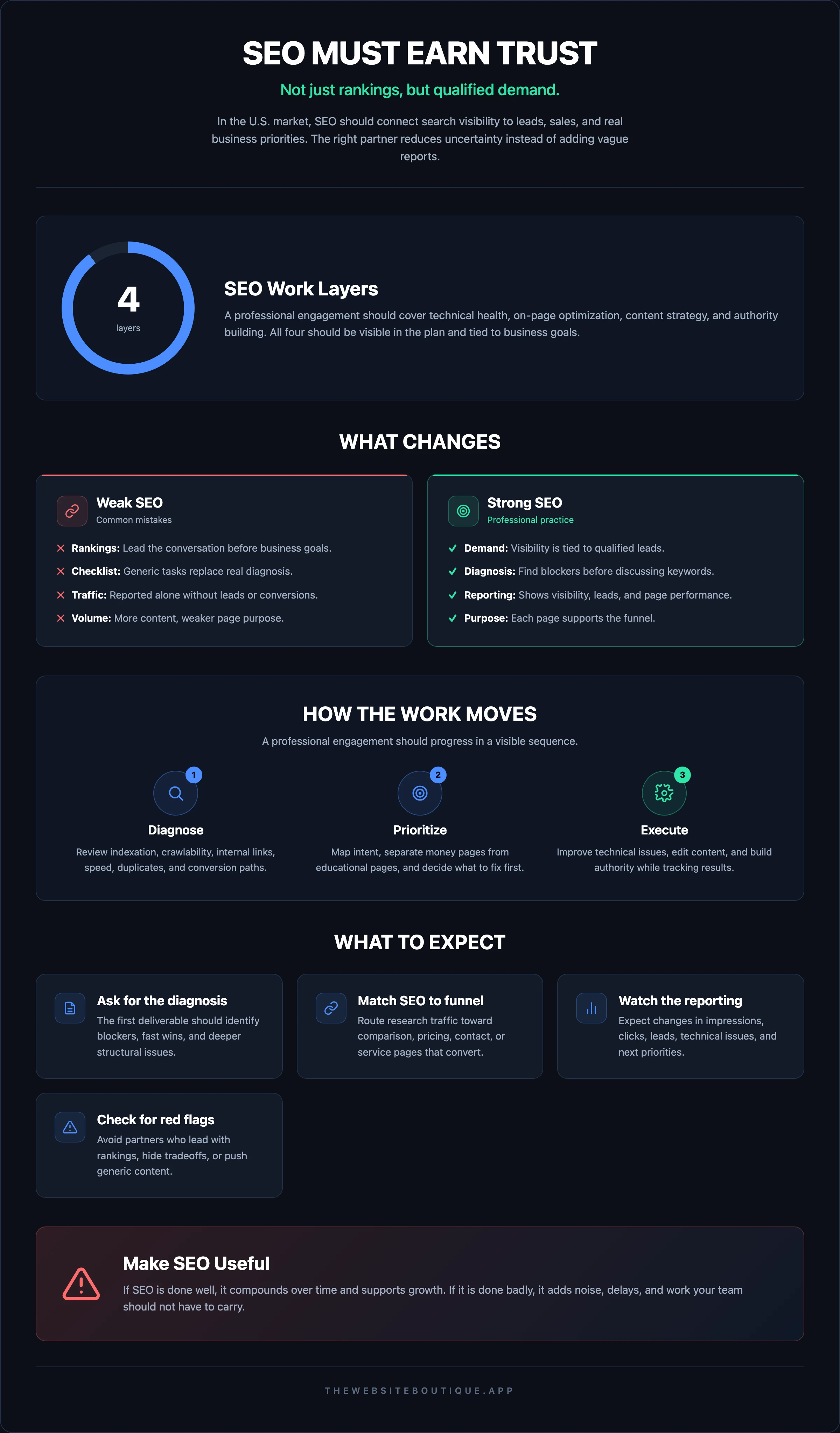
A professional SEO service for businesses in the United States usually includes four layers of work: technical health, on-page optimization, content strategy, and authority building. Depending on your site, some of that work happens fast and some takes longer, but all four should be visible in the plan.
At a minimum, expect the team to review indexation, crawlability, internal linking, page speed, duplicate content, structured data, and conversion paths. Google’s own Search Essentials are a good reminder that search visibility starts with content that is useful and accessible, not with shortcuts.
The first deliverable should be a diagnosis, not a sales pitch
A good audit is not a 60-page PDF no one reads. It should identify what is blocking growth, what can move soon, and what requires more structural work. If the site already attracts impressions but not clicks, that points to a different task than a site that barely gets indexed.
Look for concrete findings such as:
- Important pages missing title tags, internal links, or clear intent alignment
- Slow templates or layouts that hurt mobile performance
- Content pages competing against each other for the same query
- Service pages that rank but do not convert because the offer is unclear
- Local or regional signals that are inconsistent across the site
That first phase matters because a professional SEO service for businesses in the United States should prioritize the highest-leverage fixes first. A team that wants to rewrite everything before checking the site architecture is usually trying to look busy.
The work should fit your funnel, not just your keywords
Many business websites have pages that rank for informational terms but do very little for revenue. That is not a ranking problem; it is a funnel design problem. The SEO plan should distinguish between pages meant to capture research traffic and pages meant to create sales conversations.
For example, a service page may need stronger proof, clearer offers, and a more specific intent match. A blog post may need better internal links to move readers toward a comparison page, a pricing page, or a contact form. That kind of routing is where SEO becomes commercial instead of decorative.
If your company also invests in paid media, the best SEO partner will notice where search intent and ad landing pages overlap. That overlap can inform both content and conversion work. Google Ads Help is useful here because it shows how tightly landing-page relevance and campaign quality are tied to user behavior.
How the strategy should be built for a U.S. business
The United States market is broad enough that “national SEO” can become meaningless if the agency does not define segments. Different buyers search differently, compete differently, and convert differently. A business selling to one state, multiple metro areas, or the whole country needs a strategy that reflects that.
A good professional SEO service for businesses in the United States starts by mapping demand around the actual commercial problem: which products or services deserve visibility first, which pages support them, and what kind of search intent each query reflects. That beats chasing a giant keyword list that looks impressive and produces little.
Expect intent mapping, not just keyword research
Keyword research is useful, but intent mapping is what makes the work usable. Two queries can have similar volume and completely different buyer expectations. One may belong on a guide; the other belongs on a service page, comparison page, or location page.
A serious team will sort terms into buckets such as:
- Commercial pages that need immediate lead capture
- Educational pages that build trust and internal links
- Comparison or evaluation pages that support decision-making
- Brand and navigational queries that protect demand
That structure prevents a common mistake: publishing more content while the money pages stay weak. If you want better results from a professional service SEO for businesses in the United States, the strategy should point traffic toward the pages that can actually create pipeline.
Local, regional, and national signals should not be mixed casually
Some businesses serve one region. Others sell across several states but still need location-specific proof. A nationwide company may not need city pages at all, while a regional firm may need them to compete credibly.
The point is not to create pages for every place on a map. The point is to understand where searchers expect local relevance and where they do not. If an agency cannot explain that distinction, you may end up with thin pages that look engineered rather than useful.
The Website Boutique's Florida and Texas pages show how geography can be handled when it is genuinely relevant to the business context. Used well, location targeting helps searchers understand fit. Used carelessly, it adds clutter.
AI search visibility is now part of the brief
Search behavior is no longer limited to classic blue-link results. Buyers also ask assistants and answer engines for recommendations, summaries, and comparisons. That means a modern SEO plan should consider how your pages are interpreted by both search engines and AI systems.
A practical service SEO for businesses in the United States now includes structure, clarity, and entity-level consistency so that content is easier to understand and reuse. If you want a deeper look at that approach, SEO + AI Search (GEO) is the kind of framework worth reviewing when AI-assisted discovery matters to your market.
The execution phase: what should happen month to month
Once the strategy is set, the work should move in a visible sequence. The first month often focuses on access, diagnosis, cleanup, and priority fixes. After that, the cadence should balance technical improvements, page optimization, and content production.
A professional service SEO for businesses in the United States does not mean your site gets rewritten every month. It means the team keeps a controlled backlog, tests changes on the pages that matter, and makes sure new content is actually supporting revenue goals.
You should see decisions such as:
- Which pages are rewritten first and why
- Which technical issues are being fixed now versus later
- What internal links are being added to move authority
- Which pages are being created, refreshed, or removed
- How the plan responds to changes in rankings, click-through rate, or conversions
Content should be edited for usefulness, not volume
A lot of SEO programs fail because they produce content without a clear purpose. The result is a blog full of articles that attract modest traffic but do nothing for the sales process.
Useful content is more selective. It answers real questions, compares options when the buyer is deciding, and supports pages that are already close to converting. It also has a point of view. If your article repeats what every competitor says, it will not earn much attention or much trust.
For that reason, a seasoned team will often improve existing pages before launching new ones. That is usually the smarter move because existing pages already have some authority, impressions, or backlinks. Search Console Help is the place to monitor whether those changes are actually improving visibility and clicks.
Technical SEO should feel invisible when it works
Technical work is easy to ignore because it does not look dramatic on the surface. But if the site is slow, hard to crawl, or structured poorly, the rest of the program gets dragged down.
Expect your SEO partner to check sitemap health, canonical issues, pagination, Core Web Vitals, schema markup, redirect chains, and index bloat. They should also understand how changes affect both users and search engines. A beautiful page that loads slowly or confuses crawlers is not a win.
If your website is being rebuilt or your templates are changing, a strong agency will coordinate with development early. At The Website Boutique, that is where the intersection between SEO and fast site development matters most, because structural problems are often cheaper to solve before launch than after. That is also why Fast Websites belongs in the conversation when speed and conversion are part of the brief.
How to judge whether the service is working
The hardest part of SEO is not the work itself; it is judging whether the work is producing the right kind of progress. A site can gain traffic for reasons that do not help revenue, and it can lose rankings temporarily while still improving business outcomes.
A professional service SEO for businesses in the United States should report on more than positions. You want to know whether the work is improving the search terms that matter, whether the right pages are gaining visibility, and whether organic visitors are behaving like potential customers.
The report should answer business questions
Good reporting should tell you what changed, why it changed, and what the team will do next. If a monthly report only lists keyword positions, it is missing the story.
Useful reporting usually includes:
- Pages with improved impressions, clicks, and click-through rate
- Search terms that are moving into stronger positions
- Leads or conversions influenced by organic entry points
- Technical issues resolved and open issues still blocking growth
- Content updates completed and next priorities
If the agency cannot explain the reason behind a change, you are left guessing. That is a problem because SEO work is full of partial wins: a page may rank better but convert worse, or a content update may improve engagement without moving leads. You need the team to interpret that, not just display it.
Expect tradeoffs, especially in the first months
Sometimes a fix helps one part of the site while exposing a different problem. Consolidating pages can improve clarity but reduce the number of ranking entry points. Updating copy can raise relevance but lower match to a query you used to catch.
That is normal. What matters is whether the team can explain the tradeoff and keep the larger goal in view. If they promise that every change will move everything up at once, they are probably overselling.
This is where a professional service SEO for businesses in the United States earns trust: by showing judgment, not certainty theater. Good teams make sharper decisions because they understand what to leave alone.
Conversions should be part of SEO evaluation
Traffic is useful only when the site turns visits into leads, calls, demo requests, or purchases. That means organic performance should be tied to the conversion path, not treated as a separate department problem.
If a page attracts the right audience but the form is clumsy, the CTA is vague, or the proof is weak, the SEO program will underperform. That is why conversion thinking belongs in the same conversation as content and rankings. When the offer is clear, the search work has something worth sending people to.
Red flags that usually signal a weak SEO partner
Not every agency that sells SEO will manage it well. Some are excellent on strategy but light on delivery. Others promise quick wins and never explain the mechanics. A few are simply rebranding generic content production as search strategy.
You do not need to know every technical detail to spot trouble. You only need to notice whether the partner is asking the right questions and giving specific answers. If the conversation stays abstract, that is a sign.
Watch for these warning signs:
- They lead with rankings instead of business goals
- They cannot explain what will happen in the first 30 to 90 days
- They avoid discussing technical debt or site structure
- Their reporting templates look identical for every client
- They push content volume without a page-level purpose
- They cannot say how organic leads will be measured
Another warning sign is silence around cross-functional work. A meaningful SEO program touches development, content, design, analytics, and sometimes paid media. If the agency acts like search exists in a vacuum, they may not have enough operational depth.
A serious service SEO for businesses in the United States should feel coordinated. That does not mean complicated. It means each piece of work serves a specific role, and somebody is responsible for keeping those pieces aligned.
What a strong partner brings that an average one does not
The best teams are not just technically competent; they are good at prioritization. They know when a site needs a structural fix, when a page deserves a rewrite, and when a minor change can wait because it will not move the needle yet.
That judgment saves time and reduces waste. It also keeps internal stakeholders from getting lost in endless suggestions. If your team has limited bandwidth, the right partner should help you decide what not to do.
That is one reason businesses often value a senior team working in the same time zone as their own. Communication gets faster, decisions get made earlier, and revisions do not stall for days. When an agency can handle SEO alongside paid media, fast site builds, branding, social, and lead generation, the work tends to connect more cleanly across the funnel. That is the sort of operating model The Website Boutique is built around, not because every business needs every service, but because growth problems rarely live in one channel.
You can also use Clients, Use Cases, and Insights as a practical way to judge whether a partner thinks in systems or in isolated tasks. The best agencies leave a trail of reasoning, not just screenshots.
FAQs
How long does it take to see results from a professional SEO service for businesses in the United States?
It depends on the site, competition, and how much work is needed before growth can compound. Some changes can improve crawling, indexing, or CTR sooner, while stronger business outcomes usually take longer because they rely on multiple layers of execution working together.
Should SEO be focused on content or technical fixes first?
That depends on what is blocking performance. If the site has crawl, speed, or indexation issues, technical work may deserve priority. If the site is healthy but thin, misaligned, or poorly structured, content and page optimization may matter more first.
How do I know if an agency is using a real strategy?
They should be able to explain why certain pages matter, which search intents they are targeting, and how the work connects to lead generation or sales. If the plan is just a keyword list and monthly content production, that is usually not enough.
Is SEO enough if I also run ads?
Often, no. SEO and ads can support each other, especially when search intent is strong and the landing page experience matters. Organic work can improve long-term efficiency, while paid campaigns can test messaging faster and reveal which offers convert.
What should I ask before hiring an SEO partner?
Ask how they diagnose the site, how they prioritize fixes, how they measure progress, and how they report impact beyond rankings. You should also ask who will do the work, how often you will meet, and what they need from your team to move fast.
If your current SEO process feels busy but not useful, talk to The Website Boutique about a search program built around lead quality, fast execution, and clear priorities. A focused service SEO for businesses in the United States should make your next decisions easier, not give you more noise to manage.
If you are also planning a redesign or need a cleaner conversion path, start with the pages that do the heavy lifting and build from there. You can review Pricing, Free Resources, or About and decide whether the fit makes sense before you commit to the next step.